


 Shkruar nga Pamfleti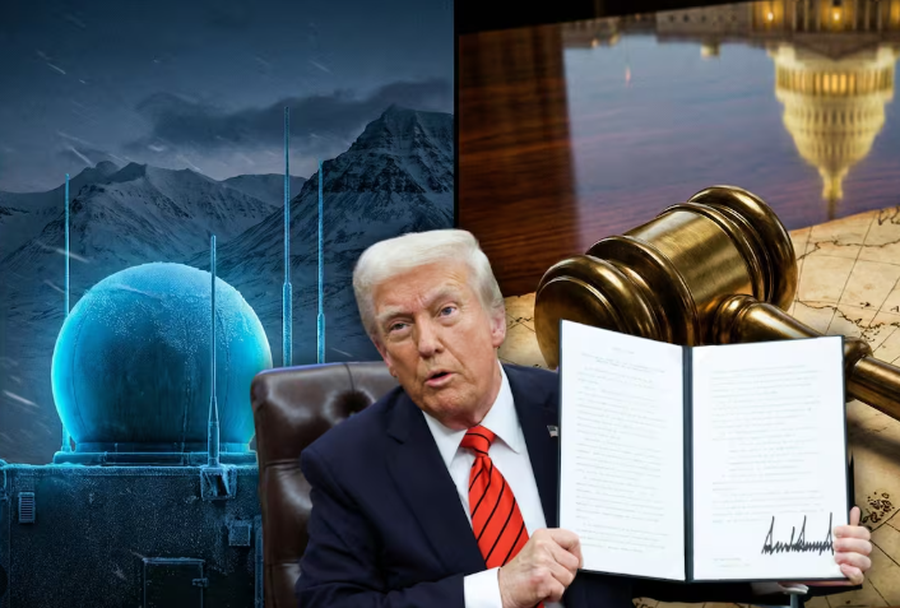
By the time Donald Trump arrived in the White House, the polar positions were clear. On one side was Russia, the country that controls roughly half of the coast. On the other, the seven other countries that border the polar ice cap: the United States, Canada, Norway, Finland, Sweden, Denmark (via Greenland) and Iceland. These eight countries formed the Arctic Council in 1996, with the main goal of protecting the environment. But the conflict quickly focused on the wealth hidden under the ice: 70% of the world's untapped oil and gas reserves.
Here too, Trump has reversed the American strategy adopted since the end of the Cold War. Vladimir Putin has also changed his stance since 2007. Since then, the Russians have renovated or built 13 air bases, 10 radar stations, and 20 additional border posts. In addition, Moscow has over 40 icebreakers, essential for navigation in extreme conditions: the US has only one. Recently, Russian submarines are capable of departing from the Barents Sea and reaching the coast of Greenland, a short distance from the US. For several years, Putin has done all this with Chinese support.
trust
Trump is convinced that a decisive response is needed and has no intention of delegating this task to Western allies. Thus, the Arctic risks disintegrating. Hence the ruthlessness towards Greenland. But that's not all. The White House is increasing tensions with Canada over free access to the so-called "Northwest Passage", which connects the Atlantic and the Pacific. Ottawa controls most of the route, accessible only a few months a year, and determines which ships can transit. The United States is also seeking the green light for large oil tankers that can quickly reach ports on the East Coast from Alaska. The US and Canada have also been negotiating since 2004 over the exploitation of the Beaufort Sea, between Alaska and the Canadian Yukon region, a sea rich in natural resources.
Other countries, however, are trying to stay out of the US-Russia-China triangle. In recent months, old territorial disputes, once considered marginal, have been rekindled. One of the hotbeds of tension is the Svalbard Islands, 1,000 kilometers from the North Pole. A 1920 treaty assigned them to Norway, which over the years has transformed them into a place open to contributions from scientists from around the world. Today, people from at least fifty nations live there. One of the largest communities is Russian. Until 2022, there were few problems. But after the invasion of Ukraine, the Kremlin began to question Norwegian sovereignty over the archipelago, especially over the seabed beyond the 12-mile limit of its territorial waters. The legal dispute barely conceals Russian plans: to facilitate the colonization of that region, with the support of the Chinese, who have already landed, so far only with scientific laboratories, in Svalbard. Oslo is reacting by tightening the rights previously granted to foreigners.
Gas and oil
Canada is also facing Russian dynamism. At the heart of the dispute is, among other things, the Lomonosov Ridge. Since 2014, Russia, Canada and even Denmark have been competing for ownership of an underwater ridge 1,800 kilometers long and between 60 and 200 kilometers wide, connecting eastern Siberia to the stretch of sea between Canada and Greenland. Beneath these rocks lie vast deposits of oil and gas. All three countries invoke the provisions of the Convention on the Law of the Sea, which entered into force in 1994.
Specifically, a state can claim control of the seabed beyond the 200 nautical miles (370 kilometers) of the exclusive economic zone if it can show that it is connected to rock formations along the coast. The dispute is particularly fierce given Russia's involvement.
In the past, and even more recently, Western countries have managed to find balanced compromises. In 2022, for example, Canada and Greenland decided to share ownership of Hans Islet (just 1.3 square kilometers) almost equally, ending a dispute that had been going on since 1973./ Corriere della Sera




Lini një Përgjigje