


 Shkruar nga Pamfleti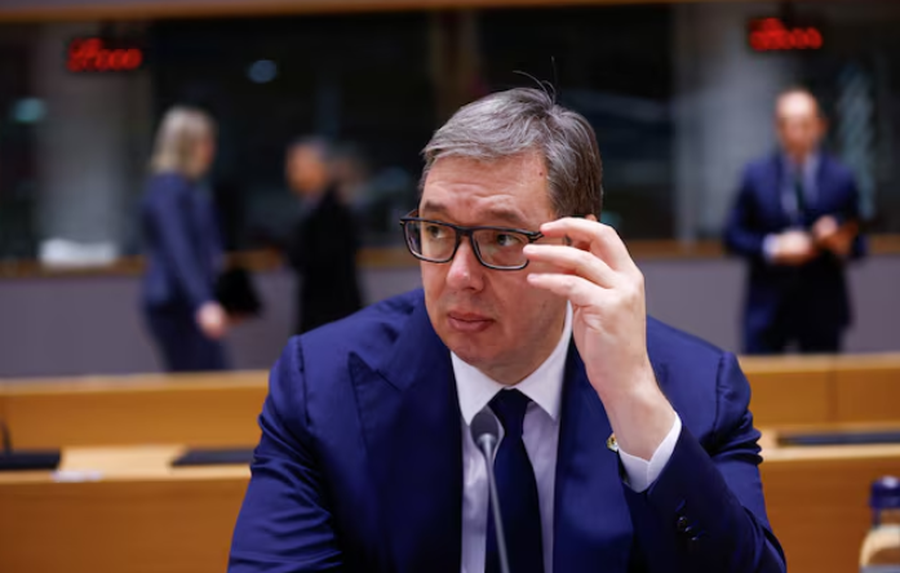
President Vučić's trip to Moscow has been fraught with challenges, from airspace denials to security threats. However, with reports confirming that he has already arrived in the Russian capital, attention will soon shift to celebrations commemorating the end of World War II and the sacrifices made during that time.
Serbian President Aleksandar Vučić made an unscheduled landing in Baku, Azerbaijan, while en route to Moscow for the Victory Day parade. The sudden stop was attributed to rising tensions and military operations in Eastern Europe, which made the flight unsafe, Serbian portal Informer reported.
The situation surrounding Vučić's flight was complicated by restrictions imposed by neighboring countries. Both Latvia and Lithuania had previously denied Vučić's plane access to their airspace, citing the "political sensitivity" of the flight's purpose. Lithuanian authorities explained that the refusal was due to "technical and diplomatic circumstances," further complicating Vučić's travel plans.
According to the Serbian newspaper Blic, Vučić's plane was unable to continue its journey to Moscow due to ongoing drone attacks and the operation of air defense systems in the region. The plane was reportedly waiting for the necessary permits to resume its flight to the Russian capital.
Despite the emergency landing, the Serbian Embassy confirmed to TASS that Vučić's visit to Moscow continued as scheduled. Reports from Baku airport indicated that after the short stop, Vučić's plane successfully departed for Moscow, where he will participate in the celebrations of the 80th anniversary of Victory Day on May 9, 2025.
Against the backdrop of this incident, Ukrainian President Volodymyr Zelensky had previously advised world leaders not to attend the celebrations in Moscow, citing security concerns. Zelensky's statements highlighted the ongoing conflict and the potential risks associated with the event, noting: "We choose such difficult points for Russia that will push Moscow towards diplomacy... They should be worried that this war continues. They should end the war."
As Vučić's plane was en route to Moscow, it was reported that other flights were also severely affected by the restrictions on air travel. Over the past day, Moscow airports had repeatedly suspended aircraft arrivals and departures due to the heightened security situation, resulting in the cancellation of dozens of flights. The Association of Tour Operators of Russia estimated that at least 60,000 passengers were affected, disrupting the schedules of approximately 350 flights.
Vučić's trip comes after a turbulent period for the Serbian president. Just days earlier, on May 3, he was forced to cut short his visit to the United States due to health concerns, which led to speculation about his ability to attend the upcoming celebrations in Moscow. After being released from the hospital, he initially canceled several engagements, raising doubts about his participation.
In the context of the Victory Day celebrations, the Kremlin has expressed its displeasure over airspace restrictions imposed by neighboring countries, labeling their actions as an “absurd policy filled with Russophobia.” Dmitry Peskov, the Kremlin spokesman, highlighted growing tensions within the European Union over these issues.
As the date of the Victory Day parade approaches, the Kremlin has announced that several foreign leaders are expected to attend, including Xi Jinping, the President of the People's Republic of China. Yuri Ushakov, an aide to the Russian President, said that 29 foreign leaders had confirmed their participation, underscoring the importance of the event on the international stage.
President Vučić's trip to Moscow has been fraught with challenges, from airspace denials to security threats. However, with reports confirming that he has already arrived in the Russian capital, attention will soon shift to celebrations commemorating the end of World War II and the sacrifices made during that time.
The European Union has repeatedly warned that it will not look favorably on such actions by member states or candidate countries, which Serbia has been since 2012.
"Relations with Russia cannot continue as usual," European Commission spokesman Markus Lammert said last week, referring to Moscow's invasion of Ukraine.
But he declined to speculate on any consequences.
This has left room for maneuver for Vučić, whom Putin honored with a high award in 2019 for promoting ties between the countries.
Vucic, who has been in power since 2012, received the Russian ambassador on Wednesday before his departure for Moscow, followed immediately by the British ambassador, just days after a visit to the United States.
The Balkan country has long maintained close ties with Russia and a shared dislike of NATO since the bombings of the Kosovo war in 1999.
Since Russian troops invaded Ukraine in February 2022, Belgrade has maintained relations with Moscow and has not imposed sanctions, although it has supported UN resolutions against it.
Maintaining good relations with Putin without losing favor with the EU is “one of the pillars” of Vučić’s foreign policy, even if “he has been more cautious in recent years,” said Florian Bieber, of the University of Graz.
It is also about “calibrating the intensity of Serbia’s relationship with Europe,” said Eric Gordy, a Balkans specialist at University College London, who compared Vučić’s approach to that of former Yugoslav President Josip Broz Tito.
On the Russian side, having "the largest country and economy in the middle of the Balkans is a very important lever -- not to directly influence, but simply to be present, to provoke... instrumentalize (or even) undermine EU projects," said Nemanja Todorovic Stiplija, of the Belgrade-based think tank Center for Contemporary Politics. /Adapted Pamphlet/


Lini një Përgjigje