


 Shkruar nga GIORDANO STABILE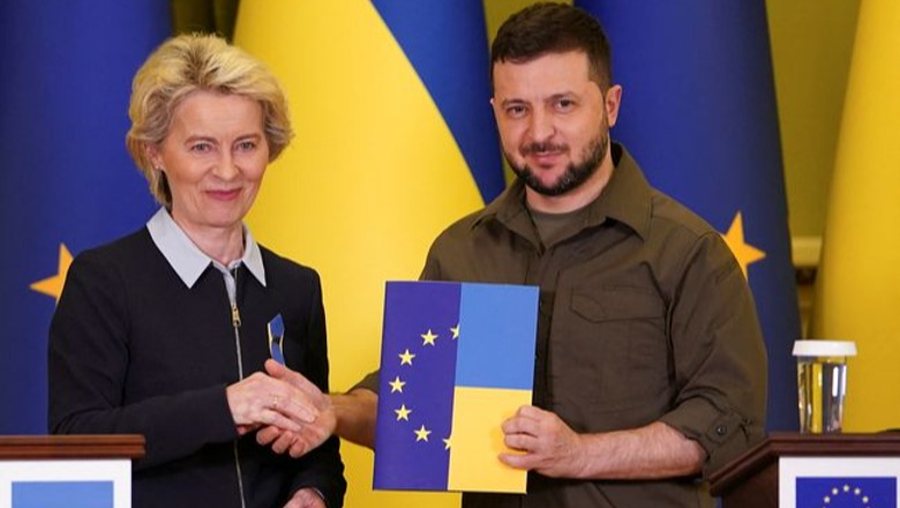
The Ukrainian crisis is just one of the emergencies it must confront. The others are escalating.
The President of the European Parliament says that all EU and NATO member states can send their armed forces, coordinated at the European level.
The Maltese President of the European Parliament, Roberta Metsola, has her feet in the Mediterranean, but her head on the threshold of “the EU’s longest border with Russia,” namely in Finland, she says in an interview with La Stampa. The Finnish government believes it is on the front line of danger. On the other side of the border, Vladimir Putin is strengthening his military presence and building new bases.
The Ukrainian crisis is just one of the emergencies it must face. Others are escalating. Like the humanitarian crisis in Gaza. The economic one, imposed by the threat of Trump's tariffs. The energy transition and the new challenges for businesses on the continent.
Do you think Europe has a role in trying to negotiate peace between Russia and Ukraine, or are we already isolated?
If we recall the images we saw at the Vatican, and the conversation between Donald Trump and Volodymyr Zelensky, we can say that there is Europe's will to achieve peace, just as there is the will of the United States, and undoubtedly there is the will of the Ukrainians.
What kind of peace?
Peace means first of all a ceasefire. And then an agreement that does not decide anything about Ukraine without Ukraine. This is a very important point for us. You will never find a country that allows someone else to make decisions about its territory. And this is the first rule of the European Union but also of our allies, including Britain and Canada.
But does Vladimir Putin want peace?
We are seeing that Russia is bombing Ukraine every day, even though the US has made efforts to talk to the Russians.
And what can Europe do in these conditions?
Today there is an agreement among major European countries, based on the principle that Ukraine's security is also our security. It is a strong and courageous policy because every day that passes our companies, our young people, especially in countries that are far from Ukraine, are beginning to have doubts about the need for assistance to Kiev. But we must never lose the courage to say that Ukrainians fight every day for our security as well.
But is Merz's approach to long-range missiles a bold or risky choice?
I think Chancellor Merz's statements are very strong. We have been waiting for such positions from Berlin for many years.
Will Germany alone be enough to guarantee adequate supplies for Kiev?
On June 24-25, we have a crucial NATO summit. All member countries must show in detail how they intend to reach the required defense spending ceiling and what weapons they have at their disposal that they can send to Ukraine.
We also need to discuss how to maintain security on the eastern front after a possible ceasefire. Who will guarantee it and how. When I went to Romania last week, this was the first question young people, students and politicians asked me.
And how did you respond?
We must try to achieve a ceasefire by all means. Then we must have the courage to say that after the war, we will be the ones to provide this security guarantee.
In your opinion, will there be a common European army by the end of this European Parliament legislature?
We are not talking about a common European army, but about the interaction between all the forces of European countries, which currently does not exist. The model could be that of Frontex. There we have a common force with personnel from all member states. When there is a particular influx towards a single country, all the others can send their forces, organized at the European level.
Then there's the crisis in Gaza...
The situation in Gaza is tragic and catastrophic. We are doing everything we can to alleviate the suffering of innocent people. I was the first European leader to enter the Gaza Strip a few months ago, with a humanitarian aid convoy, to underline how essential aid is.
The EU is the largest donor of humanitarian aid and the situation there is tragic. The European Parliament's position has been very clear since the attack of 7 October. Although it is difficult, we must work towards a two-state solution to the conflict. We must give the Palestinians the opportunity to govern Gaza, but without Hamas.
Is the EU's stance on Israel and Gaza changing? Is there a new, tougher common line on Netanyahu?
I repeat, the situation is tragic and we must do everything we can to alleviate the suffering of the innocent. The European Union's position is clear.
What is your comment on Trump's trade tariffs against Europe?
Perhaps we were a little naive. When American voters made their choice in November, the answer the new president had to give was clear. As clear as the demand of our European voters last June: Make our lives simpler, safer, and more efficient.
Now how should we deal with Trump?
We need to talk to the US as a partner, an ally, but without being naive, with the aim of protecting our industries as well.
Meanwhile, is China an alternative option, or does it remain an interlocutor that would be better avoided?
No, it is a reality. For many products we are completely dependent on China. But I do not want us to submit to a society that no longer produces, but becomes simply a consumer. The next 5-10 years will be decisive. Also, we must find ways to protect our products and be competitive in almost every sector./ Adapted from "Pamphlet" by "La Stampa"



Lini një Përgjigje