


 Shkruar nga Pamfleti
The Islamic Republic faces internal and external pressure, while state doctrine links its survival to the return of the Mahdi.
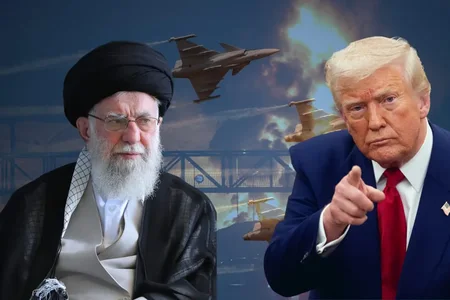
The Islamic Republic of Iran is facing one of the most difficult periods in its history. Supreme Leader Ali Khamenei, who has led the country for 37 years, has weathered waves of protests, an assassination attempt and a serious illness. Today, he faces intense international pressure and a concentration of American forces in the Middle East.
Since late last year, Ayatollah Khamenei, 86, has faced unrest considered among the worst in the Islamic Republic's history. Security forces have cracked down on the protests with brutal force. The government says about 3,000 people were killed in January demonstrations in Tehran and other cities. Independent monitors put the death toll at 30,000.
A large part of the population expresses deep dissatisfaction and demands the overthrow of the Islamic regime and the establishment of a democratic government. The religious and political elite faces the challenge of the survival of the system built after the Islamic Revolution of 1979.
For religious leaders, preserving the Islamic Republic is an essential obligation. They consider Iran a theocracy with a divine mission. According to the doctrine formulated by Ayatollah Ruhollah Khomeini in the 1970s, Islamic jurists (velayat-e faqih) not only run the state, but also bear responsibility for preserving the continuity of the faith and preparing the conditions for an event of salvific importance: the return of the twelfth Imam, the Mahdi.
The kingdom of justice
The Iranian constitution is based on the rule of Shiite jurists. According to Khomeini's teachings, their main task is to prepare the ground for the return of the Mahdi. According to Shiite belief, the "twelfth" will appear at the end of time to establish justice and restore pure Islam.
The title “Mahdi,” or “the guided one,” originated in the 7th century, during the time of the prophet Muhammad. After his death, Muslims were divided over the question of succession. Sunnis, who make up the majority of the Muslim world, accepted figures outside the prophet’s family as leaders. Shiites supported the right of Ali, Muhammad’s cousin and son-in-law, and his descendants. Twelver Shiites limited the imamate to twelve imams, all descendants of Ali, according to a Swiss media article .
There is a special tradition about the twelfth Imam. According to one version, the eleventh Imam, Hasan al-Askari, died without leaving an heir. According to another, he had a son, Muhammad al-Mahdi, who disappeared in 874 at the age of five. Since then, according to Shiite belief, he has lived hidden from the eyes of the world and will return at the time appointed by God.
Traditions vary as to the manner of his disappearance and his whereabouts. Some believers believe that he lives invisibly on earth; others suggest symbolic or inaccessible places. In the first centuries after his disappearance, some jurists claimed to receive messages from him through intermediaries. After the fourth generation of these representatives, tradition says that communication ceased.
Nearly two decades ago, Ayatollah Ali Meshkini declared during a prayer in the holy city of Qom that the Mahdi had approved the lists of candidates for the new parliament. The declaration was intended to bolster the institution’s legitimacy at a time of low turnout. Other religious authorities did not publicly support this claim, while reformist figures criticized it.
Until his return
According to the Iranian Constitution, the Mahdi is considered the supreme symbolic authority of the state. The Supreme Leader exercises power as his representative until his expected return. In this sense, Ali Khamenei exercises the function as the deputy of the Hidden Imam.
Religious doctrine links the Mahdi's appearance to end-time signs, such as the spread of injustice and global crises. Some Iranian theologians have declared in the media that his return is imminent. Ayatollah Abolghasem Khazali has claimed on state television that the Mahdi will appear soon and go to Jerusalem, where, according to this interpretation, he will meet Jesus Christ.
These beliefs also influence Iran's foreign policy. According to the interpretation of some conservative circles, the emergence of the Mahdi is connected with Muslim control over Jerusalem. Representatives of the regime have often repeated their position against the existence of the state of Israel. In public statements, Ali Khamenei has warned that any attack on Iran will cause a wide-ranging regional war, which, according to him, will lead to the destruction of Israel.
As domestic protests continue and international pressure mounts, the Iranian leadership struggles to maintain the stability of the system. For the religious establishment, the survival of the state is not just a political issue, but part of a theological mission tied to the expectation of the return of the twelfth Imam. /Adapted Pamphlet /







Lini një Përgjigje