


 Shkruar nga Pamfleti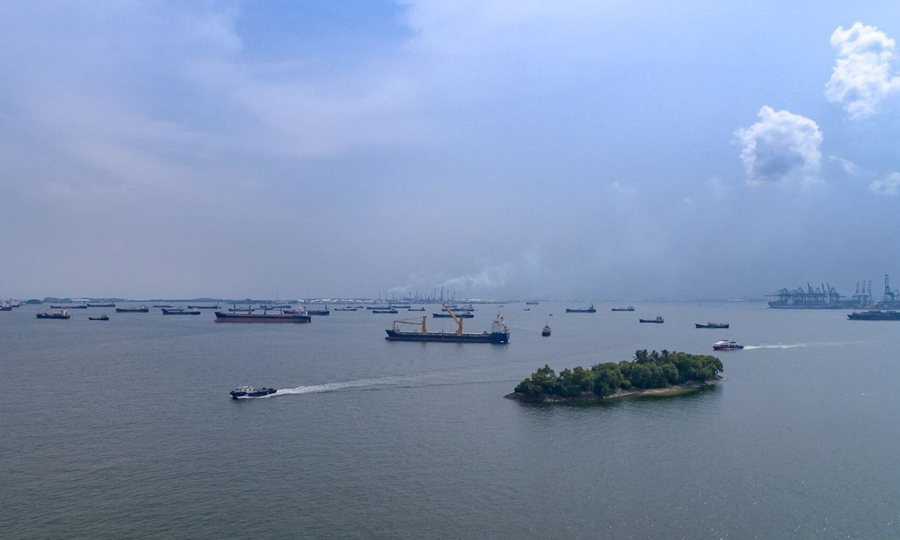
One of the main arteries of world trade is considered increasingly vulnerable to geopolitical tensions and security risks.
Disruptions to shipping through the Strait of Hormuz have brought attention back to the structural weaknesses of key maritime corridors, with the Strait of Malacca considered one of the most critical points for global trade.
The Strait of Malacca is a strategic sea route connecting the Indian Ocean with the South China Sea and further to the Pacific Ocean. It stretches for about 800 kilometers between the island of Sumatra and the Malaysian peninsula, with Thailand to the north and Singapore at the southern entrance. Due to its geographical position, it offers the shortest sea route between the Middle East and East Asia.
Its importance in global trade is crucial. More than a fifth of the world's maritime trade passes through the strait. According to data from the Malaysian Ministry of Transport, about 102,500 ships passed through it in 2025, up from 94,300 the year before. The goods transported include crude oil, liquefied natural gas, coal, palm oil, iron ore and processed products.
In terms of energy, the importance is even more obvious. During the first half of 2025, about 23.2 million barrels of oil per day passed through the Strait of Malacca, according to the U.S. Energy Information Administration. This volume even exceeds the 20.9 million barrels per day that passed through Hormuz during the same period.
However, this route remains highly exposed to risks. At its narrowest point, it is only 2.7 kilometers wide, which significantly increases the possibility of collisions or ship jams. The high density of maritime traffic makes any incident potentially costly for global supply chains.
Security is another concern. Cases of piracy and armed robbery have increased, reaching 108 incidents reported in 2025 in the Malacca and Singapore area. Local disruptions can also cause delays and increase transportation costs.
Although alternative routes through the Indonesian archipelago exist, they present significant limitations. The Sunda Strait is shallow in some areas and lies near an active volcano, while routes through Lombok and Makassar significantly increase travel times and costs. For example, a trip from the port of Ras Tanura in Saudi Arabia to Japan is more than twice as long if Malacca is avoided.
The strait is bordered by Indonesia, Malaysia and Singapore, which exercise sovereignty over territorial waters up to 12 nautical miles, in accordance with the UN Convention on the Law of the Sea. Since 1971, these countries have cooperated in its management. However, its status as an international strait guarantees the right of free and uninterrupted passage for ships and aircraft, prohibiting the imposition of simple transit fees.
Recent developments have added to the concerns. A senior Indonesian official briefly floated the idea of imposing fees for crossings, but quickly withdrew it. In parallel, Indonesia is considering a US proposal for airspace access for military aircraft, an issue that has fueled internal debate over sovereignty.
Singapore and Malaysia have publicly stressed the importance of keeping the strait open and functional, reflecting a shared interest in the stability of the route. Meanwhile, Thailand has revived the idea of building a land transport corridor that would bypass Malacca, but the project is considered complex and costly.
China remains among the countries most exposed to any disruption to this corridor. As the world's largest oil importer, it depends heavily on this route for energy supplies. This dependence has prompted efforts to diversify through pipelines from Central Asia and Russia, as well as investment in infrastructure projects under the "One Belt, One Road" initiative.
However, sea lanes remain essential to the Chinese economy. This situation is often described as the “Malacca Dilemma,” a strategic concept that emphasizes the risk that a conflict or blockade in this strait would directly affect China’s energy security.
The analysis concludes that, in a context of increased global tension, the Strait of Malacca remains a key point for international economic stability and a sensitive element in geopolitical balances.








Lini një Përgjigje