


 Shkruar nga Pamfleti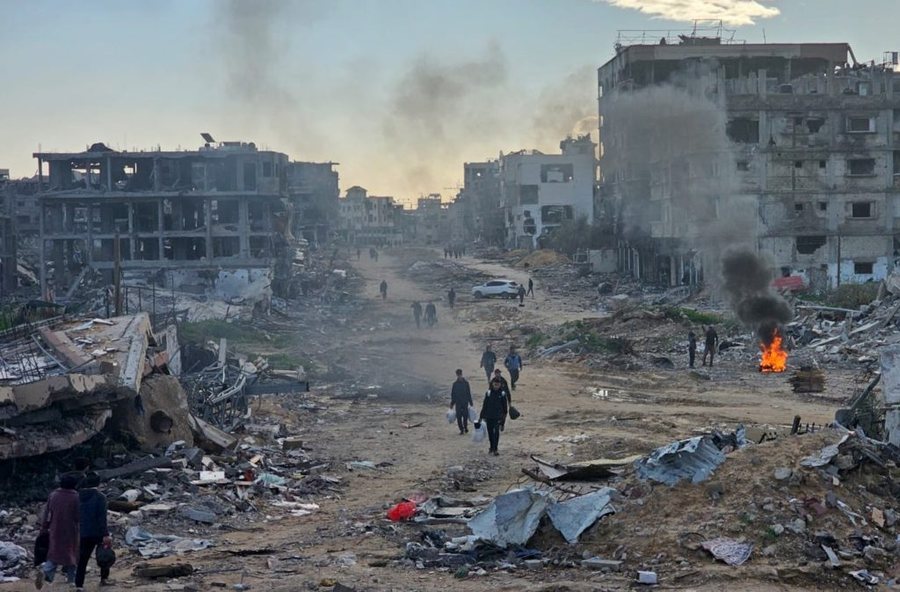
As part of its pledge to eliminate Hamas, Israel promised to destroy the group's vast network of tunnels under Gaza, which it uses to move goods and people.
It has been nearly six months since Hamas fighters swept from Gaza into Israel on October 7, killing around 1,200 people and taking hundreds hostage. In response, Israel vowed to "smash and destroy Hamas" so that it no longer poses a threat and bring all the hostages home.
In the brutal war that followed, at least 33,000 Palestinians have been killed, according to the Hamas-run health ministry, and large parts of Gaza have been destroyed. Israel says it has killed thousands of Hamas fighters and destroyed much of the vast network of tunnels under Gaza that Hamas has used to carry out attacks. BBC Verify has analyzed public statements and social media posts from the Israel Defense Forces (IDF) and assessed the evidence behind Israel's stated intentions.
How many Hamas leaders have been killed?
Before October 7, Hamas was thought to have about 30,000 fighters in Gaza, according to reports citing IDF commanders. Many of Hamas's senior political figures, such as Ismail Haniyeh, widely regarded as the group's overall leader, live abroad. But many of its leading military structures are thought to be inside Gaza. In a recent statement, the IDF said it had killed about 13,000 Hamas fighters since the war began, although it did not say how it calculated that figure. Israel also publishes the names of Hamas leaders it says have been killed. A total of 113 people have been so named since October, the vast majority of whom were reported killed in the first three months of the war. By comparison, the Israeli military did not report any senior Hamas leaders killed in Gaza this year until March.
On March 26, the IDF said it had killed Marwan Issa, deputy commander of Hamas' military wing. Considered one of Israel's most wanted men, he would be the group's most senior leader to be killed since the start of the war. The US has said it believes he was killed, but Hamas has not confirmed. The IDF has released the names of individuals it says are senior Hamas leaders who have been killed, but it is not possible to verify whether they are members of the group. One of those named in this category was Mustafa Thuraya, who was working as a freelance journalist in southern Gaza when his vehicle was hit in January.
We also found duplicate names in the list, which we subtracted from the total. Outside Gaza, Hamas political leader Saleh al-Arouri died in an explosion in the southern Beirut suburb of Dahiyeh in January. Israel is widely held responsible for that attack. However, experts we spoke to said many of the group's prominent leaders in Gaza, including Yahya Sinwar, are believed to be still alive. "The IDF has not been able to get to the top of the Hamas leadership," says Mairav Zonszein, a senior analyst for Israeli-Palestinian affairs at the International Crisis Group. "Both on a symbolic level of reaching key leaders, and on the level of replacing Hamas as the master of the territory, that's something he hasn't been able to achieve," Ms Zonszein says.
How many hostages remain in Gaza?
According to official Israeli figures, 253 people were taken hostage on October 7.
Of these:
-109 have been released as part of prisoner exchanges or in special deals
-3 have been rescued directly by the Israeli military in military operations
-The bodies of 11 hostages have been recovered, including three the IDF admitted to having killed in a from their operations
- The youngest confirmed hostage is 18 years old and the oldest is 85 years old.
-Of the 130 remaining hostages, Israel says at least 34 are dead.
Hamas says the number of dead hostages is higher – the result of IDF airstrikes. But it is not possible to verify these claims. The two youngest hostages taken in the Hamas attacks were Ariel and Kfir, who were 4 years old and 9 months old respectively at the time of their abduction. Their deaths have been reported but not confirmed.
How much of the Hamas tunnel network has been destroyed?
As part of its pledge to eliminate Hamas, Israel promised to destroy the group's vast network of tunnels under Gaza, which it uses to move goods and people. “Think of the Gaza Strip as one layer for civilians and then another layer for Hamas. We are trying to get to the second layer that Hamas has built,” IDF spokesman Jonathan Conricus said in October. Hamas has previously said its tunnel network stretches for 500 km (311 miles), although there is no way to independently verify this.
We asked the IDF how many tunnels and what percentage of the total tunnel network they had destroyed. In their response, they said their forces had "destroyed a large part of the terrorist infrastructure in Gaza". The IDF has repeatedly shown evidence of Hamas tunnels that they have uncovered. For example, in November, the IDF released video footage of part of a tunnel network under al-Shifa hospital in Gaza City, which it said was being used as a command center. To try to determine the extent of the overall network uncovered by Israeli forces, BBC Verify has examined all IDF messages on the social media platform Telegram in the reference tunnels in Gaza between 7 October 2023 and 26 March 2024 Of these, 198 mentioned the discovery of tunnels, where the military said it had located tunnels or tunnel shafts. Another 141 messages claim that a tunnel has been destroyed or dismantled.
Israel's offensive has come at a high price
Israel's war aims have come at a great cost to the Palestinians in Gaza. More than 33,000 people have been killed, according to the Hamas-run health ministry. The ministry's latest demographic breakdown from April 5 shows that more than 70% of those killed were women and children. Many more have been displaced and made homeless as Israeli forces attempt to destroy Hamas infrastructure. Over 1.7 million people have been internally displaced, according to the United Nations. Residential areas have been left in ruins, bustling streets have been reduced to rubble, universities have been destroyed and farmlands destroyed. More than 56% of Gaza's buildings have been damaged or destroyed since October 7, according to analysis of satellite data. Six months since the start of the war, it is still unclear whether Israel has achieved its goals in the war. /Taken from 'BBC'






Lini një Përgjigje