


 Shkruar nga Pamfleti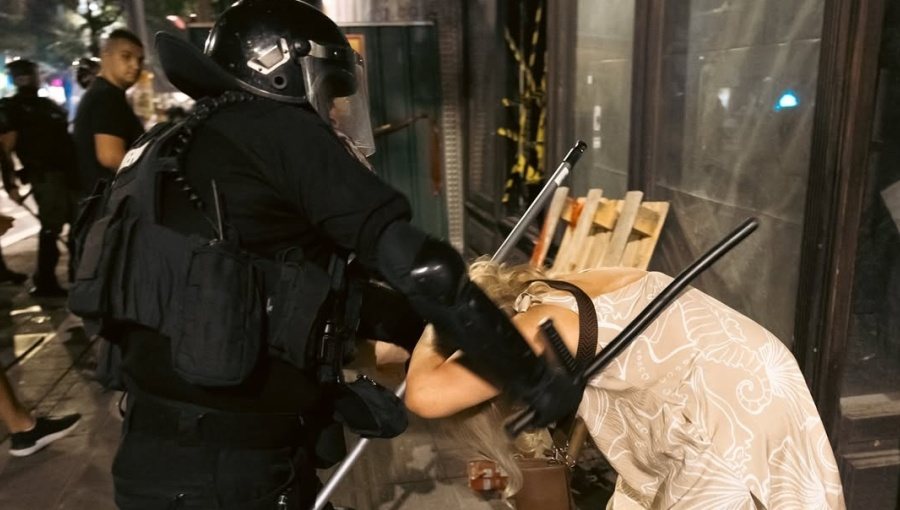
Footage shared on social media showed Andrej Vučić leading a group of SNS activists through Pioneers Park in central Belgrade...
Clashes have erupted across Serbia, as anti-government demonstrators and supporters of the ruling Serbian Progressive Party (SNS) clashed in several cities, deepening a political crisis that has dragged on for months.
The unrest comes after more than 9 months of largely peaceful protests against President Aleksandar Vučić and his administration, with tensions escalating after violence erupted between government loyalists and protesters in the northern towns of Vrbas and Backa Palanka on the night of August 12.
Student-led demonstrations, under the slogan "Wake Up Serbia," were held in over 30 cities and towns on August 13-14, including Belgrade, Novi Sad, Niš, and Kragujevac. Organizers are calling for an end to police violence and early parliamentary elections.
In Novi Sad, Serbia's second largest city, the situation quickly escalated when SNS supporters threw fireworks and flares at demonstrators outside the party headquarters. Protesters responded by breaking windows and clashing with police, who used tear gas to disperse the crowd.
The Defense Ministry said seven members of the Serbian Armed Forces were injured in the clashes, four of them seriously. Lieutenant General Duro Jovanic, head of the Military Security Agency, said soldiers were involved in the riots while trying to manage the situation.
Interior Minister Ivica Dacic said that a gunman photographed at the scene, later identified as Serbian Army second lieutenant Vladimir Brkusanin, was acting in an official capacity by holding his weapon in the air. Dacic denied allegations that SNS supporters had drawn their weapons, stating that the soldier was protecting a "certain person" and had used his service pistol lawfully.
Violence also erupted in Belgrade, where police used tear gas and attempted to stop demonstrators near the SNS offices in New Belgrade. Protesters clashed with officers, some of whom threw objects and pushed through police cordons. N1 television reported that officers were occasionally forced to retreat.
Journalists covering the protests were also injured. Nikola Bilic of Novi Sad's 192 portal was beaten, while Razglas journalist Zarko Bogosavljevic was hit in the head with a rubber baton.
Footage shared on social media showed Andrej Vučić, the president's brother, leading a group of SNS activists through Pioneers Park in central Belgrade. The park has become a symbol of the counter-protest movement.
Opposition figures accused the government of encouraging violence through selective law enforcement and the use of convicted criminals to intimidate demonstrators. Critics can point to a series of controversial pardons by President Vučić, including the release on August 1 of Milica Stojanović, who had faced attempted murder charges for driving her car into a crowd of protesters in January.
In another case, Vučić pardoned four SNS activists convicted of attacking a protester earlier this year in Novi Sad.
Interior Minister Dacic has called for the “restoration of law and order,” while President Vucic described the demonstrators as “thugs,” echoing past government rhetoric labeling protesters as “terrorists.”
The protests began after a building collapsed at a train station in Novi Sad, an incident that left 16 people dead. The tragedy sparked accusations of corruption and mismanagement of state projects.
Since then, university students have led a wave of civil disobedience and public rallies demanding accountability and democratic reforms. Protesters are now demanding early parliamentary elections.
President Vučić has hinted that early elections could be held before the 2027 deadline, but has not yet committed to a specific timeframe. On August 13, the president confirmed that he would not run for re-election at the end of his term, allaying fears that he might try to change the Constitution to extend his rule.
As violence escalates, pressure is mounting on the government to de-escalate. Without calling early elections, Serbia risks sliding further into authoritarianism and civil unrest. /Adapted from Intellinews/


Lini një Përgjigje