


 Shkruar nga Pamfleti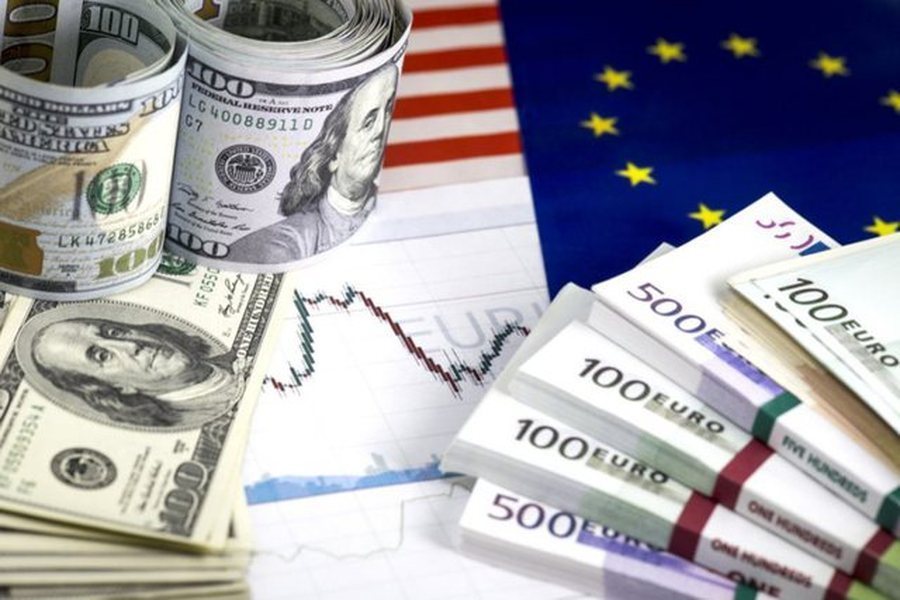
The US dollar continues to fall. Donald Trump's decision on tariffs is undermining confidence in the currency that accounts for over half of the global foreign exchange reserves.
Compared to the Swiss franc, the dollar is at its lowest level since 2011. These are the most important facts about the dollar.
The dollar can be used to pay in many countries.
The United States issues only its own currency. But the dollar is the official currency in many countries and regions. These include Ecuador, El Salvador, Cambodia, Liberia, the Marshall Islands, Micronesia, East Timor, Palau, Panama, and Zimbabwe.
Some of these countries have a national currency other than the dollar. Furthermore, the dollar is used unofficially in many countries, for example when their currency is no longer suitable as a reserve of value due to hyperinflation.
By the way, just because a currency is called a dollar doesn't mean it's related to the US dollar. The British Empire also used dollars in its colonies. The Australian dollar and the Canadian dollar, for example, still bear witness to this today.
Some currencies are pegged to the dollar
Some countries and regions have pegged their currencies to the dollar or allow only small fluctuations in the exchange rate. For example, the Caribbean countries of Barbados and the Bahamas or Jordan and Hong Kong.
This includes the five Arab oil-producing states of Saudi Arabia, the United Arab Emirates, Qatar, Oman and Bahrain. China, on the other hand, abandoned the dollar peg of its national currency, the Renminbi, in 2015 in favor of a basket of currencies.
The whole world needs dollars
The dollar's most important role is as a reserve currency. According to the International Monetary Fund, various central banks hold about $6.6 trillion in foreign exchange reserves. That's more than half of total global foreign exchange reserves—or 54 percent.
Thanks to the dominance of the dollar, the US can borrow much more than other countries. Foreign central banks constantly lend to the US by buying US bonds. The US's largest creditors are Japan and China. Switzerland also has $300 billion in US debt.
Furthermore, the dollar is the most important currency for financial and commodity markets. Oil trading is settled in dollars. In this way, the dollar exchange rate affects, for example, the price of gasoline worldwide.
The dollar was once worth much more
Although the dollar is considered a stable currency, it has lost value compared to many other currencies. In 1970, one dollar was worth over 4 francs. The devaluation is desired by the US so that American exports have a chance on the world market.
In 1985, the G5 countries, Germany, France, the UK, Japan and the US, agreed in the Plaza Accord to weaken the dollar. Trump is also relying on a weaker dollar today to reduce the trade deficit and bring manufacturing back to the US.
But the US president should not overdo it. When confidence in the dollar falls, demand for dollars abroad falls and it becomes harder for the United States to borrow new money. This concern was one of the reasons why Trump suspended his new tariffs for 90 days last week.
Despite the loss of confidence, no replacement is on the horizon
The second most important currency in the world is the euro. It is also used as a reserve currency and accounts for about 20 percent of global foreign exchange reserves. The euro also plays second fiddle to the dollar in financial transactions.
However, the euro has yet to pose a threat to the dollar. Since its peak of 1.60 euros per dollar in 2008, the euro has lost about a third of its value. In the long term, financial markets trust the euro even less than the dollar. Time will tell whether this will change with Trump's tariff war. / Adapt Pamphlet /






Lini një Përgjigje