


 Shkruar nga Pamfleti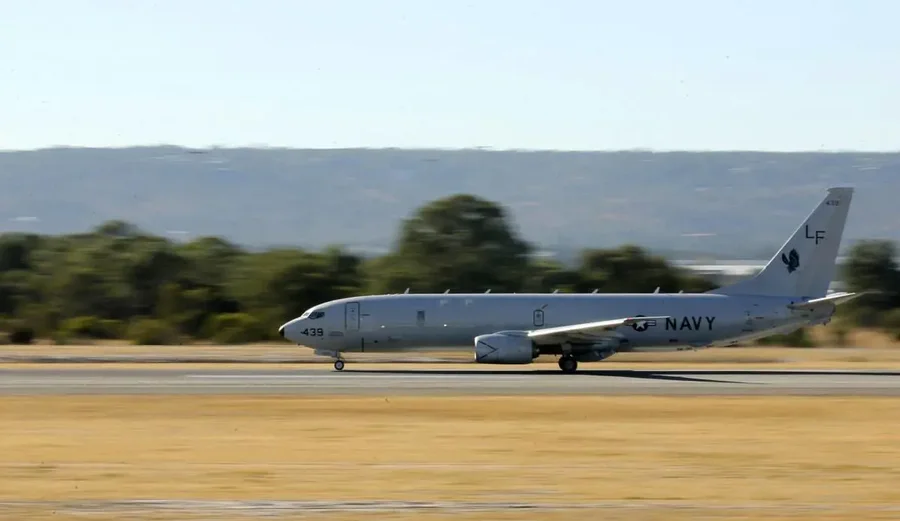
The United States is strengthening its missile capability by integrating the LRASM missile into P-8A aircraft to counter China's growing naval power in the Pacific...
The United States is increasing its missile capabilities to counter China’s growing naval power. As Beijing has bolstered its Pacific fleet, the Pentagon is reportedly developing new strategies and technologies to maintain military superiority in an arms race that could reshape the global strategic balance. In particular, Washington frequently sends its P-8A maritime patrol aircraft, an aircraft upgraded to carry Long-Range Anti-Ship Missiles (LRASM), off China’s coast.
The Chinese Navy and the US response
China, as Newsweek explained, has the world's largest navy by number of ships, with over 370 ships and submarines in service. Such a naval fleet helps Beijing expand its military presence in the Western Pacific, challenging US naval dominance. To counter the Dragon, the United States has deployed land-based anti-ship missile systems in the region, while Washington's allies and partners there have been equipped with American weapons to strengthen their capabilities in sinking enemy ships. Meanwhile, the P-8A aircraft, also known as Poseidon, is designed for anti-submarine warfare and anti-aircraft warfare, as well as intelligence gathering. The US Navy regularly uses the aircraft for patrols and exercises in the Taiwan Strait and the South China Sea.
Last August, California photographer Aaron Maurer shared an undated photo on “X” showing a Navy P-8A aircraft flying over the Mojave Desert.
A KC-46 Pegasus and P-8 Poseidon flying over Mojave. Interesting combo. #kc46 #p8 pic.twitter.com/aG0VzKvhDo
— maurer8photography (@maurer8photo) August 28, 2025
The plane was seen carrying a missile under its left wing, which some have identified as the Lockheed Martin-developed LRASM. The precision-guided missile is said to have a range of over 230 miles and a 1,000-pound warhead.
The US Navy later confirmed that the missile in the photo was indeed the LRASM, adding that work was underway to complete its integration into the P-8A aircraft. "LRASM has additional, advanced, long-range capabilities at sea and on land across a variety of platforms," Lockheed Martin explained.
In 2023, Naval News wrote that the integration of the LRASM into the P-8A aircraft had begun in 2020 and was expected to continue through 2025. The Poseidon is capable of carrying four LRASMs under its wings, but not within the weapons bay.
Washington Rockets
According to Lockheed Martin's leaflet, LRASM has been declared operational with the B-1B bomber and the F/A-18E/F fighter jet. In addition to the P-8A aircraft, efforts are being made for integration with the F-15, F-35B and F-35C fighter jets.
The continued integration of LRASM with U.S. military aircraft comes at a unique time. During its recent military parade, China displayed several Navy-based air defense systems, including missiles and a laser weapon, bolstering its fleet’s defenses. LRASM is designed to intercept a variety of surface threats at “very long range” and navigate “semi-autonomously” to its target.
Lockheed Martin has no doubts: "to penetrate sophisticated integrated air defense environments, anti-ship missiles must be capable of employing exceptional targeting, guidance and stealth accuracy, day and night and in all weather conditions."
Meanwhile, some analysts point out that LRASM is designed to detect and destroy specific targets within groups of ships using advanced technologies that reduce dependence on intelligence, surveillance and reconnaissance platforms, networking and GPS navigation in electronic warfare environments. / Adapted from Il Giornale /








Lini një Përgjigje