


 Shkruar nga David J.Bailey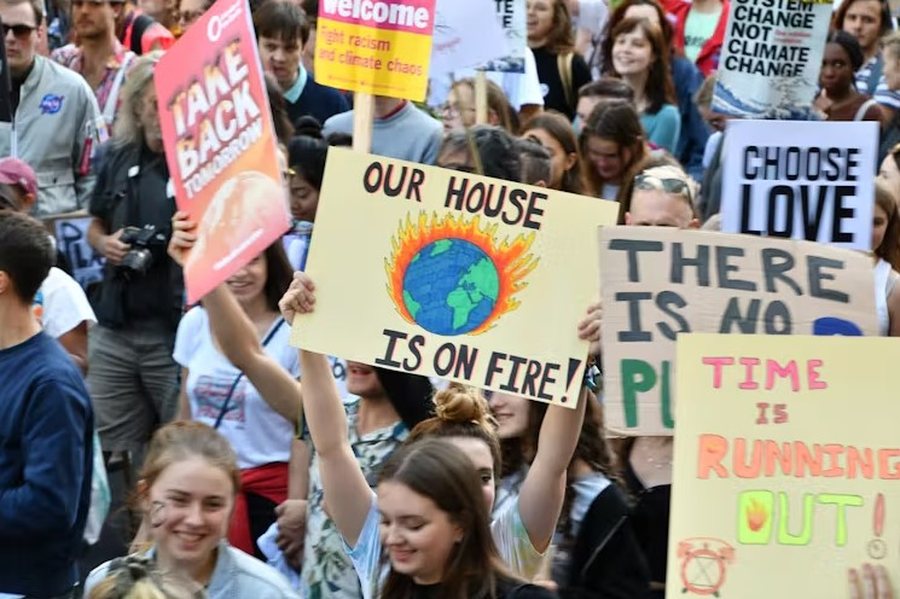
Most of the British public believe that protests can rarely bring about change. While young people are more optimistic, about half of adults believe they are unlikely to change anything.
The current global wave of protests calling for a cease-fire in Gaza includes large demonstrations, road blockades and efforts to block arms production.
It continues a decade-long trend of increasing protests around the world, except for a temporary decline during the Covid-19 pandemic.
But ironically, despite so much collective action, those who participate in protests are often challenged by skepticism, and then the question arises: "There is no change happening, so why do we keep protesting?".
This seems to be the view of the Home Secretary of Great Britain, James Cleverly, who stated recently: "The question I ask myself is: What do these protests really hope to achieve...? They are not saying anything new."
Most of the British public believe that protests can rarely bring about change. While young people are more optimistic, about half of adults believe they are unlikely to change anything.
Protests work
This approach is strange as we constantly see examples where protests have spurred change. This year we have seen blockades and protests by French farmers who are forcing the government to make concessions. Also in India, the farmers' movement marching on Delhi has already prompted a government bid for higher prices for their crops.
Huge protests over a child sexual abuse scandal in Budapest recently forced Hungarian Prime Minister Viktor Orbán to introduce a new law to avoid similar scandals in the future. Late last year, massive protests and roadblocks in Panama led to the government shutting down one of the world's largest copper mines.
Even studies have revealed that protests have a tangible impact. The workers' protest and their strikes were decisive in the adoption of Franklin Roosevelt's New Deal, as part of the creation of the welfare state in the USA. And it is the protests that have slowed the adoption of austerity measures that have weakened welfare systems in all high-income democracies for the past 40 years.
Colonialism was met in almost every case with constant resistance and protest, including Gandhi's campaign of non-violent civil disobedience, but also the most radical movements. This movement grew throughout the 20th century, until maintaining the occupation proved unmanageable for the colonial powers.
Given all this evidence, why do so many people remain convinced that protest is ineffective as a means of instigating change? One possible reason is that many of the underlying motives for protest—exploitation, racism, patriarchy, and the poor quality of democracy—are systemic problems that many scholars believe are byproducts of capitalism.
These problems can be challenged through collective action, but can only be eradicated through system-wide change, which is obviously much more difficult to achieve. This can create the impression that while protests can spur political and social reform, it is generally impossible to change the status quo.
Three steps to an effective protest movement
Distrust of protests rests on some truth. Protest is not a magic formula. Sometimes it brings about the desired political and social change, but other times a compromise is reached. And sometimes, it can foster oppression and imposition. In my recent research, I have analyzed the impact of many different protests and campaigns that took place in Britain during the 2010s. And I have identified a number of factors that determine which protests are the most effective.
1. Disruption
While disruptive protest may be unpopular, there is no doubt that it is effective. One of the most successful environmental campaigns of the 2010s was the anti-fracking movement (a political movement that aims to stop the practice of extracting natural gas from shale rock formations to provide energy due to its negative environmental impact), where protests by physically hindered or interfered with this process to such a degree as to make the activity impossible. But division also brings the risk of repression. Three protesters of that movement were sentenced to prison, although they were later released. Since the pandemic, the British government has used repressive measures which further criminalize disruptive protest.
2. Political support
The protest has the potential to put several issues on the political agenda of the day. But this often requires parts of the political elite - usually opposition parties - to take up these issues and put pressure on the government to take action. Anti-government protests broke out in Georgia last year against the so-called "foreign agents law", which penalizes foreign-owned or foreign-funded media and NGOs, and was widely seen as a pro-Russian move. The protests were fueled by the encouragement of President Salome Zurabishvili, an independent figure. She promised to veto the bill, ultimately forcing the government to withdraw the bill.
3. Persistence
While a single protest can take place without achieving the desired result, broad campaigns that drive change often require action over many days, weeks, sometimes even years. For example, in 2018, the Royal Bank of Scotland announced it would stop funding new coal mining projects around the world, following a decade-long protest campaign by climate change activists.
Why should you participate in protests?
The movement to achieve a ceasefire in Gaza may seem to have very little effect, especially when we see destruction and death every day. But, partly thanks to it, political divisions have begun to appear even among those who support the Israeli government. Even the USA has started talking about a ceasefire. The protest cannot be ignored indefinitely.
Even when it does not lead to immediate political or social change, participation in it brings other positive consequences. Protest activity can be empowering and provide the skills and networks needed to participate in future political activities. Numerous studies show that the effects of participating in a protest can have a long-term impact on the lives of those who participate in it./ Adapted "Pamphlet" from "The Conversation"
Note: David J. Bailey, Associate Professor of Politics at the University of Birmingham, England.




Lini një Përgjigje