


 Shkruar nga Pamfleti
Washington's new decision frees up exports of H200 chips to China, rewriting the balance of the global technology war and giving Nvidia access to a billion-dollar market under strict American control...
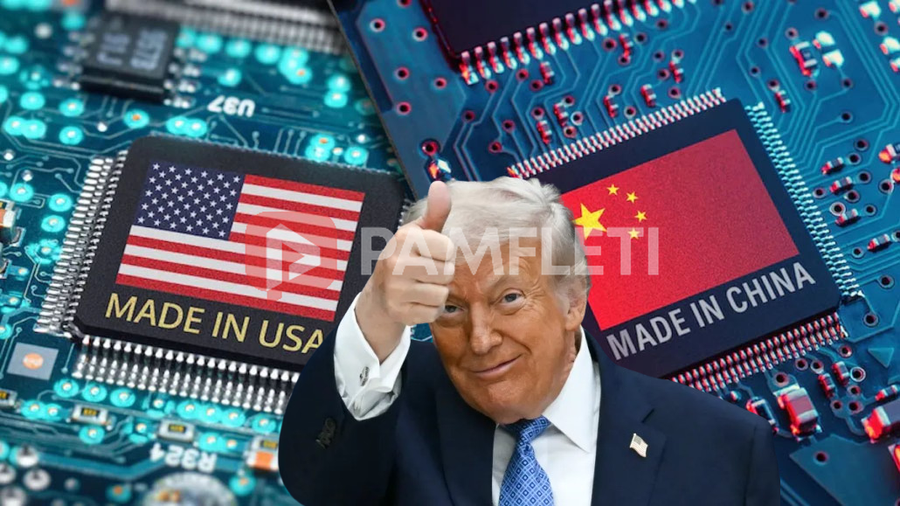
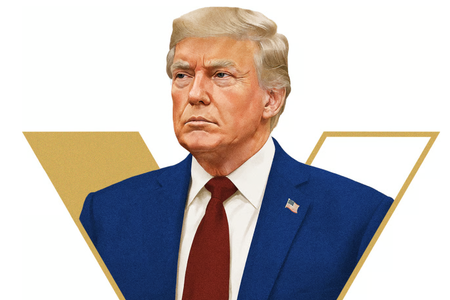
The United States today announced one of the most important decisions of the year for technology and artificial intelligence. The US administration, through an announcement confirmed by Reuters , announced that it will allow the export of advanced Nvidia H200 processors to China, accompanied by a 25% customs tariff and strict controls by the Department of Commerce. President Donald Trump stated that he had spoken personally with President Xi Jinping and that the latter, according to him, had positively welcomed this major change in chip policy. Immediately after the announcement, Nvidia shares rose by about 2%, a clear signal that the markets understood the decision as a step to unlock hundreds of millions of dollars from the Chinese market.
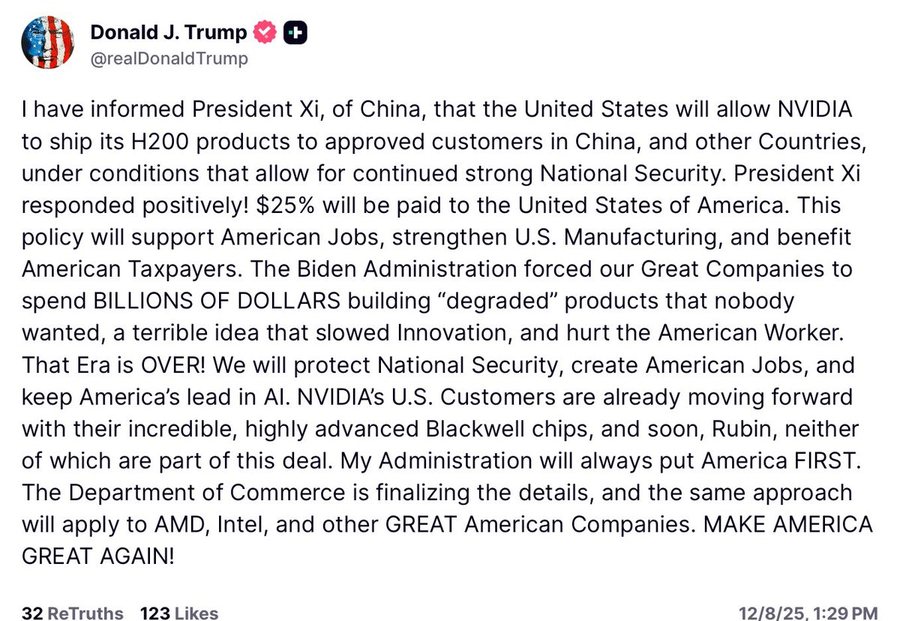
The H200 processor is at the heart of this movement and is one of Nvidia's most powerful chips, the successor to the H100, known for its crucial role in training giant artificial intelligence models such as ChatGPT, Gemini or Claude. The H200 is used by world-class supercomputers and data centers that process billions of information. The chip has an extraordinary capacity to handle complex training and to support advanced defense and security technologies, which is why it has long been banned from being exported to China, precisely because of the risk that it could strengthen Beijing's technological and military capabilities.
Washington's new decision changes the rules of the game , but with strong conditions. Each H200 will first pass from Taiwan to the US for technical verification, to ensure that the final destination is fully controlled by US authorities. No information has yet been given on how many chips will be allowed, nor which Chinese companies will be included in the list of authorized customers. The Commerce Department reserves the right to impose immediate restrictions if it is suspected that the chips could be used for military purposes. Models more advanced than the H200 remain completely banned, which shows that the US is not backing down from its strategy to maintain superiority in artificial intelligence.
Reactions in Washington are divided. Some conservative lawmakers have called the resumption of chip trade with China a strategic mistake, warning that Beijing could use the profits to improve its defense technologies. On the other hand, economic and technology analysts argue that a total embargo would severely hurt American companies, pushing China to invest even more in domestic chip production. According to them, the move is a thoughtful compromise: the US maintains control over critical technology, while allowing a limited degree of trade so as not to lose ground in a multibillion-dollar market.
Whether this decision will ease technological tensions between the two superpowers or open a new chapter in the global race for artificial intelligence remains to be seen. But one thing is clear: by allowing the export of the H200, the US is rewriting the rules of the chip war and sending a signal that the policy of total blockade against Beijing is no longer economically sustainable. For now, China gets technical oxygen, the US maintains strategic control, and Nvidia regains access to one of the world's largest markets. /Pamphlet


Lini një Përgjigje