


 Shkruar nga Pamfleti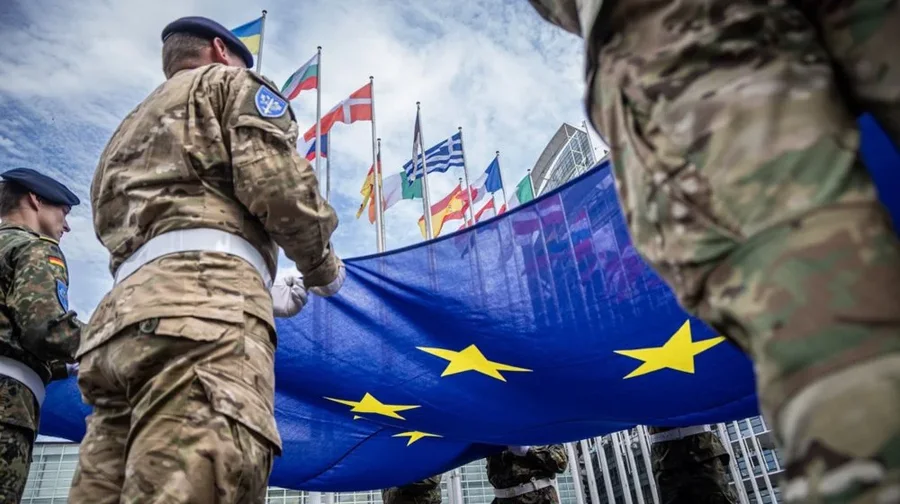
For years there has been talk of a "military Schengen", a zone within the European Union's passport-free zone where weapons and troops can move as freely as civilians...
The European Commission will tomorrow (November 19) present its proposal on "Military Mobility", a concept described as "Military Schengen". For years there has been talk of a "Military Schengen", an area within the European Union's passport-free zone where weapons and troops could move as freely as civilians.
The Kyiv Post newspaper writes that the European Union does this in the event of a conflict with Russia. However, such a system has not yet been implemented for either the EU or NATO, despite growing security concerns caused by the war in Ukraine.
The idea of a “military Schengen” was made a “priority area” in 2017 and the European Commission drew up action plans in 2018, 2022 and 2024, but little progress has been made. It remains to be seen how the EU’s latest attempt to achieve this by the end of the decade will go tomorrow.
The preliminary version of the document, to which RFE/RL had access, outlines two ways to achieve this: first, by investing money in hundreds of "blocking points" across the continent, such as railways, ports and bridges, including in EU candidate countries Ukraine and Moldova, which the text considers essential for integration into the EU's military-transport structures.
And second, cutting red tape to prevent different national laws and red tape from hindering efforts to move military assets quickly and easily from one EU country to another. Currently, many European bridges and tunnels cannot handle heavy tanks, and complicated paperwork can delay troop movements for days.
“Transporting tanks from the West to the eastern flank could lead to them being stuck in tunnels or waiting for transit permits,” said Dariusz Ionski, a member of the European Parliament’s Defense Committee, according to the Kyiv Post.
The European Commission's plan aims to remove such obstacles by strengthening bridges, expanding rail capacity and improving coordination between member states. Brussels also wants to digitalize customs logistics and create an "emergency framework" for emergency military transport.
Another proposal would create a "solidarity fleet", a group of specialized wagons and locomotives, available for rapid military use across Europe. In addition, the EU is expected to propose new security measures to protect critical transport routes from sabotage or cyberattacks.
In the EU's latest multi-annual budget (2021-2027), around 1.7 billion euros were earmarked for dual civil-military transport infrastructure, focusing on 95 projects in 21 countries, RSE recalls. However, as the document states: "the demand for EU funding has significantly exceeded the funds available."
For the next long-term budget (2028-2034), the European Commission has proposed €17.65 billion for dual-use transport infrastructure, focusing on 500 critical points where the transport of military equipment needs to be faster and more efficient.
The biggest changes the EU could make are to laws that would facilitate the movement of troops and equipment. Obtaining a permit for military transport from one EU country to another can take up to 45 days.
The target, set by Brussels, is three days. However, it is surprising that harmonised EU rules on the transport of dangerous goods do not apply to military transport, meaning that ad hoc arrangements often have to be agreed. This would change and the European Commission aims to push for even more.
Another proposal is that permits for the movement of military equipment between member states would no longer need to be renewed every year. They would simply be valid until revoked. Non-EU countries could also be part of this change.
Key to this would be the so-called "European Enhanced Military Mobility Response System (EMERS)", which could be launched within 48 hours of a proposal from the European Commission or an EU member state.
When activated, in the event of a potential military emergency, cross-border military transport will only require notification, with a shortened notice period for military movement. Most standard procedures can be bypassed, except for customs formalities.
The military readiness launch comes amid uncertainty over U.S. commitment to NATO's eastern flank. In Washington, President Donald Trump's administration nominee to head the Pentagon's office of strategy, Austin Dahmer, recently acknowledged under oath that Russia remains a threat to U.S. security.
Dahmer's admission came at a time when the Pentagon faces bipartisan anger over a series of murky decisions, from the silent suspension of aid to Ukraine to the withdrawal of a U.S. brigade from Romania, a move that shocked allies along NATO's eastern flank.
“ Every time Washington hesitates, Moscow tests the line ,” a European diplomat said, speaking anonymously to the Kyiv Post regarding sensitive domestic assessments. If the US backs down even slightly, he added, Russia immediately fills the void.
Romania, Poland and the Baltic states see the Pentagon's mixed signals as possible warning signs of diminishing American influence.
European officials stress that the plan will be developed in close cooperation with NATO in order to avoid duplication. Poland, in particular, insisted on ensuring that EU efforts remain consistent with NATO's logistical and defense planning./ Adapted from "Pamphlet" by "Danas"






Lini një Përgjigje