


 Shkruar nga Roger Myerson, Timothy Mylovanov & Konstantin Soni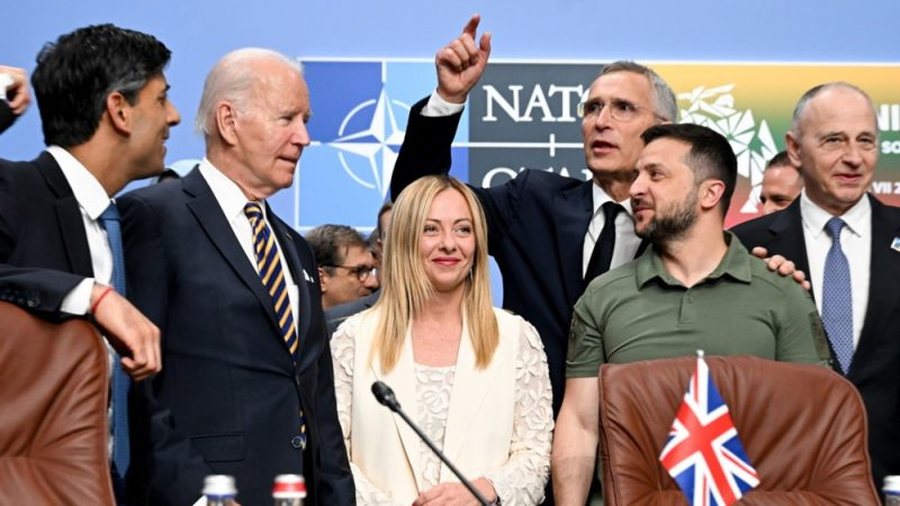
A negotiated peace in Ukraine can only be credible if it includes strong international commitments to ensure the country's long-term independence. The safest solution is the inclusion of NATO defense for Ukraine...
The last NATO summit last month ended with an unclear statement on whether Ukraine will ever be a member of the alliance. But while it is impossible to provide an exact date for Ukraine's accession, at a time when the country is at war, the event that should trigger it should be clear: The United States and its NATO allies must be ready to provide full protection to Ukraine as soon as possible in order to reach a peace agreement with Russia.
This would encourage the Ukrainian government to make the tough choices that are necessary to end the fighting. The first step toward charting a path to lasting peace in Ukraine is recognizing that Russia did not launch its full-scale invasion in 2022, only to annex part of Ukrainian territory.
Nor was the intent to prevent the fulfillment of vague promises of Ukraine's future NATO membership, although the Kremlin used them to convince the Russians and others that the invasion was crucial to preventing serious threats to Ukraine's security. Russia.
Rather, Russia's goal has always been to destroy Ukraine as an independent democratic country, which Russian President Vladimir Putin sees as an existential threat to his autocratic regime. NATO's lack of security guarantees for Ukraine fueled Vladimir Putin's illusion that the neighboring country could easily be defeated on the battlefield.
After more than two years of war, this illusion is gone. The official position of the Ukrainian government is that its forces will continue to fight until they liberate all the territory currently under Russian occupation. This attitude should not be seen as an obstacle to peace: if the opponent's goal is your complete destruction, then territorial concessions will not bring an end to the war; they will only weaken your position.
The real obstacle to any reasonable resolution of the conflict and guaranteeing peace is Putin, who remains committed to making a free and democratic Ukraine impossible to survive, and who has a long history of reneging on promises and breaking treaties. from the West side.
Since no political institution in Russia can force Putin to abide by the terms of a peace agreement, it is reasonable to assume that he would abandon it and re-occupy Ukraine at the earliest opportunity, unless the international community give him a very good reason not to.
A negotiated peace in Ukraine can only be credible if it includes strong international commitments to ensure the country's long-term independence. The surest solution is to include NATO's defense of Ukraine in any kind of peace agreement.
Ultimately, it is the threat of war with NATO that prevents Russia from invading the Baltic states. One possible path would start with the stabilization of the front line by the Ukrainian army, using weapons and Western aid. Once this condition is met, Ukraine can sit down with Russia at the negotiating table, with the mutual understanding that any deal will be backed by NATO guarantees.
NATO membership, for example, may include the condition that alliance protection covers only those parts of Ukraine controlled by the Ukrainian government at the time of joining the alliance. This approach would assure the Ukrainians that any territorial concession will not allow Russia to invade other territories of the country in the future.
This would not be the first time that NATO accepts into its fold countries with unresolved territorial disputes. But other approaches can be considered. For example, Ukraine could be offered some sort of de facto NATO membership, or negotiators could agree to limit NATO's normal military presence to parts of Ukraine, as happened in Norway during the Cold War.
A major multilateral commitment to the development of Ukraine's military would further strengthen deterrence against future Russian aggression. Of course, NATO can offer Ukraine membership even without Russia's involvement.
But including NATO's security guarantees in a peace agreement, rather than setting them out separately, would make it harder for Putin to convince Russians that they pose a threat to Russia's national security.
And to be clear, they are not. Because Russia's large nuclear arsenal guarantees its security very well. When the Russians realize that NATO's defense of Ukraine poses no threat to Russia, they will be less inclined to support preventive wars.
NATO's security guarantees for Ukraine - whether in the form of membership or some other agreement - would constitute a major commitment for the US and its allies, with great costs and risks. But these alternatives must be weighed against the prospect of prolonging a European war that has already resulted in great destruction and cost hundreds of thousands of lives, with regular threats of further escalation.
Ultimately, it will be up to Ukraine itself to decide how it will manage the difficult and costly trade-offs that any kind of peace negotiations will require. It is the Ukrainians who will be forced to fend off an unprovoked Russian invasion, and only they can decide what they are willing to sacrifice to liberate the occupied territories.
But on the other hand, it is up to the international community - and NATO in particular - to ensure that when Ukraine decides to negotiate, any peace agreement is credible and that the country's independence and long-term security are guaranteed. Like many observers of the war in Ukraine, we too would like to see Putin and his cronies brought to justice for launching an unprovoked war of aggression, killing civilians and terrorizing communities.
Also, we would like all the territories occupied by Russia to be returned to the control of Ukraine. But the most urgent priority should be ending the war and guaranteeing the future security of Ukrainians. And this can only be made possible by the guarantees given by NATO.
Note: Roger Myerson, Nobel Prize winner in economics and professor of Global Conflict Studies at the University of Chicago. Timothy Mylovanov, a former Minister of Economy and Agriculture of Ukraine, currently head of the Kyiv School of Economics.
Konstantin Sonin, former deputy rector of the Higher School of Economics in Moscow, currently a professor at the University of Chicago. / Adapted "Pamphlet" from "Project Syndicate"


Lini një Përgjigje