


 Shkruar nga Pamfleti
The chess game between Washington and Caracas could still be very long, with the lives of millions of Venezuelan citizens and thousands of people imprisoned without trial in the Latin American country's prisons at risk.
The United States carried out an attack on several facilities in Venezuela, including military bases in the country, on the night of Saturday, January 3. At the center of the strong tensions with Caracas was the fight against drug trafficking.
It was the Central Intelligence Agency (CIA) that attacked a port facility on the Venezuelan coast with a drone in early December, the first known US attack against a target within the borders of the Latin American country.
Donald Trump said on Monday that US forces had struck and destroyed a pier used by suspected drug traffickers, confirming what he had warned in an interview on December 26: “It’s a big structure where ships leave from... the area of the pier where drugs are loaded... That’s where the staging area is, and now there’s nothing left.”
CNN has revealed that the CIA carried out this operation.
In early 2025, Trump authorized the CIA to conduct operations in Latin America, but until then the United States had officially limited itself to naval attacks against suspected drug traffickers, destroying over 30 ships in the Caribbean and the Eastern Pacific Ocean since September, and killing around eighty people in the attacks (the last two last night).
The drone attack on Venezuelan territory reportedly destroyed a pier and several anchored ships, without causing any casualties.
According to an anonymous source quoted by CNN, it was largely a symbolic attack, "because it is one of many port structures used by traffickers departing from Venezuela."
According to the US government, these piers are used by the Venezuelan gang Tren de Aragua to store drugs and transfer them to ships for onward shipment to the US or Europe.
The history of US interventions in Latin America
The CIA and American intelligence services in general have a long history of interventions, more or less covert, in Latin America.
Over the past two centuries, the United States has occasionally conducted military operations in this subcontinent, which it has long considered its "backyard."
Since the late 19th century, when Washington launched the Banana Wars, a series of military interventions in Central America to protect the interests of American companies operating in the region.
The starting point was the "Monroe Doctrine" , named after then-President James Monroe, who in 1823 first declared that "America is for the Americans", warning European powers to avoid interference in his sphere of influence.
In 1904, with the “Roosevelt Corral,” named after President Theodore, the White House demanded the “right to intervene” in the internal affairs of Latin American countries. “Teddy” Roosevelt was a key figure in the Spanish-American War (1898) in Cuba: he led the “Rough Riders” volunteers to Santiago, achieving a decisive victory at San Juan Hill, which led to the American occupation of the island, the fall of the Spanish colonial empire, and the rise of the United States as a world power.
Intervention ceased under the presidency of Franklin D. Roosevelt, who in 1934 introduced the "Good Neighbor Policy," committing not to invade or interfere in the internal affairs of Latin American countries.
But this "truce" was violated during the Cold War, when to prevent the expansion of Soviet influence, Washington funded many operations, mainly coordinated by the CIA, founded in 1947, to overthrow elected leftist leaders in the region.
Under the presidency of Dwight Eisenhower, in 1954 the CIA supported the coup against the elected president of Guatemala, Jacobo Arbenz Guzmán, and five years later devised a plan to train immigrants to invade Cuba to overthrow Fidel Castro, who had just won the civil war against dictator Fulgencio Batista.
The challenge to the "leader maximo" continued under the presidency of Democrat John F. Kennedy, who in 1961 ordered the failed Bay of Pigs Invasion of Cuba.
In the sixties, the CIA financed anti-communist groups that in Brazil, in 1964, led to the coup against President João Goulart and the establishment of a pro-American military dictatorship that lasted until 1985, and in Ecuador to the 1963 coup against the pro-Soviet Carlos Julio Arosemena and the banning of the Communist Party.
Similar operations took place in Bolivia, on two different occasions: the 1964 coup d'état by General René Barrientos Ortuno against elected president Victor Paz Estenssoro and then in 1971 with the support of officer Hugo Banzer, who overthrew president Juan José Torres, accused of nationalizing several American companies.
In the 1970s, with the infamous Operation Condor, the CIA immortalized its reputation by supporting brutal and murderous regimes. In Chile, it financed the coup forces that overthrew in 1973 the leftist president Salvador Allende, who wanted to nationalize the country's copper companies, most of which were owned by the United States. General Augusto Pinochet remained in power for 17 years.
In 1975, under the presidency of Gerald Ford, the CIA openly supported right-wing military dictatorships in six Latin American countries, Chile, Argentina, Bolivia, Brazil, Uruguay and Paraguay, through a transnational network called Operation Condor. The aim was to suppress, through “disappearances”, torture and death, political dissidents, left-wing representatives and communist sympathizers.
Dictatorships used a shared database to monitor their movements in a brutal manhunt for men (or women). Among the victims were many minors and pregnant women, whose newborns were taken away, especially in Argentina.
US and CIA interference in internal affairs south of its borders continued throughout the 1980s and well into the 1990s, particularly in Central America. For example, during the Salvadoran civil war (1980-1992), in December 1981, the elite Atlacatl Battalion of the Salvadoran army, trained and equipped by the US, carried out a massacre in the village of El Mozote, killing about a thousand civilians, including women and children.
In 1983, the US decided to invade the small Caribbean island of Grenada, with Operation Urgent Fury, which overthrew Marxist-Leninist Prime Minister Maurice Bishop. Six years later, under the presidency of Republican George HW Bush, Operation Just Cause took place: the invasion of Panama and the capture of dictator Manuel Noriega, a former US ally now accused of drug trafficking.
The case of Venezuela
Maduro like Noriega? Venezuela is not Panama and a ground invasion does not seem a practical option even for US forces.
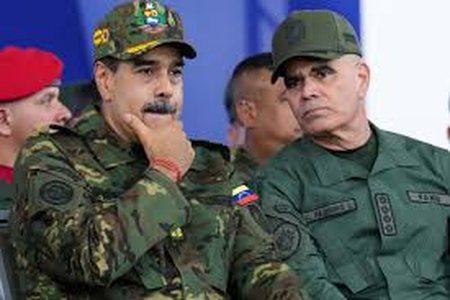
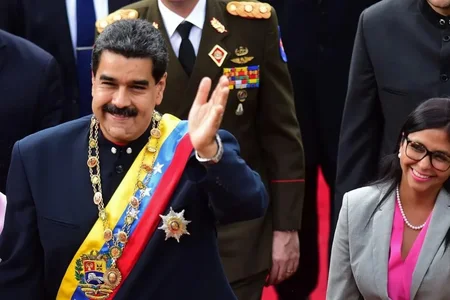
Thirty years ago, 30,000 soldiers were needed, but in the large Latin American country, ten times more would not be enough. Trump's strategy, according to analysts, is more aimed at pressuring Nicolás Maduro into voluntary surrender and a "protected departure" to a friendly country like Russia, China, Cuba or an African state, to avoid ending up in shackles like Noriega. But for now, the Venezuelan leader is resisting the siege.
Maduro does not give up, and even accelerates the process towards collectivization and the "armed phase of the revolution", inspired by the Maoist concept of "protracted people's war" in the event of an attack on the country.
The Chavist caudillo has ordered the "distribution of weapons" and the "preparation of national defense" even in factories and workplaces, inciting a wave of popular mobilization throughout the national territory to quickly create the Integral Committees of the Bolivarian Base: bodies with a political, paramilitary and social supervisory function, aimed at organizing a vast espionage network among citizens.
The chess game between Washington and Caracas could still be very long, with the lives of millions of Venezuelan citizens and thousands of people imprisoned without trial in the Latin American country's prisons at risk. / Taken from "Corriere della Sera"


Lini një Përgjigje