


 Shkruar nga Pamfleti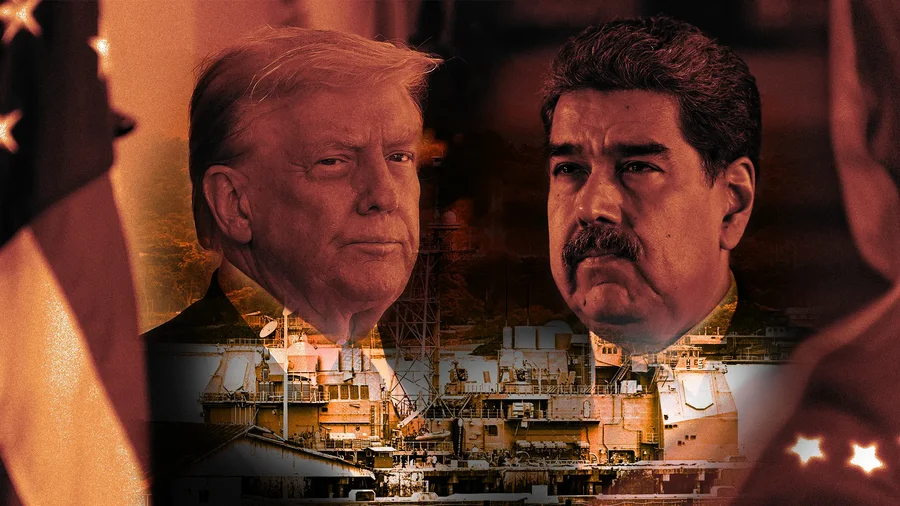
War rhetoric, US troops in the Caribbean and a Maduro calling for resistance. But is this really the start of a war, or just a war of nerves?
With US warships carrying cruise missiles and thousands of marines positioned near Venezuelan territorial waters, tensions between Caracas and Washington have reached one of the most dangerous peaks in the last decade.
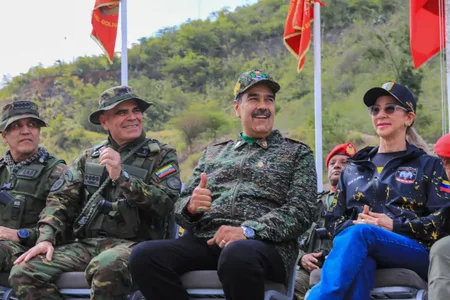
President Nicolás Maduro, in a defiant tone and with strong patriotic rhetoric, called on the people to rise up and join the Bolivarian militias to confront what he calls an "imperialist plot for an invasion."
On the other side of the diplomatic border, Donald Trump's hardliners in the US have made no secret of their goal of overthrowing Maduro. Provocative tweets, direct threats and glee over the military presence off Venezuela's coast all form a narrative that has revived fears of a Baghdad-style intervention, similar to the US invasion of Panama in 1989.
However, analysts remain skeptical. Latin American experts and veteran diplomats say this is more of a strategic spectacle than a real preparation for invasion. They point out that the current force deployed by the US, about 4,500 troops, is numerically insufficient to overthrow a regime that controls a complex territory, with mountains, jungles and dense cities.
Former US diplomats suggest that this show of force may be aimed at inciting internal fractures in Maduro's inner circle, perhaps a mass military defection, rather than an immediate offensive. So far, there is no evidence that the US is making sufficient preparations for a major ground operation. According to estimates, the only possible intervention would be a precision strike on specific targets, such as the Fuerte Tiuna military base, where Maduro himself is suspected of being sheltered.
But even that seems more like a theoretical option than a real one. According to Thomas Shannon, one of the most experienced US diplomats for Latin America, the harsh rhetoric towards Venezuela comes more as a result of internal political pressure on the Trump administration to please the Republican base than a concrete plan for intervention.
Despite this, there is a secret directive signed by Trump authorizing the use of force against organizations declared narco-terrorists, a category that includes the Cartel of the Suns in Venezuela, which the US says is led by Maduro himself. The US has put a $50 million reward for his capture, an amount that doubles the figures once announced for Osama bin Laden.
Meanwhile, on the streets of Caracas, the situation remains tense but calm on the surface. The population, tired of a deep economic crisis and chronic insecurity, follows developments with caution, but also with distrust. Some citizens still hope for a democratic solution and the avoidance of an armed conflict that could lead to total collapse.
Ultimately, despite the rhetoric from both sides, it seems that neither the US nor Trump himself is really ready to undertake a full-scale invasion of Venezuela. The risk exists – especially if an unexpected incident occurs, but for now, it all looks more like a battle of nerves than a straightforward plan for intervention. /Adapted from “The Guardian”


Lini një Përgjigje