


 Shkruar nga Pamfleti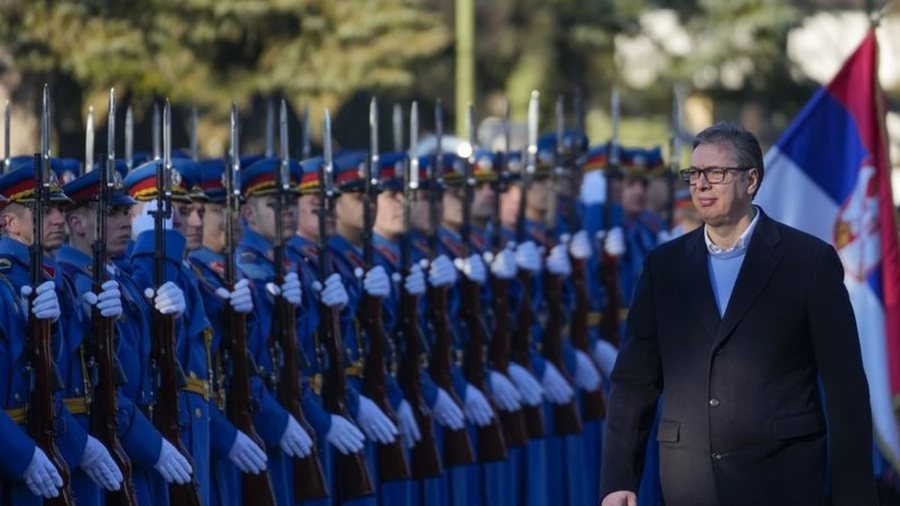
Serbia is considering bringing back conscription, its president said on Tuesday, citing tensions in the Balkans and elsewhere in Europe.
President Aleksandar Vucic said senior army commanders gave him "strong arguments" in favor of reinstating conscription, which was suspended in 2011 in an effort to professionalize the armed forces.
The Serbian populist president did not specify when that might happen, but stressed that the parliament, which is dominated by his allies, will vote on the proposal, which follows a long campaign by nationalists in its favor.
"We are not threatening anyone," said President Vucic as he inspected an exhibition of military equipment after meeting with army commanders. "Today, if you don't have a strong army, you don't have a state," he said.
"We will see if the military service will last 90 or 100 days, or maybe 110 days," President Vučić told reporters.
Opposition politicians and other critics of the military service have questioned the logic of such an action when Serbia is almost entirely surrounded by NATO member states that have superior power in the event of conflict. There are also concerns that the government may struggle to foot the bill for a larger army.
Tensions have been high in the Balkan region, which saw the bloody breakup of the former Yugoslavia in the 1990s. Although officially neutral, the Serbian military has maintained close ties to Russia, from which it buys most of its weapons, including fighter jets and tanks.
The Serbian president said on Tuesday that Belgrade will next month introduce a Russian drone defense system called Repellent, which it bought from Russia some time ago.
Although officially seeking membership in the European Union, Serbia has refused to impose sanctions against Russia because of its aggression in Ukraine.
Tensions are high with Kosovo, which declared independence in 2008, which Serbia and its allies Russia and China have not recognized. Serbia has raised the combat readiness of its forces on the border with Kosovo several times during the last few months.
Serbia has also maintained cordial relations with NATO, whose peacekeeping troops have been stationed in Kosovo since 1999, when the Western military alliance intervened to end a bloody crackdown on Albanians by Serbian forces.
Another volatile region is Bosnia, where Republika Srpska leader Milorad Dodik has threatened to declare his entity's independence and merge it with neighboring Serbia. Milorad Dodik accompanied President Vucic to the meeting with the army commanders on Tuesday.



Lini një Përgjigje