


 Shkruar nga Andrea Malaguti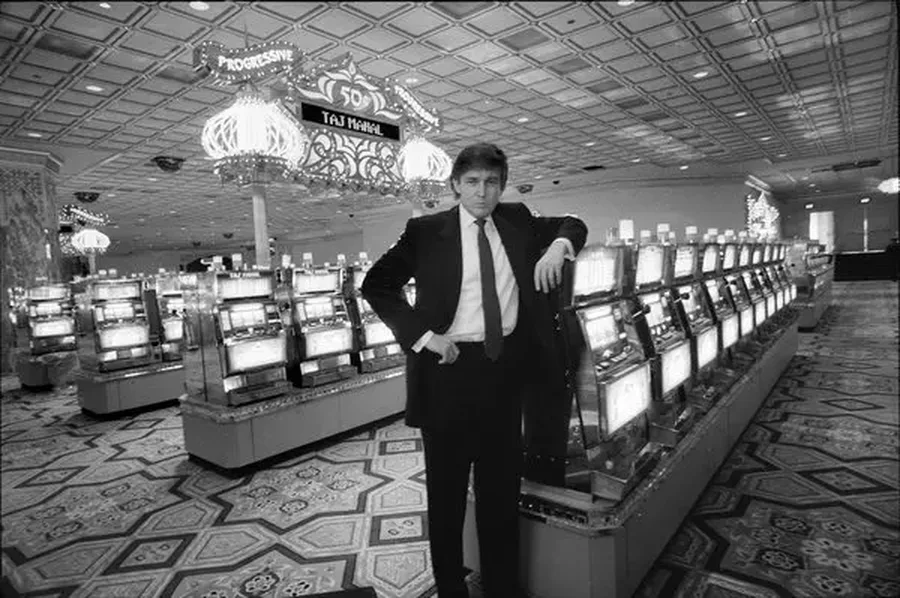
It's Donald Trump's big casino...
The global right, led by the speculative President Donald Trump, who amasses hundreds of millions of dollars while markets tumble and the dollar depreciates, has understood something that progressives, fixated on the rearview mirror, miss. The real power, the one that changes people's lives and enables the accumulation of large capitals, is no longer in the hands of politics, but of technology. Even digital money, such as bitcoin and cryptocurrencies, can replace gold.
The value of currencies, their ability to multiply, to pay our salaries, vacations or pensions, will no longer depend on gold reserves in banks, but on algorithms that simulate a direct link between paper currency and gold stored in vaults. This is thanks, or rather because of, Charles de Gaulle, who in the mid-1960s said: "The international monetary system is malfunctioning because the US can afford inflation without paying for it ."
He demanded that France's loans be repaid in gold, not dollars. Worried and without the necessary gold, in 1972, Richard Nixon cut off the right to exchange the dollar for gold, turning the currency into a fiat currency, the value of which is based on trust in the issuing state. Fifty years after this break and the Bretton Woods agreement, the explosion of artificial intelligence has brought about a final upheaval and raises two key questions. The first: Can the management of the new technological world be left to private interests, the law of the strongest, as is happening in the US? Or should it be run by the public, in respect of a social pact that protects increasingly fragile collective interests? The second: The European Union will not survive without a digital currency, which does not please nationalists and worries banks, especially French ones, who fear that they will lose part of the savings intended for citizens.
The future scares you: it either overtakes you or wipes you out. If the Japanese are right when they say that "a breeze is enough to blow a crane off course," then with Atlantic storms, the cranes will fly to another galaxy.
What impressed me this week?
In Greece, former Prime Minister Giorgios Papandreou hosted the annual meeting of European progressives, to which Gabriele Segre was also invited. "I have never seen such a high level of confusion on the left ," he said.
Politicians, academics and commentators are shocked by the rapid turn that history has taken, of which Donald Trump is a consequence, not a cause. Essentially, the great powers are concentrated in a small number of oligarchs, from Russia to Washington and Beijing. The conflict of interests between politics and business has never been so close, risking tearing apart the social fabric and reshaping the values and power relations in the West. Solutions to this slide? " None, for now ," says Papandreou.
Beyond a general call for faith in democracy, when democracy is reduced to faith, it means your back is against the wall. Control is no longer in the hands of governments. The winning logic is that of social networks, where uncontrolled participation turns intelligence into noise, giving Big Tech a dominance that no one can challenge. Power requires coercive capacity, which politics no longer has. This is what the progressive camp should have been discussing with insistence.
Meanwhile, as Fabrizio Goria writes in La Stampa, Washington intends to abandon the public digital dollar, relying on private Stablecoins, while American monetary policy favors the private, lining the pockets of important figures. Brussels, weak, is trying to find solutions that could be implemented within two years and that are already ready in the drawers of the European Central Bank, along with strategies for consumer protection.
In the days when Trump approved the wild deregulation of cryptocurrencies in the House of Representatives with the Genius Act (a name prone to caricatured exaggeration), rereading Fabio Panetta's recent speeches helps to understand the magnitude of the challenge and the risk.
Why are Stablecoins and cryptocurrencies, introduced into official payment systems, a problem? Currency is issued by the state and should be safe, without risks. Unlike stocks or government bonds, currency cannot change value. Removing this uniqueness would complicate exchanges and shake up markets.
The transition to digital is inevitable. Paper currency is becoming increasingly rare. This must be accepted in order not to be overcome by reality. No cryptocurrency, not even Stablecoins (linked to government securities and usable as a credit card or transfer), has a guaranteed nominal value.
In the 19th century, the Free Banking system in the US allowed banks in Dallas to issue their own dollars, which, when they arrived in Buffalo, had a different value. This is why central banks were created, to guarantee the stability of the currency and the markets. Now we are going backwards, towards the end of financial intermediation. Whoever is more capable, wins; whoever is weaker, loses money and the future.
Without an immediate overhaul of these increasingly necessary digital tools, we could all lose, except for Trump, his supporters, and organized crime, which, thanks to cryptocurrencies, has an unprecedented ability to launder money anonymously.
We are heading towards disorder, a quagmire of instability where security is replaced by gambling and the deceptive promises of the most powerful private individual. It is the great casino of Donald Trump, a man who, after high tariffs, the Russia-Ukraine war and plans for mass deportations, now seeks to deal the final blow to monetary security. For him, an 80-year-old billionaire looking for a spectacular and reckless exit, this is a bet where he only wins. The question is, are we? / Adapted from "Pamphlet" by "La Stampa"






Lini një Përgjigje