


 Shkruar nga Pamfleti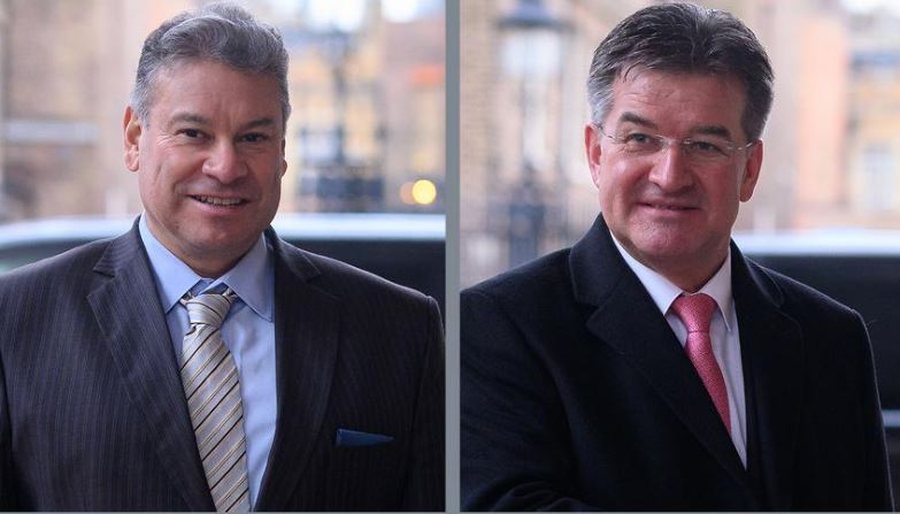
The two Western emissaries for the Kosovo-Serbia dialogue, the American and European envoy for the Western Balkans, Gabriel Escobar and Miroslav Lajçak, are on Monday in Belgrade and Tuesday in Pristina, in an effort to influence the parties to reduce tensions in the north of Kosovo. .
More than a week ago, in this part inhabited by a majority of Serbs, there were riots after the protests of the Serbs, where many KFOR soldiers were also injured.
EU warns of consequences
The European Union but also the United States of America asked Kosovo to remove the special police units from the municipal buildings from the north, and the new Albanian mayors of the four municipalities, North Mitrovica, Zveçan, Leposaviq and Zubn Potok, to move to the offices of other alternatives. The organization of new elections in the north as soon as possible was also requested, with the hope of the participation of Serbs in the elections. Meanwhile, Serbia is required to withdraw the Serbian military forces stationed near the border with Kosovo and reduce the state of readiness, maintain the peace of the protesters in the north and ensure the participation of Kosovo Serbs in new elections. If Kosovo and Serbia do not take these actions, then the European Union warned of negative consequences for both countries.
The European Union, and the head of European diplomacy, Josep Borrell, condemned in the strongest way the violent acts in the north against citizens, KFOR troops, law enforcement and the media. In an EU statement, it is said that "we call on Kosovo and Serbia to immediately and unconditionally take measures to de-escalate, stop using divisive rhetoric and refrain from any further uncoordinated actions. Calm must to be restored urgently".
The EU expects Kosovo to act in a non-escalating manner and to immediately suspend police operations in the vicinity of municipal buildings in the north of Kosovo. The EU statement states that, "municipal mayors should temporarily perform their duties in facilities other than municipal buildings. Early elections should be announced as soon as possible in all four municipalities and organized in a fully comprehensive manner We expect Kosovo Serbs to participate in these elections".
Serbian forces demonstrate readiness in the "Granite 2023" exercise Photo: Milos Miskov/AA/picture alliance
For Serbia, the EU expresses "concern about the state of higher readiness of the Serbian Armed Forces". "The European Union expects that Kosovo and Serbia act responsibly and engage immediately in the EU-mediated Dialogue to find a sustainable solution to the situation in northern Kosovo that guarantees safety, security and participatory democracy for all citizens and paves the way for the implementation of the Road Agreement towards its Normalization and Annex. This includes the start without any delay or further preconditions of the work for the establishment of the Community of Municipalities with a Serbian Majority", says the EU statement.
OSCE commitment to new elections
For the new elections in the north, direct involvement of the OSCE is expected. Presenting a nine-point EU plan for the north, the head of the Organization for Security and Cooperation in Europe, Bujar Osmani, said that Kosovo and Serbia must implement the Ohrid agreement, as the only way to ensure the extension to the north and normalization. of Kosovo-Serbia relations. The EU's guide to the north states that "elected mayors of municipalities in the north should step down in the summer to make way for new elections to be held by the end of the year". The OSCE will support the process. election, the destruction of trust between communities, said Bujar Osmani.
Turkey responds to NATO's request
Tensions and unrest in northern Kosovo were fueled after local elections on April 23, which were organized by official Pristina but massively boycotted by Belgrade-backed Serbian parties. With a very low turnout in the elections of only 3.6%, four Albanian mayors of northern municipalities inhabited by Serbian majority were elected. These leaders are not accepted by the local Serbs and during the Serb protests and attempts to enter the municipal facilities, they injured 30 members of KFOR. After that, NATO decided to send 700 additional troops, if needed even more, to keep the situation under control and guarantee peace. This number of KFOR soldiers, according to the Turkish Ministry of Defense, is joined by Turkish commando troops, in response to NATO's request.


Lini një Përgjigje