


 Shkruar nga Pamfleti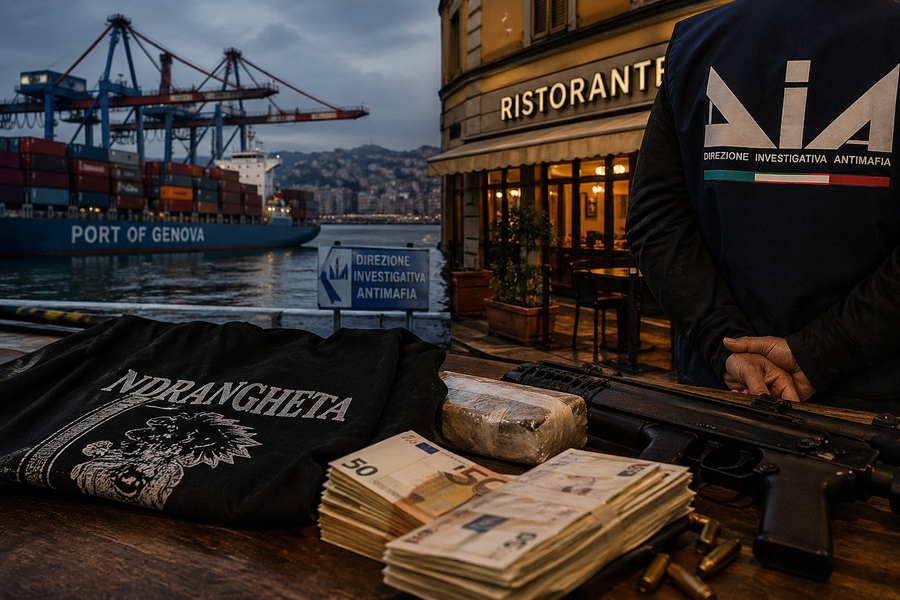
Italian Antimafia report reveals organized structure, investments in restaurants and role in drug trafficking, with growing involvement of Albanian groups
The mafia organization "Ndrangheta" continues to remain the most structured and entrenched criminal force in the Italian region of Liguria, while it is evolving towards more clandestine forms of operation, becoming increasingly integrated into the legal economy. This emerges from the annual report of the Antimafia Commission, approved by the Regional Council, as well as from hearings with prosecutors and investigators.
According to the report, in the province of Savona, criminal dominance is exercised mainly by families of Calabrian origin, especially from the Reggio area, involved in tender manipulation and forms of intimidation. However, this dominance is gradually being challenged by other criminal structures.
At the regional level, the 'Ndrangheta operates through a well-defined territorial organization. A "macrozone" called Liguria coordinates the activities of local units ("locali") spread across the East and West. According to investigations, the Genoa structure serves as a "control room", directly linking the criminal centers in Calabria with the local branches. Meanwhile, the Ventimiglia unit functions as a "passage room", guaranteeing operational continuity with the networks in France, particularly on the Côte d'Azur.
The "silent" mafia and the legal economy
The report highlights that the 'Ndrangheta and other criminal groups are increasingly operating discreetly, transforming into what is defined as the “silent mafia.” This strategy is based on concealing illegal activities and expanding the entrepreneurial role, especially through money laundering.
The main risk is related to the acquisition of financially distressed businesses, which are used to recycle illicit capital. In this context, the restaurant sector is considered particularly exposed.
Rome's Anti-Mafia Prosecutor, Maria Cristina Palaia, stated during a parliamentary hearing that "the restaurant sector is among the most exposed to the reinvestment of money of illegal origin," adding that financial flows in this area are often difficult to trace.
Investigations by the Antimafia Directorate in Rome into the so-called "Senese group" have identified investments in restaurants, where funds linked to criminal organizations, including structures linked to the 'Ndrangheta and the Camorra, are suspected of being used.
Ports and international drug trafficking
Liguria is considered a strategic hub for international drug trafficking. The ports of Genoa, La Spezia, Savona and Vado Ligure are identified as key entry points, especially for cocaine from Latin America. The region represents over 18% of port seizures at national level, the highest figure in northern Italy.
Criminal organizations use sophisticated techniques to evade controls, including the "rip-off" method (removing drugs from containers with the help of corrupt port employees), the use of divers for hidden cargo on ships, and the "drop-off" technique, where drugs are left at sea and recovered via satellite devices.
The role of Albanian groups
The report highlights a significant shift in the balance of organized crime: the cooperation between the 'Ndrangheta and Albanian criminality has become more equal. If previously Albanian groups were used mainly as an operational force, they have now specialized in logistics, managing key stages such as the transport, storage and distribution of drugs.
This development indicates an increase in the autonomy and capacities of Albanian groups in the international drug trafficking chain.
Impact on institutions and the economy
According to the report and statements by Andrea Orlando, former Minister of Justice and currently head of the Anti-Mafia Commission in Liguria, the danger lies not only in direct infiltration, but in more sophisticated forms of influence.
“ The 'Ndrangheta remains the most structured organization, but it is evolving towards a less visible and more penetrating form, capable of entering economic sectors, logistics and struggling enterprises ,” Orlando declared.
He warned that ports and public investments, including National Recovery Plan (NRP) funds, constitute high-risk areas for abuses, from financial fraud to corruption and tender manipulation.
New strategies and challenges in the fight against the mafia
Investigations are increasingly focusing on so-called “signal crimes”, such as fiscal fraud, fictitious invoices and the illicit benefit of public funds. In parallel, authorities are using preventive instruments such as “white lists”, site inspections and legality protocols to monitor economic activities.
Another challenge remains the management of confiscated assets. In Liguria, there are hundreds of properties and businesses seized by the mafia, but the lack of funding and institutional support risks their return to illegal circulation.
The report concludes that the main challenge is not only to crack down on the mafia, but also to prevent its integration into the economy and public institutions. In this context, the role of transparency, control and inter-institutional cooperation remains crucial. / Pamphlet



Lini një Përgjigje