


 Shkruar nga Pamfleti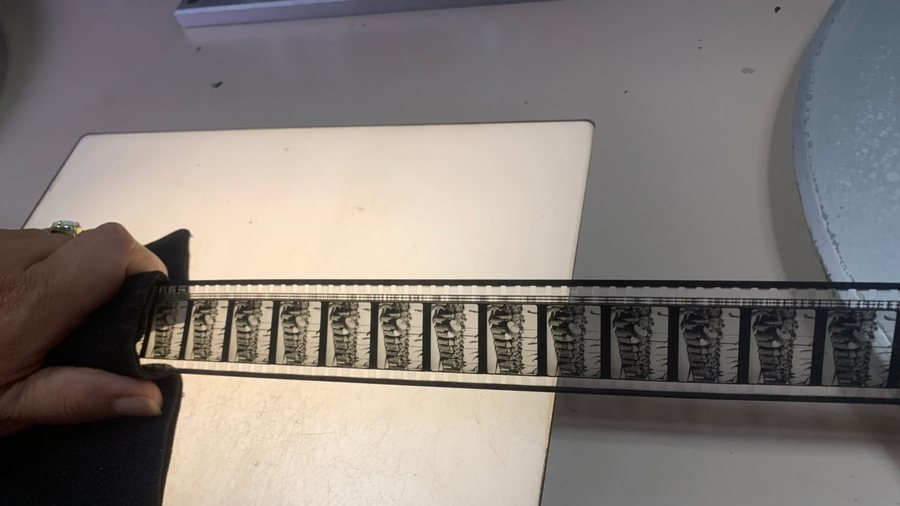
Every day at the Central State Film Archive in Albania, tapes are cleaned to restore films that are in danger of being destroyed.
This process started 12 years ago and required collaboration with cinematographic studios in several countries around the world, as far as India.
As the restoration continues, the debate continues whether or not films from the communist period should be shown.
For those who work every day with the film, the stock is an asset that must be preserved in its originality.
The restoration of the film fund in Albania started in 2012. This process was considered important not only because of the development of technology, so that Albanian films became accessible in digital format, but also because of the fact that some of them were at risk of being damaged and to no longer exist.
Eriona Vyshka, editor at the Central State Film Archive in Albania, tells Radio Free Europe that, so far, 20 films have been restored.
"In the Archive we have 6,600 film titles, not only Albanian, but also foreign - half produced by the former Kinostudio, half are foreign films that circulated until the fall of the communist regime in our country. If we translate them into film acts, there are 45,000, which are kept in six storage locations. So far, 20 films have been restored", says Vyshka.
The process, according to her, is quite important, not only to have the film stored digitally, but also to show it in good picture and sound quality.
Vyshka clarifies that the selection of films to be restored is based on certain criteria or requirements. The first film that was restored was "November the Second".
"It was decided to be the first to be restored, because we wanted it to appear on the 100th anniversary of Albania's independence [November, 2012]. "We collaborated with an American company and the film was sent to Virginia, to the 'Colorlab' laboratory," says Vyshka.
The restoration of the film "Poppies on the Wall" was decided due to the fact that it would be shown in international activities, according to her.
"It was a film that spoke to an international audience. We were able to show it in Lyon, France at an archival film festival. Then it was also included in a quarterly program of ARTE, Franco-German television, which has an important section on classic European films. It is still showing and will continue until the end of September", says Vyshka.
She points out that this film is subtitled in six foreign languages - Italian, English, German, French, Polish and Czech - this is done by the Archive.
"Although a small and isolated country, I think we had a big enterprise dedicated to cinematography. European and global audiences want to discover this cinematography", says Vyshka, as she talks about the importance of promoting Albanian cinematography in the world.
The Archives specialist explains that the first step in restoring a film is to clean the tape from dust or any other residue that it may have received, due to the long period since its production.
Then, the restoration goes into two stages. The first is to convert this film strip into a high-resolution digital file. Until now, this process has been carried out outside Albania, in countries with which cooperation contracts have been concluded.
"Several months ago, we provided the Archive with our own scanner, a device that enables the transfer of film tape to digital files with a very high resolution. If earlier we were obliged to send the film strip physically to the country where this process was to be carried out, now we carry out this first stage of restoration here", says Vyshka.
The second stage of restoration, according to her, is carried out in the state where agreements have been made with specialized companies for the process.
The work at this stage includes the repair of images that have begun to be damaged, or show marks or stains, and the reinforcement of colors, but always preserving every element of the originality of the work.
Then, with the return of the restored material, the work is passed to the editors, to connect all the parts into a whole and profit the restored film.
Subtitling in any language, however, is another job of the Film Archive, depending on the event where the restored film will be shown.
The film that has just been restored is "Captain" - produced in 1972.
The premiere will be on September 24 within the framework of the International Film Festival in Tirana.
Also in the process of restoration is the film "The Return of the Dead Army" directed by Dhimitër Anagnosti, based on the novel "General of the Dead Army" by the writer Ismail Kadare.
"We have two more films in the plan, 'Freedom and Death' and 'Death to Death'. Preliminary contracts are being made for their restoration", says Vyshka.
"'Liberty or Death' has problems with colors, because at the time of production, at the end of the 70s, there was a lack of film solution, where color films were washed and stamped. This problem has caused the colors to fade after the first year of production. Now we have the opportunity to bring these colors back", says the Archive specialist.
She shows that the films "The Teacher" and "Concert in the year '36", which had problems and were part of the endangered fund, have already been restored.
The films "Face to face", "Girls with red ribbons" and "In our house", in which problems with colors have appeared, need to be urgently restored.
However, problems have not only appeared in films made many years ago, but also in those from the 90s. Such is, for example, the movie "Bolero".
"It was realized in 1992, but the Kinostudio laboratory was almost giving up its soul. It had to be renovated with machines of the time, which were missing", says Vyshka.
“Për shkak të kushteve të ruajtjes, filmat kanë bartur pasojat e asaj kohe, kështu që janë në prioritetet tona për t’u restauruar”, thekson ajo.
Bashkëpunimi i parë për restaurimin e një filmi ka qenë ai për “Nëntorin e dytë” me një studio në Shtetet e Bashkuara të Amerikës. Më pas është bashkëpunuar me disa shtete në Evropë, si Itali apo Zvicër, por bashkëpunime ka pasur edhe me Indinë.
“Në Indi kemi restauruar filmat ‘Koncert në vitin '36’ dhe ‘Mësonjëtorja’. Duke qenë një vend i largët dhe jo shumë i sigurt, negativin e kemi skanuar në Evropë dhe kemi dërguar në Indi hard-disqet”, thotë specialistja e Arkivit.
Vyshka thotë se trashëgimia që ka lënë ish-Kinostudioja, është një pasuri e rrallë që duhet vlerësuar.
Për të, debati i hapur nga politika në lidhje me shfaqjen apo jo të filmave të periudhës komuniste, që bartin edhe propagandën e asaj kohe, është i pavend.
“Unë mendoj se jemi me fat që e kemi ‘kinemanë e propagandës’ që na ka lënë ish-Kinostudioja, sepse duke e studiuar, arrijmë të kuptojmë të kaluarën, mentalitetin, çfarë vendimesh janë marrë, si janë bërë veprat artistike... Arrijmë të zbulojmë makinerinë e propagandës, mësojmë nga e kaluara, është burim studimi”, thotë Vyshka.
“Në Arkiv nuk kemi vetëm filmat, por gjithçka që lidhet me procesin e krijimit të tyre - që nga para-produksioni, materialet e shkruara, mbledhjet që janë zhvilluar, fotografi, dokumente, procesverbale nga ato që njiheshin si këshillat artistikë, nga shesh-xhirimet, si dhe nga post-produksioni. Posterët janë një koleksion shumë i bukur grafik, flasin për punën e krijuesve - një punë që nuk mund të hidhet poshtë apo të harrohet”, thotë redaktorja e Arkivit.
Ajo sqaron se çdo film i restauruar shfaqet me paralajmërimin që shpjegon se si kanë qenë kushtet politike-ekonomike në atë kohë.
“Filmi tani shihet me botëkuptimin e vitit 2024. Ajo është një propagandë që sot nuk ndikon më askënd”, thotë Vyshka.
Studiues të huaj kanë shprehur interes viteve të fundit për të studiuar kinematografinë e Evropës Juglindore, thotë redaktorja e Arkivit, duke shtuar se Shqipëria zë një vend të rëndësishëm, sepse ka qenë si pikë e errët e pazbuluar.
“Ka studiues që kanë mësuar edhe gjuhën shqipe, për të mësuar mbi kinematografinë tonë, sepse edhe studimet e librat janë të paktë, dhe ata që janë, janë shkruar shqip. Kohëve të fundit kemi studiues të rinj, si Julian Bejko e Fabio Bego, që shkruajnë edhe në anglisht dhe kanë bërë disa botime rreth kinematografisë shqiptare”, thotë Vyshka.
Ajo tregon se Bruce Willims, nga Universiteti i Pensilvanisë, ka botuar disa studime për kinematografinë shqiptare në kohën e komunizmit.
“Ka bashkëpunuar me ne [Arkivin] për informacione të ndryshme që i janë nevojitur për studimet e tij. Madje, edhe ka financuar titrimin e filmave, me qëllim që më pas të marrë kopje të tyre dhe t’i studiojë. Aktualisht, është duke përgatitur një tjetër studim”, thotë Vyshka.
In the Central State Film Archive, in the area named Kinostudio in Tirana, there is a real wealth related to the Albanian film industry.
The Archive stores over 6,600 films, half of which are Albanian productions.
But, apart from them, the Archive has everything related to their realization.
As the restoration of the films continues, the photo library has been digitized - the scripts and any written material are now being digitised.
"We have a fund with photographs, even the negatives that show filming in the field, in the cinema studio, the employees, the machines... Each film has its own file with written materials, before and after production, and the promotional part", says Vyshka.
She adds that, soon, there will be a museum for the history of Albanian cinematography.
Such an initiative was promoted in 2021 by the Ministry of Culture of Albania, but has not yet been implemented.
The Film Archive is located in the former "New Albania" building, which was inaugurated on July 10, 1952, together with the film studio complex, Kinostudio.
The first film produced was "Skënderbeu", in cooperation with the Soviet Union, while the film "Tana" in 1958 bears the seal of Albanian production.
In the 80s, the "New Albania" Kinostudio managed to produce 14 films a year. After the fall of communism, it was called "Albafilm" and continued to function until 1996 and then it was called the National Center of Cinematography.
Since 2015, this building houses the Ministry of Culture of Albania, the Albanian National Center of Cinematography, the Central State Film Archive, the Institute of Cultural Monuments, etc./ REL





Lini një Përgjigje