


 Shkruar nga Pamfleti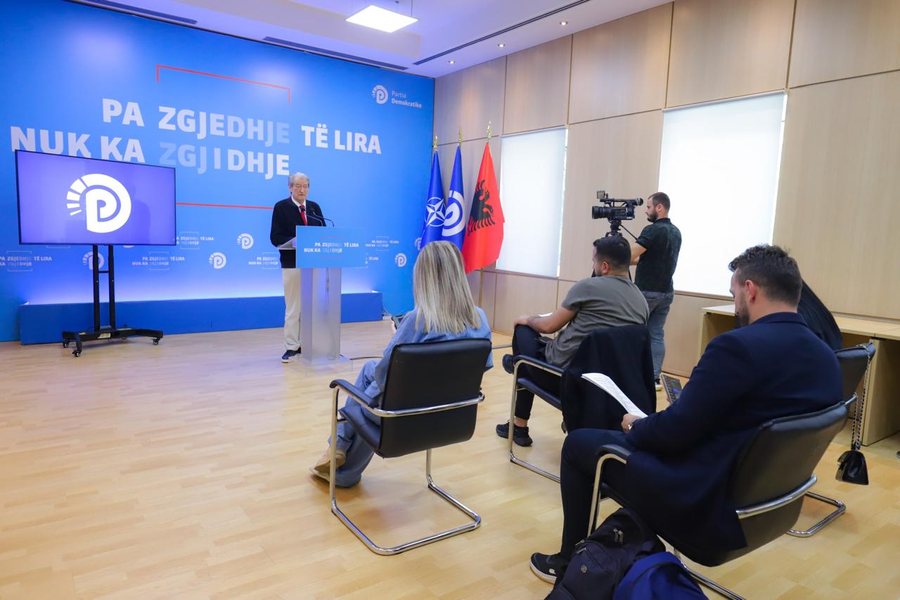
Sali Berisha, leader of the Democratic Party, presented today during a media conference a recent resolution approved by the IDC-CDI grouping, which includes 108 parties from all continents, through which the Democrats' position is supported not to recognize the May 11 elections, while a technical government and a repetition of the process are requested.
Berisha said that the electoral farce of May 11, 2025 in Albania received a major international punishment from the world's largest political organization of center and center-right parties, the Center Democratic International, which groups together 108 political parties from all continents and which has its session on the European continent, the European People's Party and its member parties.
Presenting the resolution, Berisha said that the Democratic International of the Center universally denounces what happened on May 11 in the farce of our country.
In its denunciation, it is based above all on the preliminary report of the OSCE/ODIHR observers, the OSCE Parliamentary Assembly, the European Parliament and the Parliamentary Assembly of the Council of Europe.
“Reaffirming the essential importance of free and fair elections for democratic governance and for Albania’s EU accession process,
Recalling the previous resolutions of the EPP, IDU and IDC-CDI that have warned of the democratic regression and misuse of institutions by the ruling Socialist Party (SP),
Alarmed by the findings of international observation missions (OSCE/ODIHR, OSCE PA, PACE, European Parliament) regarding the elections of 11 May 2025,
Express deep concern that these elections were a political farce, that they did not meet international standards and violated the Copenhagen criteria, including:
•Voters' freedom to choose (paragraph 7.7 of Copenhagen):
Voters were subjected to systematic pressure, surveillance, intimidation and massive vote buying. The government distributed bonuses of 100 euros to 760,000 pensioners shortly before the elections; it forgave fines and debts of over 200 million euros from the period 2015–2025 just two days before the elections. Around half a billion euros were spent on tenders, procurements and concessions in violation of the law, all with the aim of securing electoral support. The secret ballot was not respected in many polling stations, and the climate was characterized by fear and pressure, denying citizens the right to free choice.
•Freedom of expression and access to information (paragraph 7.8 of Copenhagen):
The ruling party's control over the media, editorial censorship, and the politically motivated ban on the TikTok platform severely damaged voters' ability to access balanced and diverse information.
•Separation of the party from the state (paragraph 5.4):
The ruling Socialist Party has erased the boundaries between the state and the party, using public institutions and state resources for party benefit, contrary to the principle that "the state should be separate from the ruling party."
•Misuse of public resources: Hundreds of thousands of public administration employees were pressured to campaign through a “patronage network” spread across the country, undermining democratic competition.
•Voters' freedom to choose (paragraph 7.7): Voters faced pressure, surveillance, intimidation, threats, vote buying, and lack of secrecy of the vote;
•Freedom of expression (paragraph 7.8): Government control over the media, censorship, and the ban on TikTok limited access to impartial information.
•Institutional impunity: Around 200 formal reports of electoral crimes to the Special Prosecution Office and hundreds of complaints to the CEC remained without any reaction or criminal prosecution.
IDC-CDI condemns the manipulation of the electoral process through:
•State capture and criminal collaboration in voter intimidation and manipulation of results;
•Judicial persecution of opposition leaders, including Sali Berisha, Ilir Meta, Fatmir Mediu, Ervin Salianji and Fredi Beleri;
•Institutional impunity, with over 30 formal reports of electoral crimes filed with the Special Prosecution Office and hundreds of complaints to the CEC, without any legal prosecution.
IDC-CDI calls on the Albanian authorities to:
Urgently implement OSCE/ODIHR priority recommendations, including those on campaign equality, media and impartial institutions;
Stop political persecution and restore full rights to opposition leaders;
Create a technical (caretaker) government to oversee EU-related reforms and prepare new elections;
Ensure real media pluralism and equal access to the media for all political forces.
IDC-CDI:
•Expresses strong solidarity with the Democratic Party of Albania (DP-ASHM) and all civil actors who defend democracy;
•Calls on the members of the CDI to send a fact-finding and observation mission to Albania to assess the conduct of the elections, meet with relevant stakeholders and provide an independent assessment of compliance with democratic norms;
• Calls on the EU to condition Albania's progress in the accession process on concrete electoral and democratic reforms;
"Warns that authoritarian consolidation and criminal influence in Albania constitute a serious threat to domestic democracy and regional stability," the resolution made public by Berisha states.





Lini një Përgjigje