


 Shkruar nga Pamfleti
His Grace Andoni and the Russian delegation arrive in Albania, while the mystery and interests of the Russian Patriarchate shake political and ecclesiastical circles...
While the Western world was focused on Alaska, where Donald Trump and Vladimir Putin met to attempt peace in Ukraine, a small episode, linked to Moscow, occurred in the Albanian capital.
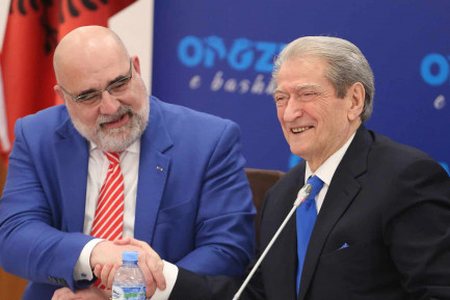
His Grace Andoni, head of external relations of the Russian Orthodox Patriarchate, has unexpectedly visited Tirana on a diplomatic mission.
A mission that was talked about very little, both in political and church circles, but also in the local media.
The media, which, for the most part, have used a standard of "friendship" with the new head of the Orthodox Church, invariably publishing every announcement coming from the press office of the successor of Anastasios Janullatus.
Meanwhile, the press release from the Albanian Orthodox Church, the host of the Russian delegation, was very dry.
Namely, just two small paragraphs: “During the meeting, opinions were exchanged on inter-Orthodox relations, as well as on various topics related to the witness of Orthodoxy in today's world.
Special emphasis was placed on the major issue of peace in Ukraine, also emphasizing the need for prayer, dialogue and continued efforts to achieve it.
Even in a normal situation, a visit by the Russian Patriarchate is somewhat unusual in Albania, as the Albanian Orthodox Church is part of the Istanbul Patriarchate, not part of the Moscow church hierarchy. Their arrival could be justified by a pilgrimage to a special holy site in the Orthodox world, or a pan-Orthodox summit. Which is not the case.
Then why did Archbishop Andoni, Patriarch Kirill's right-hand man, come to Tirana, together with Protopresbyter Nikolaj Balashov and Protopresbyter Igor Yakimchuk?
There is no particular reason for church matters of an organizational or liturgical nature. This is because the Moscow Patriarchate mainly governs Slavic countries, but not all of them, as Serbia, Bulgaria, etc. also have autocephalous churches, having established their own patriarchates for centuries.
For liturgical matters, there is no relationship of exchange of materials or literature, as the Church of Moscow uses the Russian language in its activity, while that of Albania uses literature in Albanian, Greek, or even English.
So, the mystery of this mission, without knowing the real reason, is understandable, and the questions and conjectures are numerous. However, there is a thread, not a small one, that nourishes a relationship, not a 'lightning bolt from the blue' of the Russian Church with the Orthodox Church of Albania.
A few years ago, in April 2018, the head of the Russian Church, Patriarch Kirill, personally came to Albania. He was received in a special audience by Edi Rama, who treated him with special care, showing him artifacts from the prime minister's office and talking about Albanian art, mainly Byzantine art.
The Russian Orthodox Church is a very important institution, not only spiritually but also politically. With Putin at the helm of the Kremlin, the Moscow Patriarchate has returned to the key role it had in the time of the Tsars, when it was the backbone of Russian hegemony.

The Patriarchate strongly defended the military invasion of Ukraine and opposed the autocephaly of the Ukrainian Orthodox Church. Even after the invasion of Ukraine, a major schism occurred between the Patriarchate of Istanbul, which includes the European Orthodox, and that of Moscow.
The Patriarchate of Istanbul openly opposed the occupation of Ukraine and has helped the Orthodox Church there. Meanwhile, at the time of Janullatus, the Albanian Orthodox Church was the only Western Orthodox center that not only did not participate in this debate, but maintained ties with the Russian Church.
Her mission to Tirana, a NATO member country, is nothing more than a breach of the international isolation that the Patriarchate has, as part of the political-ideological establishment of Russian hegemony. As it is the first visit to a Western country, after Putin's invasion of Ukraine in February 2022.
When Edi Rama received Patriarch Kirill, it was said by some circles in Tirana that he was preparing more carefully for his visit to Moscow as the next chairman of the OSCE. A visit he made in February 2020, when he met Sergey Lavrov, the head of Russian diplomacy, who has created a powerful network of influence in Moscow with the Patriarchate.
But today, what is the Russian Church doing in Albania?
Is a high-level visit being prepared, or some other development, some kind of parallel negotiation or exchange of messages? No one is saying this, yet the fact is quite shocking. After all, not even Greece, which is the most Orthodox country in the Western world and has direct ties to the Patriarchate of Istanbul, has such a close connection to the Patriarchate of Moscow, as Tirana does./ Pamphlet



Lini një Përgjigje