


 Shkruar nga Pamfleti
Overall, Vučić's statements indicate a dual strategy. Towards the European Union, he emphasizes the need for faster and more ambitious decision-making, while seeking a better understanding of Serbia's position...
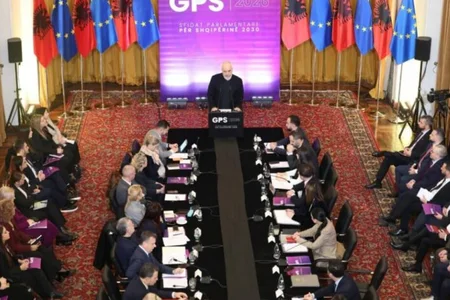
Serbian President Aleksandar Vučić and Prime Minister Edi Rama seem to be on the same wavelength in their criticism of the European Union, and both almost use Russian, Chinese, and Indian influence in the Balkans as tools to pressure Brussels.
Prime Minister Rama declared on April 23 that Europe is distancing itself from any future peace agreement between Ukraine and Russia by avoiding direct engagement with Moscow.
"Europe has made a big strategic mistake by cutting off every channel with Russia. Europe must always, always, always talk to everyone ," declared Rama, who thus took aim at European Commission President Ursula von der Leyen and EU chief diplomat Kaja Kallas, who have avoided direct contact with Russian leaders, including President Vladimir Putin.
Earlier, Rama tried to use China as pressure, when during a conference, he declared "if Albania were not potentially so important, the Chinese, who are the oldest civilization and the most indisputable traders, would not have set their eyes on it and would not consider Albania as the "honeymoon spot" in all of Europe, right?"
Three days after Rama's statement, Serbian President Aleksandar Vučić, speaking at an international conference organized in Chantilly, France, on global politics, would declare that Europe is "losing many battles" and is lagging behind the United States and China in key areas such as artificial intelligence, robotics, security and defense.
Responding to a question from Thierry de Montbrial about the future of Europe and the European Union, Vučić said that Europeans often overestimate their position in the global system, while underestimating the pace at which other powers are advancing. As he noted, Europe remains one of the most attractive continents in the world, but it cannot ignore its low growth, demographic pressures and the technological gap that separates it from its main global competitors.
The Serbian president linked Europe's backward position to a lack of strategic and bold decision-making, arguing that the continent often moves slowly, limited by technical and bureaucratic processes.
Vučić sent a clear message to Brussels that Serbia's European path remains a strategic choice, but cannot be separated from the specifics of its foreign policy.
Unlike Rama in his relationship with Brussels, Vučić does not hesitate to use Russia and India.
In this context, Vučić reiterated the position that major powers such as China, India and Russia have not recognized its independence and underlined that Serbia cannot fully comply with the foreign policy of the European Union, while issues it considers vital to its sovereignty remain unresolved.
His reference to Kosovo also had a broader dimension. Vučić drew a parallel between the way the West deals with violations of Ukraine’s territorial integrity and his stance towards Serbia, arguing that Europe must apply the principles of international law consistently. In doing so, he placed Serbia’s position within a broader debate on the credibility of the international order and the role of great powers, writes Independent Balkan News Agency.
Overall, Vučić's statements indicate a dual strategy. Towards the European Union, he emphasizes the need for faster and more ambitious decision-making, while seeking a better understanding of Serbia's position. Domestically, he maintains the political initiative, keeping the option of elections open without committing to a specific timeframe.
For Belgrade, the current moment offers room to negotiate influence, but it also carries risks. Criticism of Europe may reinforce the narrative of an independent Serbian policy, yet the European path remains a key factor for the country's economy, investment climate, and international standing.
Rama and Vučić jointly proposed to Brussels a new formula for Albania and Serbia's membership in the EU through an accelerated procedure, but without the right of veto. The formula put on the table by Rama and Vučić did not find the support of official Brussels, nor of Berlin, which immediately reminded the countries aspiring to EU membership that they must meet the conditions, especially those related to the rule of law. /Pamphlet/


Lini një Përgjigje