


 Shkruar nga Pamfleti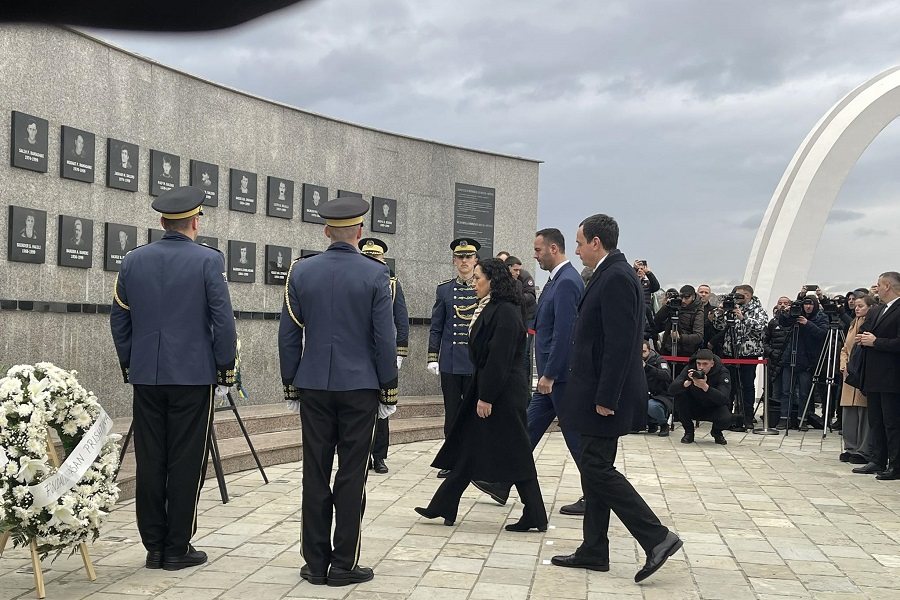
In Kosovo on January 15, the heads of state honored the victims of the Recak massacre.
In this village of Shtime, 25 years ago, Serbian forces killed 45 Albanian civilians.
During the laying of wreaths in this village of Shtime, the president of Kosovo, Vjosa Osmani, thanked the former American ambassador, William Walker, who was present at this ceremony.
Walker, during 1999, had served as the head of the Verification Mission of the Organization for Security and Cooperation in Europe (OSCE) and had documented the crimes committed in this village.
According to Osman, the Reçak massacre internationalized the Kosovo issue. She said that Walker has been working for 25 years to protect the truth about Recak, but added that this event is still denied in Serbia.
"At a time when, unfortunately, the current regime of the Serbian president, Aleksandar Vucic, which is the continuation of the regime of the former Serbian leader, Slobodan Milosevic, not only denies the massacre of Recak, but also arrests and tortures those who who put flowers on the graves of children killed during the war", said Osmani.
For Walker, this anniversary is an exciting event, but he added that the residents of this village sacrificed for the citizens to have the Republic of Kosovo today.
The Prime Minister of Kosovo, Albin Kurti, said that the massacre of Recak "shocked the international public opinion and international diplomacy and made the military intervention of NATO necessary to stop the genocide of Serbia in Kosovo".
Meanwhile, Speaker Glauk Konjufca said that after the massacre of Recak, the democratic world "understood that the language that Serbia knows is the language of strength", referring to the NATO bombings on Serbian targets.
After the Recak massacre, in March 1999, NATO attacked military and police targets in the former Yugoslavia.
After 78 days of attacks, the bombings were stopped on June 10, 1999, with the adoption of Resolution 1244 of the United Nations Security Council.
NATO's intervention in Kosovo had enabled the return to their homes of more than 800,000 refugees, displaced persons inside and outside Kosovo.
In the war fought in Kosovo in 1998/99, more than 13,000 civilians were killed and thousands more disappeared.
Over 1,600 people are still missing - most of them Albanians. /REL



Lini një Përgjigje