


 Shkruar nga Pamfleti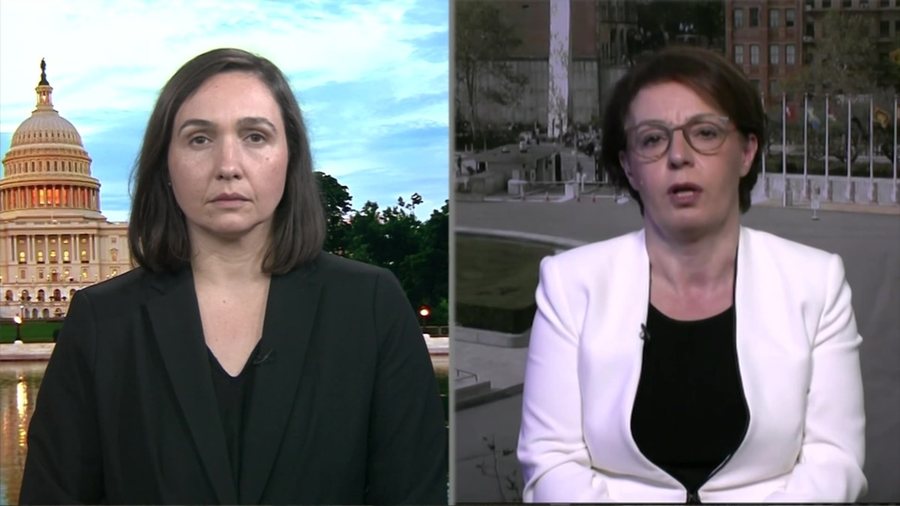
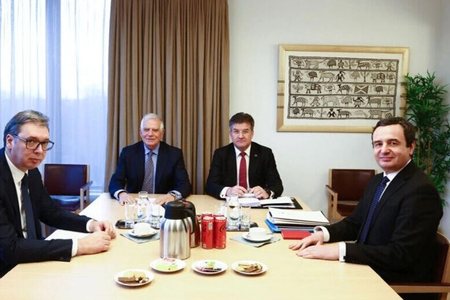
This week in Brussels, after the meeting with the leaders of the European Union and the presidents and prime ministers of France, Germany and Italy, the Prime Minister of Kosovo Albin Kurti expressed his willingness to sign the project offered by the Western diplomats for the establishment of the Association of municipalities with a Serbian majority, while accused the Serbian President of unwillingness to implement the agreement known as the Franco-German plan.
In a comment to the Voice of America, the State Department said that the normalization process, mediated by the EU, is the only way to ensure peaceful and productive relations and to realize the aspirations of the two countries for membership in the European Union. The US also reiterated the call for the two sides to seriously and urgently commit to this goal and fully implement all commitments that emerge from the dialogue.
In an interview for the Voice of America, Kosovo's Foreign Minister Donika Gërvalla Schwartz said that the agreement must be implemented in its entirety. In the interview that the chief diplomat of Kosovo gave to her colleague Garentina Kraja on Friday, she said that a partial implementation would not bring the intended progress.
Voice of America: Mrs. Gërvalla, Prime Minister Kurti accepted it, but did not sign the Association agreement. Why does Prime Minister Kurti connect the creation of the Association in Kosovo with the signing of the agreement by Belgrade for its own obligations from this process?
Donika Gërvalla: Now, in fact, what the Prime Minister offered yesterday to the German Chancellor, the French President, the Italian Prime Minister and other international representatives is to finally finally implement the Basic Agreement that we concluded with Serbia in Brussels in February of this year and the plan of the implementation of March, which provides in point 7 and 10 also a part related to the self-management of Kosovo Serbs. Within this agreement, Kosovo has seen a new draft, which came from the European Union, which respects the concerns we have expressed over the past two years about the substance of that mechanism, and Prime Minister Kurti has shown international partners that if they will be able to ensure the signing by Serbia of the agreements we have concluded, then Kosovo will not become an obstacle in their implementation.
VOA: Can you share with us what the new association model envisions? Until yesterday you called the association dead, while now you have accepted it.
Donika Gërvalla: But this is the problem when even serious media are served with headlines and not with the content of interviews of political representatives. We talked in the interview that you quote, we talked about the association of 2013 and 2015, which, as the Constitutional Court has said, violates the Constitution of the Republic of Kosovo in more than 22 articles. So that association, which violates the Constitution of Kosovo, is dead both for us and for the international community. A new document that we received, which I don't know if it will be called an association or what it will be called, which serves to implement the plan concluded in February, respects the concerns, respects the Constitution of the Republic of Kosovo and all other documents that ensure the functioning of our state.
Voice of America: Through a statement, the leaders of France, Italy, and Germany call on the Kosovar side to start the process of implementing the association independently of Belgrade. Will Kosovo start the process of implementing the association, Ms. Gërvalla?
Donika Gërvalla:If the agreement concluded in Brussels is implemented as a whole, it includes articles 7 and 10, and within the framework of the implementation of the agreement, we are ready to give our contribution. Agreements or fragments of the agreement, which Belgrade does not even accept, do not bring about the desired normalization, the necessary normalization between our two states and are therefore meaningless. The agreement is implemented as a whole, otherwise its fragments will not bring progress.
Voice of America: Before the September 24 attack, your government criticized the international community for putting unfair pressure on Kosovo rather than Serbia. Have you noticed any different attitude of the European Union and the international community as a whole since then?
Donika Gërvalla: I think that not only our government, but also many observers of the processes in the Balkans, many researchers, many journalists, serious media have criticized the approach of the European Union as one-sided in relation to Kosovo and in the continuous demand that Kosovo make moves big while there has been some continuous understanding for Serbia, which not only does not move in the case of Kosovo, but does not fulfill its international obligations neither in relation to Russia and its war in Ukraine nor in relation to other phenomena related to forces that are not part of the strategy of the European Union and the West in general. September 24 has shown that Kosovo was right, that Serbia, while we were trying to achieve results in the dialogue, Serbia has been preparing paramilitary troops to send to Kosovo to occupy the territory of Kosovo, therefore we hope that the international community finally to be more determined in its demands in the punishment of the aggressor, but also in the search for ways that enable a long-term solution.
Voice of America: Although Mr. Kurti accepted the association, EU leaders in the statement after yesterday's meeting equally blamed Kosovo and Serbia for the implementation of the Normalization Agreement. What is your comment on this rating?
Donika Gërvalla:I want to emphasize once again that I do not know which admission you are talking about. I tried to explain in detail what happened yesterday, what was the commitment of the Prime Minister of the Republic of Kosovo, and on the other hand, let me emphasize that the High Representative of the EU's Foreign Policy is not the first time which is very biased in assessing the situation. Mr. Borrell in the past has also been noted for statements that did not reflect the reality of the dialogue, did not reflect the reality of the positions of the Republic of Kosovo. There were no two pairs yesterday. The Prime Minister of the Republic of Kosovo has offered a clear way out of the situation we are in, and that way has been rejected by the President of Serbia, and to tell you the truth, we don't even expect the President of Serbia to be constructive in this process.
Voice of America: What do you expect from this process? What is your vision for the way forward, Madam Minister?
Donika Gërvalla: The way forward is the strengthening of the Republic of Kosovo as an independent and sovereign state, respecting the interests of the citizens of our entire Republic, regardless of their national, religious, regional or whatever affiliation. The way forward is the commitment of the Government and the institutions of the Republic of Kosovo to establish the rule of law, to strengthen democracy and to always offer all neighbors the possibility of good neighborly relations. This is what is in our hands. All the rest are not only in the hands of the Republic of Kosovo and therefore we hope that the international community will exert the right pressure, express the right sanctions against Serbia in order to have an opportunity to move towards the normalization of our relations.
Voice of America: The United States has often repeated this year that there is a time pressure to conclude the agreement with Serbia. Is there still a chance that the deal will be completed before the elections next year in America?
Donika Gërvalla: As for the Republic of Kosovo, we have shown the way how it could be concluded immediately. Prime Minister Kurti offered the opportunity to finalize the agreement yesterday with the signature of both parties in the presence of all European leaders. Such an opportunity was not used yesterday; let's see if there will be similar, principled and successful opportunities for the Republic of Kosovo in the future. This does not depend, I said once again, only on us. This depends a lot on what position the international community will take, our partners, friends and allies will take in relation to the fair demands of the Republic of Kosovo, but also with Serbia's continuous efforts to avoid negotiations and strengthened the aggression against Kosovo and other neighbors.
VOA:We are returning once again to the issue of the new model that has been offered by the international special envoys for the association. Can you detail what makes this model acceptable for the Republic of Kosovo?
Donika Gërvalla: Very simple: the new model, which has been presented to us, respects the Constitution of our Republic and as responsible institutions, the minimum of what we ask for with any kind of proposal that comes to us is respect for citizenship, sovereignty, the Constitution of the Republic. I think that this is the obligation of every government of every democratic country.
VOA: And do you feel that the new model respects these basic principles?
Donika Gërvalla: I think I emphasized it three times during this joint conversation that we had, that this is the basic change of the proposal that came to us and that is the reason why Prime Minister Kurti in a very sincere and very principled offer yesterday in Brussels offered the signing of the Basic Agreement of the implementation plan and in its framework of the implementation of Article 7, which foresees a single mechanism for the Kosovo Serbs. / VOA


Lini një Përgjigje