


 Shkruar nga Pamfleti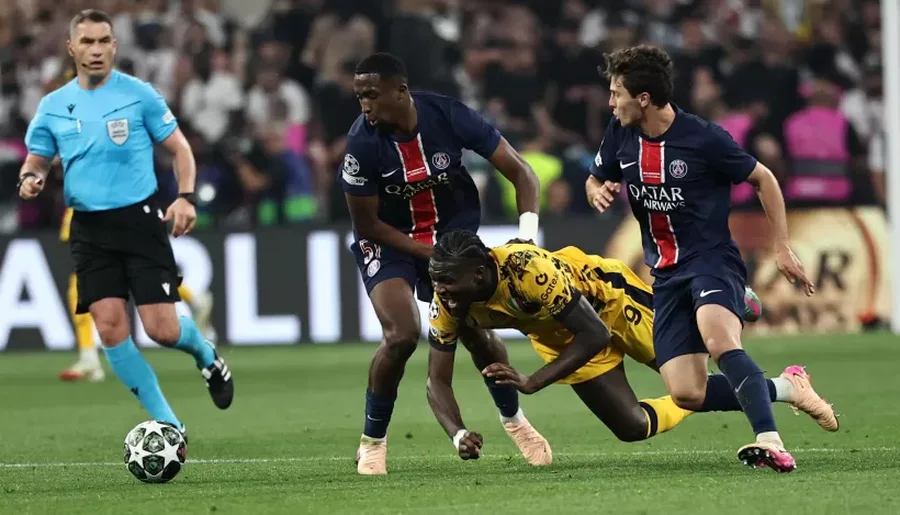
Inter reached the final exhausted, physically and mentally. An overlong season, a number of matches that surpassed any rival in Europe, a team that still relied on old bone and a coach who, although often praised for his tactical flexibility, had no choice about PSG's plan...
The Allianz Arena, with its futuristic white rubber structure with LED lighting that changed according to the event or the host team, seemed like the perfect stage to pay homage to the art of Simone Inzaghi and his Inter — a Bauhaus-inspired football where functionality and aesthetics coexisted in harmony: with constant pressing, synchronized defensive runs and surprise bursts of diagonal passing. This final appeared to be a golden opportunity to solidify Inzaghi’s status and restore the black and blue glory to German soil. And yet, what happened in Munich was the opposite.
Paris Saint-Germain dominated the field and Inter with a crushing 5-0 win, lifting the most prestigious trophy in European football for the first time in its history. This was not the triumph of a superpower supported only by Qatari billions, but of a new project, of a sustainable construction and a tactical vision masterfully led by Luis Enrique. A coach who began his journey with obstacles, with a tough experience in Rome where he faced tension and distrust, but who transformed into a master of positional play through Barcelona, Spain and then PSG.
Luis Enrique, or “Lucho”, has evolved from a solitary idealist who tried to transplant the Catalan style into every context, to a strategist who reads games with the eye of a surgeon. While he failed at Roma early in his career due to a lack of support and culture, at Barcelona he built a winning team that dominated Europe. With the Spanish national team, despite failures in the result, he developed and refined the didactic approach to football built on conscious possession and precise rotations.
At PSG, Lucho did not stop with domestic trophies. He created a team that knew how to alternate rhythm, that shot with precision, that knew how to cancel out the opponent. In Munich, his strategy was exemplary: he neutralized all of Inter's weapons, avoided dangerous build-ups from the goal and forced Inzaghi's team to feel like puppets without wires in a tactical theater orchestrated by the Asturian master.
On the other hand, Inter reached the final exhausted, both physically and mentally. An overlong season, a number of matches that surpassed any rival in Europe, a team that still relied on old bones and a coach who, although often praised for his tactical flexibility, had no solution to PSG's plan. An Inter that had excelled in the past for its elegance and synchronicity, this time appeared without identity, sluggish and blocked.
This defeat became a symbol of a deeper problem that has affected Italian football in the last decade: four finals lost (two by Juve, two by Inter), against coaches who represent a modern philosophy of football: positional play, advanced possession, rotations and courage in construction. It is not enough to say that "they were richer", because more and more the difference lies in ideas, in approaches, in tactical education. Italy continues to remain in suspense, divided between defensive tradition and the lack of a new identity.
In this context, PSG's victory is not just a sporting success. It is a lesson for all of European football — especially for Italians: success requires vision, investment in ideas, patience and transformation. Lucho did not build a team of stars, but a precise orchestra, where every element moved in harmony. Inter, on the contrary, stopped halfway. And the Allianz Arena, with all its spectacular lighting, became the stage where a new era began — and another faded. / Corriere Della Sera


Lini një Përgjigje