


 Shkruar nga Pamfleti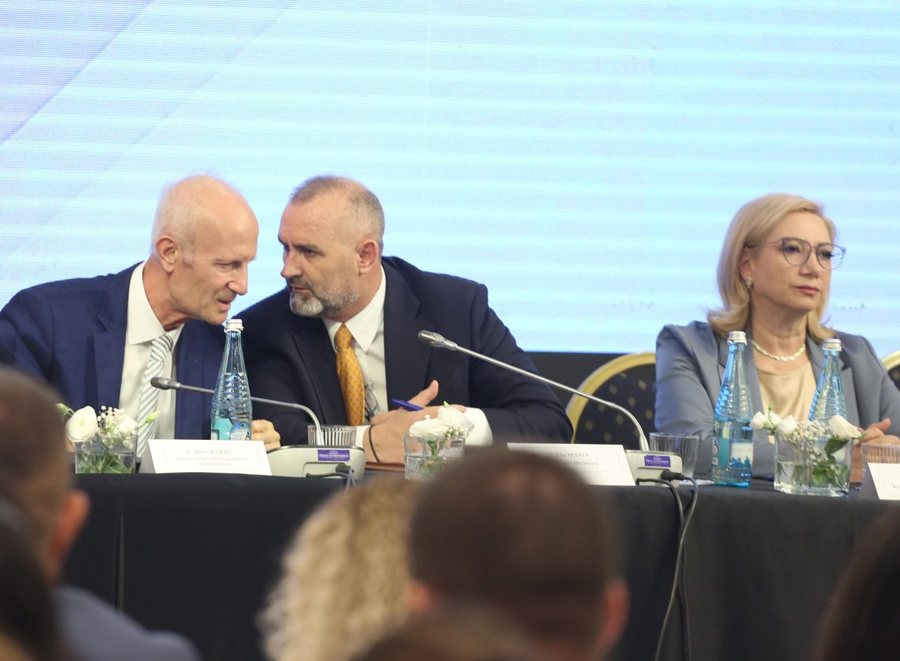
A draft of amendments to the Criminal Code, presented at a meeting of the Ministry of Justice, has drawn criticism from media freedom organizations and justice system actors for "confusion and ambiguity."
A government project to adopt a new Criminal Code, made public on July 25 by the Minister of Justice, Ulsi Manja, has been met with strong criticism from various societal actors and independent justice institutions, as a project that violates individual freedoms.
Several articles related to the prohibition of comments about judges or the publication of investigative files have particularly concerned media freedom organizations, which see them as an attempt to limit freedom of expression.
Article 534 of the draft, entitled 'influence on the independence of the court', prohibits the making or publication of comments that aim to influence the court's ability to make decisions, an article that, according to Flutura Kusari, senior legal advisor at the European Centre for Press and Media Freedom (ECPMF), is an interference in the work of the media and civil society actors.
“The article is deliberately drafted in a general and vague manner to enable the prosecution, police and courts to interpret it as they wish and use it against journalists and others,” Kusari told BIRN, adding that “consequently, the draft article enables the prosecution authorities to prosecute any individual who comments on a court case before it is decided by the court, thus making it impossible to comment on criminal cases.”
Kusari suggests that this article was proposed precisely at a time when senior political figures from the Socialist Party and other parties are being prosecuted for abuse of power and corruption, thus making it impossible for journalists and others to monitor these criminal cases and inform the public about developments surrounding them.
According to her, the legal proposal "is arbitrary, seriously violates the right to freedom of expression, reduces the transparency of the judicial system and will have a chilling effect on society."
Blerjana Bino, director of the Science and Innovation for Development Center, SciDev, also views with concern the government's draft Criminal Code, which, according to her, "directly violates freedom of expression and creates serious risks for media freedom in Albania."
“The proposed amendments to Articles 119 and 120 on insult and defamation not only do not meet our repeated recommendations, but also those of European institutions, to decriminalize these offenses, but on the contrary, they increase criminal sanctions and expand the scope of application in a way that could have a frightening effect on journalists, activists, and engaged citizens and public watchdogs,” said Bino.
According to Bino, "the expansion of criminal liability for comments made in the media, social networks or through public acts, the increase in fines, as well as the ambiguities in legal formulations, constitute an increased risk of abuse and selectivity in implementation."
She also highlights provisions such as those that justify harmful statements made “in a state of anger,” which, she says, “can be used to evade the responsibility of powerful actors, creating double standards.”
Kusari and Bino call for these legal proposals to be adapted to Council of Europe standards and the case law of the European Court of Human Rights.
Opposition figures have also raised concerns about the articles that affect freedom of expression. Democratic Party MP Ina Zhupa, in a public statement on Wednesday, said that the draft proposals in this code impose censorship, strike at freedom of expression and violate journalists in the exercise of their profession.
"Autocratic articles, similar to dictatorial countries," Zhupa called the proposals related to comments on judges and the publication of 'investigative secrets'.
Criticism from justice institutions
During the presentation of the government draft, the first criticism came from the President of the Supreme Court, Sokol Sadushi, who spoke of a lack of consultation and information of the justice bodies in the preparation of the new Criminal Code.
In the absence of knowledge of the draft, he called for in-depth, professional and institutional reflection and a Criminal Code that guarantees more effective and humane justice and the avoidance of vague definitions of criminal offenses.
The draft was also opposed by the Attorney General, Olsian Çela, who in a statement to the media on Tuesday criticized the government for the lack of a prior consultation process and putting the justice system at risk.
"The lack of this process constitutes a fatal structural error in the construction of this edifice, which instead of being the product of a natural institutional and social flow as a historical necessity, in fact represents nothing more than a hasty action that risks irreparably undermining the proper functioning of the criminal justice system in the country," Çela declared.
According to him, a new criminal code at a difficult moment for the justice system "would multiply the chaos in the investigation and judicial processes, due to the inevitable confusion that the implementation of the new criminal norms would bring."
On Wednesday, the Chamber of Advocates also reacted, describing the draft as "inquisitorial" with repressive punishments similar to those of the communist regime and with discriminatory articles and contrary to the principles of advocacy.
Opposing the government's draft, Maks Haxhia, president of the Chamber of Advocates, told the media that there was a lack of transparency in its drafting, it did not justify the need, and that it was contrary to European criminal legislation.
"We do not see the need for a new code. It is not a consequence of the need of the justice bodies," he said, warning of his opposition, including through legal channels, to the Constitutional Court if it is approved in the Assembly. / BIRN




Lini një Përgjigje