


 Shkruar nga Giansandro Merli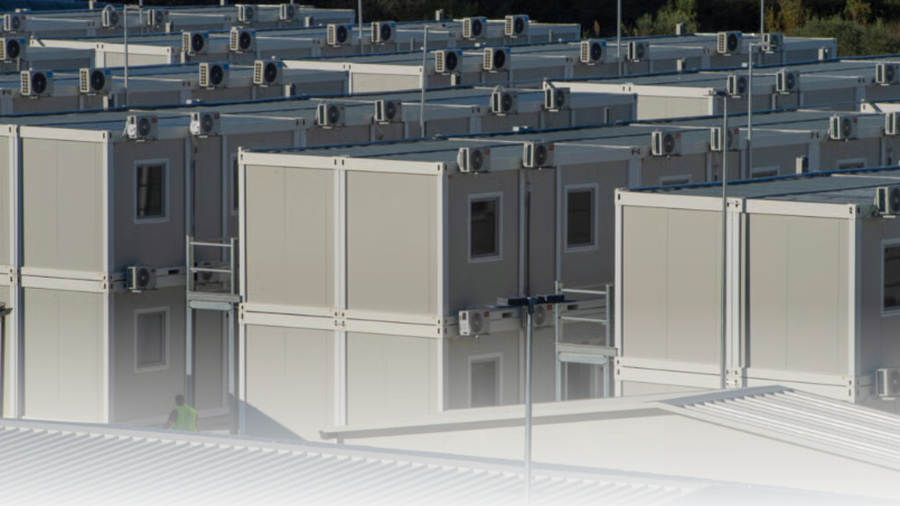
A serious fact that confirms that the lack of transparency towards Italian citizens goes hand in hand with the violation of fundamental rights and the reduction of guarantees for foreign citizens'...
"The Albanian model is a system of governance based on a lack of transparency and an emptying of democratic spaces. Parliament has been marginalized, the role of civil society has been diminished, and information has become inaccessible even to institutions authorized to exercise control."
This is the gist of the 52-page report presented to the Chamber of Deputies by the Asylum and Immigration Committee (TAI) under the title "Border Wounds". It lists the total number of people transferred to the Gjader Border Reception Center in the second phase of the project: 132. These are "irregular" migrants expelled from Italian territory, following the government's change of the initial destination of the structures, which were originally intended for asylum seekers who never entered Italy.
A 'nonsensical' choice, says Arci vice-president Filippo Miraglia, 'given that we are talking about individuals already detained and knowing that returns are usually made within the first twenty days of detention'.
This number was derived from monitoring visits carried out by TAI and by a group of opposition MPs and MEPs who are following this issue. Because the Ministry of the Interior does not provide complete data, not even to the requests of institutional representatives. During a recent inspection, the DP MP, Rachele Scarpa, discovered that on July 16 there had been a transfer of 13 migrants for which no notification had been given.
'A serious fact that confirms that the lack of transparency towards Italian citizens goes hand in hand with the violation of fundamental rights and the reduction of guarantees for foreign citizens,' says Scarpa. The circular issued in April by the Ministry of the Interior to prevent the entry of casual collaborators of deputies also moves in this direction. 'A circular against TAI, they have made to prevent us from entering Gjadra,' they said during the press conference.
The report by the main network of organizations dealing with migration lists all the abuses that occur across the Adriatic, under Italian jurisdiction: transfers are made without any decision by the judicial authority, without motivation and with the use of coercive means; access to healthcare is limited and discriminatory; there is no review of suitability for detention at the moment of entry to Gjadra, which, due to its location, presents different problems than other CPRs; the right to protection is deeply limited, if not compromised.
Citing recent decisions of the Constitutional Court and the Court of Cassation, TAI highlights many legal issues in relation to constitutional, international and European principles for the centers that the Meloni government wants and demands that the 'transfers be stopped and the agreement be canceled'.
'Why does the government insist so much despite such small numbers?', asks Riccardo Magi. The answer of the secretary and MP of +Europa is that 'the purpose of the protocol with Tirana is to prove that you can do whatever you want with those people. The most important point is the threat to democracy, the rule of law and legality. Be careful: those centers are built to last'.
Meanwhile, yesterday the International Organization for Migration updated the data on the dead and missing on the central Mediterranean route: this year there are a total of 659. Meanwhile, the so-called 'Libyan coast guard' has intercepted at sea and returned to detention centers 13,243 people. Of these, 11,508 are men, 1,180 women and 410 minors (for 145 migrants there is no gender data). As of yesterday, the number of landings in Italy was 36,545, compared to 32,723 in the same period of 2024. /Adapted from Il Manifesto/




Lini një Përgjigje