


 Shkruar nga Pamfleti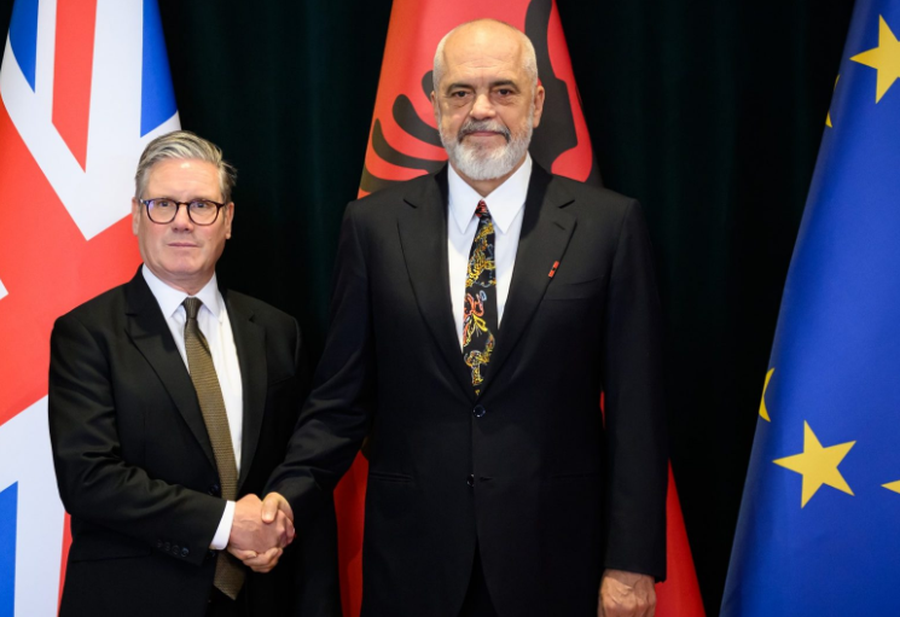
Edi Rama has friendly relations with the Labor Party, but the closure he gave to the current leader's plans for immigrants will be felt very much...
He models his party on Young Labour and counts Sir Tony Blair as a close advisor.
But that didn't stop Edi Rama, the prime minister of Albania, from obstructing Sir Keir Starmer's plans to send rejected asylum seekers abroad.
“Some countries have asked us if we are open to this and we have said no,” Rama said at a press conference in the capital, Tirana, on Thursday. He had agreed to set up only two migrant accommodation centres with the Italian side “due to the very close relations between the two countries.”
Indeed, there is an element of mystery as to how the message did not reach the British Prime Minister before his first visit to Albania.
Sir Tony still flies regularly to offer his advice to Mr. Rama. As does Alastair Campbell. Either of them might have warned the British Prime Minister that it would be unwise to inform GB News of his plans to open “return centers” just before departure.
Perhaps Mr. Rama, who is very powerful, is now at a level of power that he no longer needs to follow his words very carefully, regardless of which European leader stands by him.
On Sunday, the former professional basketball player won a fourth term as prime minister, extending his record as Albania's longest-serving leader since the fall of communism in the early 1990s.
His Socialist Party secured 52 percent of the vote compared to just 34 percent for the Democratic Party, led by Sali Berisha, the 80-year-old former prime minister.
The commitment of Chris LaCivita, the Trump 2024 campaign manager, did little to persuade voters to support a man who has been banned from entering the UK and US due to corruption allegations.
"Hiring LaCivita and thinking you can become Trump is like hiring a Hollywood hairdresser and thinking you're going to become Brad Pitt," Mr. Rama told Politico.
At summits of world leaders, Mr. Rama is warmly greeted by European and American officials, who see him as a stabilizing force in the still fragile Balkan region.
As a young man, he studied art in Paris. As prime minister, he has deepened Albania's efforts to break away from Russia's orbit and integrate with democratic and cosmopolitan Europe.
Near the start of his term in 2013, he posted a selfie alongside Mr Campbell, celebrating Albania's status as a candidate for EU membership. The goal is now 2030.
He hopes the cause will gain support from Giorgia Meloni. In January, he knelt down to give the Italian prime minister a white scarf on her 48th birthday.
The white-sneakers rebel leader has called Ms. Meloni a “little sister” of Albania, praising her “great charisma” after the pair signed the agreement on migrant return centers in 2023.
That same year, the EU also signed a border security agreement with Albania, allowing Frontex guards to be deployed at its borders.
Mr. Rama's political rise began as mayor of Tirana, where he proved himself a zealous reformer.
Working with a budget of “zero, comma, something,” the former art student reimagined the capital’s gray Soviet architecture in jazzy shades of orange and green. (The EU, which provided the funding, tried to block the scheme, he says, for regulatory reasons.)
Albania has changed too. It is now a pro-market, socially democratic nation — and, increasingly, a tourist destination. The Albanian Riviera now attracts more than 10 million foreign visitors a year, growing by 35 percent from 2022 to 2023.
Friendly EU diplomats describe Mr. Rama's failure to root out corruption as the price of getting any work done in the country.
During his short tenure, Mr. LaCivita highlighted accusations – which Rama steadfastly denied – that the prime minister had collaborated with organized crime to influence the election, calling Albania “Edi’s drug state.”
He was accused of colluding with Charles McGonigal, the corrupt former FBI official, to target his political enemies, charges he repeatedly denies. Journalists describe a crackdown on press freedom under the guise of "anti-defamation" laws.
Election observers from the Organization for Security and Cooperation in Europe said this week's vote was transparent and fair, although the long tenure of Mr. Rama's Socialists had created an "unfair advantage in power."
Staying longer than ever, the Albanian Prime Minister is determined to deepen these advantages even further.
Sir Keir, who at 1.78m was shorter than his counterpart, may not be the last visitor to publicly take a dip in the water. / Adapted from The Telegraph Pamphlet /


Lini një Përgjigje