


 Shkruar nga Pamfleti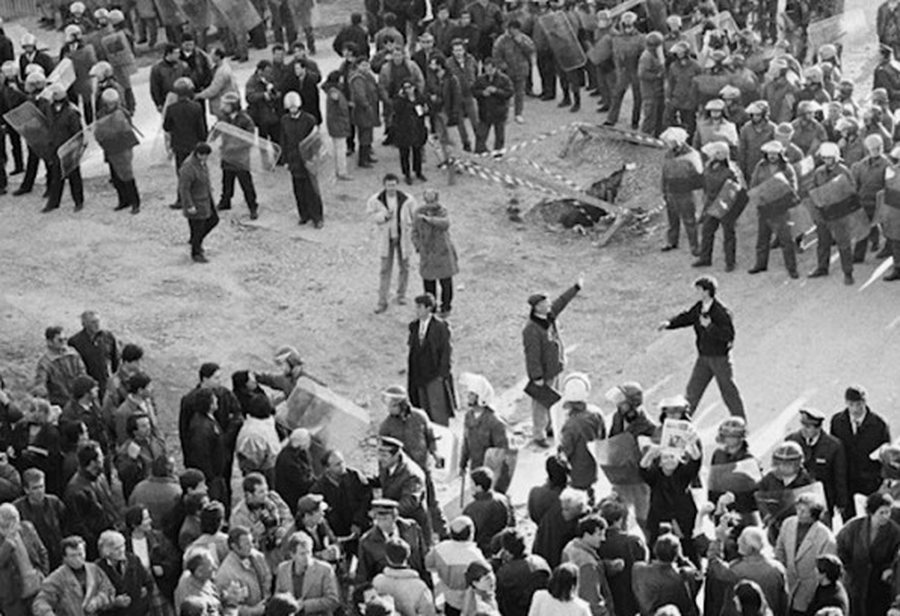
On January 14, 1990, the first anti-communist demonstration took place in Albania. Thousands of citizens of Shkodra gathered in the city center, protesting silently.
Their goal was to bring down the bust of Stalin, but this attempt was a signal of other anti-communist actions that would follow. The event was also covered by foreign media such as BBC “World Service”, RAI, VOA – Voice of America. This rally had been planned for days. The initiators had notified many citizens in order to join the protest and its dimensions would be large.
The organizers’ movements had not escaped the notice of the State Security, which was aware of such a gathering, considering them “enemy elements inspired by events in Eastern European countries”. According to the Archives Authority, documents from the former State Security prove the preparations, surveillance and arrests that preceded the demonstration of January 14, 1990. The documents shed light on the way the authorities reacted to any sign of civil opposition. This protest did not meet the organizers’ expectations, as the State Security structures arrested its main leaders on January 13 and 14.
Some of them were sentenced to several years in prison on charges of agitation and propaganda, diversion or failure to report a crime. According to him, hundreds of citizens were arrested, a large part suffered torture, ten of the main ones; Dedë Kasneci, Gjergj Livadhi, Rin Monajka, Kolec Hublina, Flamur Elbasani, Nikolin Margjini, Tonin Dema, Nikolin Thana, Klaudio Daka, Aldo Perizi were sentenced to many years in prison, six others; Gjovalin Rolba, Gjovalin Zefi, Ndoc Leqejza, Pjerin Veli, Paulin Shtjefni, Viktor Martini were admitted to a psychiatric hospital and many families were deported. One of the prisoners, the late Rin Monajka, with the advent of democracy was released from prison in a state of extreme disability. The bestial tortures had a macabre effect
Anti-communist slogans
The researcher Kastriot Dervishi has recounted the measures taken by the State Security and the hours leading up to this demonstration. On Saturday evening, the regime had taken measures to prevent the demonstration of the following day, Sunday, January 14, 1990. The Department of Internal Affairs and the Committee of the Albanian People's Party had sent their people to be present here. The entire gathering was secretly filmed, material that is not known where it ended up. The Shkodra DPB opened file no. 126, while the General Investigation opened file no. 113.
The investigation estimated the participants at around 2000 people. The main role in the January 14 rally was played by Rini Monajka. The main intensity of the actions can be seen on January 13-16, 1990. While the actions to “dismantle” those who had been arrested continued (Dedë Kasneci was in a strong position of denial in the investigation), the main action remained the close observation of those who would approach the bust of Stalin. It was decided that the most active elements, who had been filmed on the 14th near the bust, “some processing with sharp data, would be hit”.
Of the 21 arrested, 7 of them admitted the purpose of their participation, while the majority did not. On the 13th-16th, there was an increase in anti-communist leaflets and slogans, while on the 15th, a prepared dynamite was thrown behind the Party Committee, which did not explode “due to the high vigilance of the police on duty”. Deputy Minister of Internal Affairs, Zylyftar Ramizi, reported that the purpose of the demonstration had been to bring down the bust of Stalin and then meet with the first secretary of the ALP Committee, Xhemal Dymylja, from whom the protesters would demand freedom of the press, speech, democracy, etc. In all the notes it is noted that the main inspiration had been the developments in the communist East. The investigation focused its case on the people participating in the demonstration, as well as those who had written the slogans of these days.
Arrests and torture
The citizens of Shkodra spontaneously rose up in protest against the communist regime. On that historic day, thousands of Shkodra residents had come out to the city center and tried to throw down the bust of Stalin, but the police and the communist army managed to disperse the crowd. The regime's wrath in its final throes fell on dozens of protesters, who were arrested and brutally raped in prisons. At the end of April 1990, the Shkodra group that had organized the demonstration to topple the bust of Stalin appeared before the panel of judges headed by Shefqet Muçi at the High Court.
The trial at that level deprived them of the right to appeal and de facto made the sentence final. The charge was based on articles 55/1+13 and 57 of the Criminal Code of the RSSSH, for the creation of a counter-revolutionary organization with an anti-socialist character, for committing crimes in collaboration against the state and for the overthrow of the people's power by force. The punishments for these articles could go as far as shooting, but times had changed. During the investigation, which was conducted by a group of investigators led by Deputy Minister Zylyftar Ramizi himself, inhuman violence was used, in particular against Rini Monajka, who, as he himself confessed in the diary kept a few months later in Burrel prison, during the transfer by car from the Internal Affairs Department in Shkodra to Tirana, was brutally beaten by the sambistas, who caused a seven-centimeter fracture in his skull. But the regime tried to show a certain calmness alongside the violence.
Ramiz Alia, during a visit to the Tractor Factory, said that “The wind does not move Tarabosh”. But the “East Wind” that was blowing from Berlin to Prague and Timisoara had also reached Shkodra, bringing the echo of the epochal events that were marking the fall of dictatorships and the overthrow of communist ideology. The fire that had laid the Ceausescu couple to the ground a few weeks earlier was too close not to be felt in Tirana and the entire machinery of violence was turned against the eight organizers of the demonstration, and in particular Rini Monajka.
This event, due to its importance and the time in which it took place, was rightly considered the first anti-communist demonstration in Albania. It had echoes inside and outside Albania, it was analyzed and commented on by international media because it later paved the way for other democratic developments throughout Albania, and its democratic fruits were not delayed. Lek Kurti, a participant in this demonstration with his wife and only 2-year-old child at his side, confessed years ago that the movement was prompted by the changes in Eastern Europe.
In an interview with the media in Shkodra, he recalls that the night before the protest, state security terrorized neighborhoods where it was thought that there were elements organizing this civic reaction, arresting at least 4 people during the night, but again they failed to prevent it from taking place. While Filip Guraziu, in an article from several years ago, states that “it cannot be considered a coincidence that the first anti-communist demonstration on January 14th was organized precisely in Shkodra.” “The people of Shkodra and the surrounding highlands had previously demonstrated that communism was foreign to them.
This people, who carry in their genes the freedom of the mountain people, historically in contact with Western culture through trade exchanges and the influence of the Catholic Church, could never accept the dictatorship and communist dogma. We recall the armed resistance to the point of self-sacrifice of the Kelmenda highlanders in January 1945 and the bloody uprising of Postriba in 1946. Unique examples in Albania and beyond.
The political terror that followed January 14, 1990 failed to defeat the democratic spirit of the people of Shkodra; on the contrary, the wave of protests like an avalanche grew and became fiercer to be an inspiring example for all Albanians. The history of Albanian democracy respectfully remembers the revolts of the people of Shkodra; June 16, 1990, November 11, 1990, December 13, 1990 and April 2, 1991. Bowing with respect and gratitude to all those who sacrificed themselves in the efforts against communism and the victory of democracy, I take this opportunity to remind historians of the fact, surprisingly forgotten, that the history of post-communist Albanian democracy begins on January 14, 1990 and this should be written and commemorated not only in Shkodra! "The people of Shkodran built the foundations of Albanian democracy and the first, main stone of the foundation was the demonstration of January 14, 1990," Guraziu said./ Panorama.al






Lini një Përgjigje