


 Shkruar nga Julia Khrebtan-Hörhager & Miranda Mccreary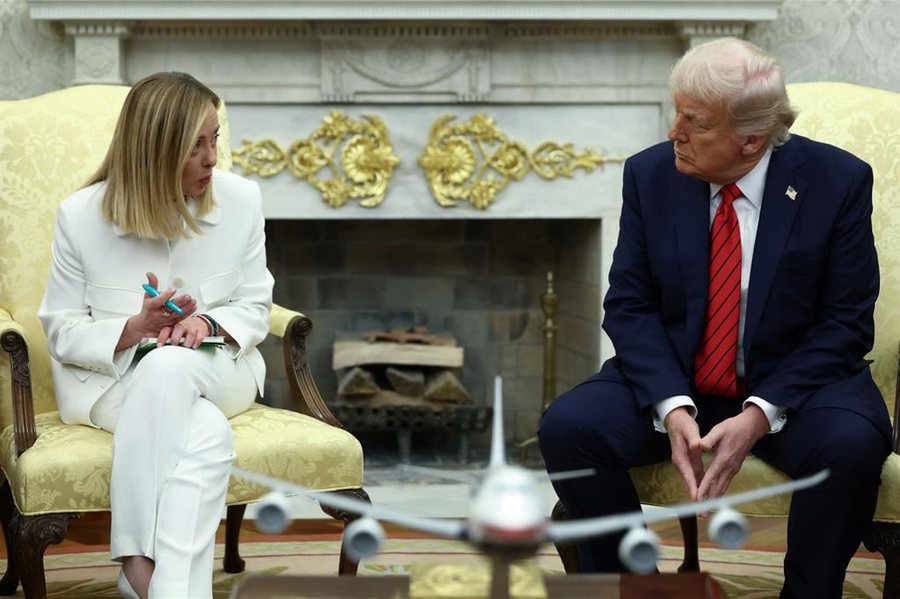
Italian Prime Minister Giorgia Meloni recently became the first European leader to visit the United States.
By trying to play both sides, it could end up isolated by both, damaging Italy's credibility and influence on the world stage.
Italian Prime Minister Giorgia Meloni recently became the first European leader to visit the United States after President Donald Trump announced a new tariff regime for trading partners, including a 20 percent tax on imports from the European Union.
While those tariffs have been postponed for now, the ongoing threat of their passage has heightened attention to Meloni’s visit in mid-April. Controversial and often perceived by critics as a pragmatic pedant, since becoming Italy’s prime minister in 2022, Meloni has walked a delicate balance between EU solidarity and embracing far-right causes.
She was the only European leader to attend Trump's inauguration in January, and counts tech giant Elon Musk among her allies. Meloni reflects in many ways Europe's own identity crisis: a regional power with global ambitions.
Italy was one of the founding countries of the European Union, signing the Treaties of Rome in 1957 that established the European common market. But for decades, it has often remained outside the EU's sphere of influence, overshadowed by the Franco-German partnership.
However, when the moment is right, Italy knows how to use its influence, especially as a bridge between opposing camps in Brussels. In Washington, Meloni made Trump her offer: a closer ideological alliance, based on a shared disdain for leftist politics of diversity, equality and inclusion agendas, and a soft approach to migration.
She offered more Italian investment in the US as a solution to the transatlantic trade dispute. But on the other hand, she reiterated her and the EU's support for Ukraine, in direct contrast to Trump's distrust of the US's continued support for Ukraine's conflict with Russia.
In this way, Meloni has presented himself as someone who can serve both Brussels and Washington, without burning bridges of cooperation with either side. The danger? This balancing act could backfire.
Trump's demands on trade, and increased defense spending by NATO countries, force Meloni to choose between appeasing Washington and staying in line with EU norms. Her friendship with Trump risks alienating key European allies, who are wary of his disruptive policies.
By trying to play both sides, it could end up isolated by both, damaging Italy's credibility and influence on the world stage. The history of modern Italy has been one of playing offside. During the Cold War, Italy pursued a delicate policy between NATO commitments and accommodating a powerful domestic Communist Party.
At the time, Italy was regularly governed by a series of often tense center-right coalitions, which were forced to operate amidst a very high political polarization between the right and the far left. The center-right Christian Democrats who dominated that period combined domestic conservatism with a strong pro-European outlook.
In the first decades after the end of the Cold War, Italy continued to follow its own unique path, seeking a moderate approach to issues such as migration and fiscal rules.
It oscillated between pro-European integration and periods of Euroscepticism, with successive governments often challenging Brussels over budget constraints or border management.
Meloni's rise to power also has its roots in 2015, when Italy, overwhelmed by the migrant crisis in the Mediterranean, felt abandoned by its European partners. Her party's tough stance on migration capitalized on citizens' frustration.
Now she now presents herself as a staunch supporter of the EU, because this is a version of Europe that aligns with her vision: safer borders, stronger national sovereignty, and less technocratic interference.
Ironically, as the bloc itself shifts to the right on migration, Meloni's stances no longer seem so extreme, allowing him to embrace the EU's approach in a pragmatic way, even as he criticizes it ideologically. Meloni's career reflects this ambiguity and duality.
Emerging from a political movement with fascist roots, she now presents herself as a passionate Europeanist and pacifist, while maintaining right-wing positions on migration and cultural issues.
Meloni's strong nationalist rhetoric and right-wing cultural views may seem at odds with the EU's purpose, but her approach to the continent is very pragmatic. Thus, despite regularly criticizing EU bureaucracy, her government remains the largest beneficiary of EU recovery funds, securing 191.5 billion euros from the post-Covid recovery plan program.
In addition, Italy continues to benefit from cohesion and long-term structural funds. Meanwhile, Meloni's support for Ukraine helps him distance himself from pro-Russian voices in his coalition, and strengthens Italy's positions in NATO and the EU.
While Meloni’s approach of presenting Italy as a bridge between the US and Europe may bring some short-term diplomatic gains, it is a delicate path fraught with risks. A rapprochement with Washington under Trump, whose policies – particularly on trade – have caused great anger in Europe, risks unsettling Brussels./ Adapted from “Pamphlet” by “The Conversation”




Lini një Përgjigje