


 Shkruar nga Rym Momtaz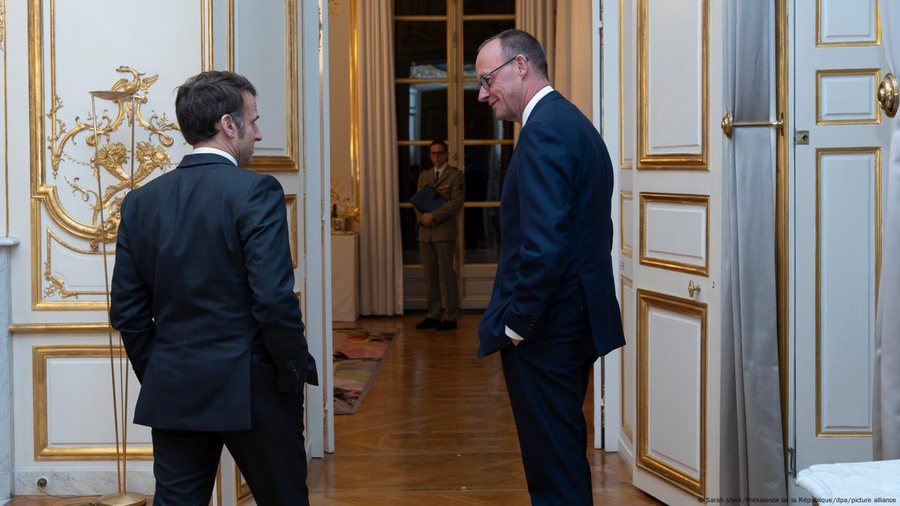
As Europe's military and economic leaders, France and Germany remain at the top of the list.
These two countries have a special responsibility to lead the continent in the midst of the epochal geopolitical crisis it is experiencing. To reaffirm Europe's strength, Paris and Berlin must renew their foreign and defense strategies, as well as their economic foundations, and cooperate with allies.
Foreign and defense policymakers in France and Germany find themselves in a delicate position. The United States is increasingly engaged in a kind of isolationist expansionism. It is retreating from its role, which it has played for decades, as guarantor of an international order from which it has benefited greatly.
Instead, Washington is undermining the security of its closest allies by waging a trade war against them, threatening to withdraw its troops, and annexing part of their territory, all while seeking to reach a peace deal in Ukraine that does nothing to deter continued Russian aggression.
As Europe's military and economic leaders, France and Germany remain at the top of the list. They are tasked with preserving Europe's security, stability, and development, reinventing the transatlantic relationship to save it, while facing an expansionist Russia and aggressive competition from China.
But for this to happen, an epochal transformation is needed from both Berlin and Paris, which is twofold: They must direct the military and financial capacities for Europeans to support Ukraine even without the United States, while also reviewing their industrial, defense, and foreign policymaking.
It seems that for the France of former President Charles de Gaulle, this is a dream come true. The moment has finally arrived when Europeans are seeing US hegemony for what Paris has always suspected it was: unreliable, dominant and rival.
But the reality is very different. No one in positions of responsibility in France is rejoicing over this serious damage to the Western order, or claiming that Paris can replace Washington's role and weight. And the higher up the officials, the more aware they are of the extraordinary scale of the challenge.
France currently faces three major challenges. First, in light of the increasingly unreliable US security guarantee in Europe, Paris must convincingly explain to its European allies its nuclear deterrence doctrine, how it differs from the American one they are used to, and why it is effective.
Second, France should not continue to consciously behave as if it is competent in everything, when in fact it is not, until it achieves success in managing its national finances. Its budget deficit is preventing the proper unfolding of its power.
Third, its defense industrial base must become more dynamic, adaptable, and effective, both to produce larger quantities more quickly and to successfully achieve the consolidation within the bloc that is now required.
Beyond the Rhine, the calculations are even more difficult, given the fundamental role that the US security guarantee played in post-war Germany. Even though incoming Chancellor Friedrich Merz has sent firm signals about his willingness to take the right steps.
He broke a historic taboo on the night of his party's election victory - the CDU - by declaring that "his absolute priority will be to strengthen Europe as quickly as possible, so that step by step we can truly achieve our independence from the US." However, Germany also faces three challenges.
First, the German establishment must invest as soon as possible in a new foreign and security policy strategy without the United States. Recent discussions behind closed doors and with various officials - including some from the CDU - show how difficult this process is.
Many Germans still refuse to accept that the United States no longer wants to be the main guarantor of European security. They either avoid addressing the issue directly or continue to hold out a lukewarm hope that everything will return to normal after the second and final term of current President Donald Trump.
They are against an imagined “self-fulfilling prophecy” that European leaders, who are facing the changing role of the United States, could create.
Second, Germany's weak economy poses a serious geostrategic problem for Europe as well. It contracted for two consecutive years, in 2023 and 2024, and is expected to grow 0 percent this year.
In these conditions, Berlin must reinvent an economic model that is far from the three pillars that have supported it until now: US security, cheap Russian energy, and Chinese export markets. Of course, this transformation is one of the most challenging, but if successful, it could bring a windfall for future generations.
Third, once he takes office as chancellor in early May, Merz will need to find the political courage to push Germany to take a more prominent role in the coalition of the “willing” in support of Ukraine, even without sending troops there.
The good news is that with his arrival at the helm of Germany, Franco-German coordination and cooperation will be revitalized after a gloomy period under former Chancellor Olaf Scholz. But none of the above prevents the two countries from successfully leading European efforts to strengthen Ukraine.
They are capable of helping him contain the negative effects of two current possible scenarios: a US-brokered deal with Russia - that recognizes the annexation of Crimea and expels Kiev from NATO - or the United States' withdrawal from the process, after the failure to reach an agreement.
But in the meantime, they have encouraged Russia in its aggression by weakening the Western camp. This will be the first of two tests of their leadership, which they cannot face without close and vital coordination with Great Britain, the northern, Baltic and eastern states, in addition to Turkey.
The second test concerns addressing the question of whether and when Europeans should reengage with Russia. This topic was raised by several countries, though not France, at a recent summit hosted by French President Emmanuel Macron on building a strong peace and security in Ukraine and Europe.
The issue was dismissed as premature and unimportant. But it has since been raised in lower-level discussions, and Europeans must begin to prepare to respond. It will be the second critical phase of how the continent will deal with the end of Russia’s war against Ukraine, once Europeans ensure Kiev’s survival and strength.
This will be the ultimate test of the German and French foreign policy review. They would repeat the grave mistakes of the past if they do not invent a new diplomatic format that at least ensures close, systematic coordination with the Baltic, northern and Polish allies before any discussion with their Russian counterparts.
Collective leadership and truly shared capabilities are how Europe can reaffirm its geopolitical power in a future world without an international order. / Adapted from “Pamphlet” by “Carnegie Europe”


Lini një Përgjigje