


 Shkruar nga Mattia Ferraresi
The real source of her political power lies in the European institutions she once despised, not in any short-lived, populist sympathy for the White House.
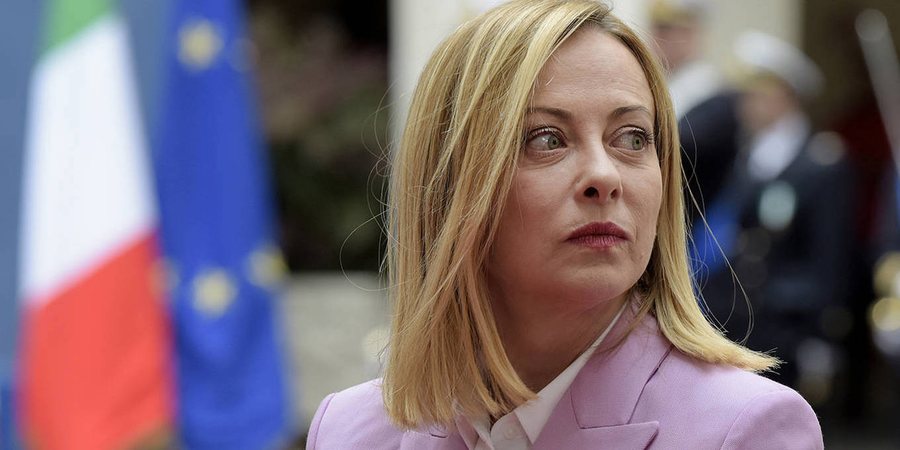
Over the past few years, Italy’s right-wing Prime Minister, Giorgia Meloni, has forged strong ties with European Union leaders in Brussels, while also remaining a darling of American right-wing populists. The question now is whether EU powerbrokers will use her fully to their advantage.
Donald Trump's return to the White House has made Giorgia Meloni an unlikely leader of the European Union in its relations with the United States. Italy's prime minister may come from a far-right nationalist party, but she is standing squarely with the EU, arguing that it is "childish" to think that Italy must choose between Trump and Europe.
Meloni was the first European leader to visit the White House after Trump announced his sweeping tariff plan — which he quickly shelved under market pressure, claiming it was all intended to force others to the negotiating table. She then returned to Rome the next day to host Vice President JD Vance, who had made his opinion of the Europeans clear in a scathing speech at the Munich Security Conference in February.
Although Meloni’s ideological instincts align with the current US administration, she has tailored her diplomacy as part of a carefully coordinated effort with the European Commission, which leads trade policy. She and the Commission president, Ursula von der Leyen, spoke several times by phone before and after her meeting at the White House, and briefly exchanged words at Pope Francis’ funeral on April 26. Meloni is lobbying to arrange a meeting between Trump and von der Leyen in Rome, positioning herself as a mediator between Washington and Brussels.
Although she has promised to import more liquefied natural gas from the US and increase Italy’s defence budget, she is a European team player, not just a national leader. “The first thing Meloni will do in dealing with Trump is to call Brussels and involve the EU in the decision,” a senior Italian official told me last November, shortly after Trump was elected. The implication was that her institutionalist side would prevail over her populist instincts. So far, it has.
This outcome was by no means certain. In principle, Meloni disagrees with Trump's description of the EU as a "pathetic" institution that exists only to tear America apart, or with Vance's image of a den of predators who have betrayed their values.
"I've been saying this for years," she said after Vance's speech in Munich. "Europe has lost a little bit of itself."
The question is whether EU power brokers will trust her enough to give her a leading negotiating role when the time comes.
“The great irony here is that Germany and France acted as informal representatives of the EU for decades, and no one objected to that,” an adviser to Meloni told me. “But if Italy tries to take on that role, suddenly it’s a problem even though Italy’s leader is objectively in a favorable position to talk to the White House.”
Meloni is walking a fine line. A regular at the American Conservative Political Action Conference, she was the only European leader invited to Trump’s inauguration. She is so confident in her MAGA credentials that, days before Trump was sworn in, she flew to Mar-a-Lago to press him to release an Iranian engineer whom Italy had arrested on the orders of the U.S. Justice Department. Iran had imprisoned an Italian journalist in retaliation, and the two prisoners were quickly exchanged. Trump has
praised Meloni as someone who could “fix the world a little,” and her advisers have built strong ties in Trump’s world. Her relationship with Elon Musk is so warm that Musk once had to deny any romantic involvement. Meloni is the first post-fascist leader to rule Italy. Until a few years ago, her Fratelli d’Italia (“Brothers of Italy”) party thrived on attacking Brussels bureaucrats and openly advocated breaking up the eurozone. But things have changed radically since Meloni came to power in 2022. She has moderated her stance on the EU and abandoned her harsh rhetoric against the European Commission. Her firm support for Ukraine has boosted her credibility with other European governments, and key figures in the pro-European establishment have vouched for her credibility. In two and a half years as prime minister, Meloni has gone from a threat to the EU to an internationally recognized European leader (though many grant her this status only reluctantly). She has reversed the approach taken by Hungarian Prime Minister Viktor Orbán, who regularly blocks EU projects to secure national advantages.
Meloni also has very practical reasons for remaining aligned with the EU. The Italian government is still supposed to receive 72 billion euros ($81 billion) from the NextGenerationEU fund. Moreover, Meloni managed to secure von der Leyen’s blessing for her controversial plan to stop migrants in Albania, outside the EU’s borders, and she has installed her close ally, Raffaele Fitto, as a vice-president of the Commission.
At this point, Meloni’s ties to Brussels are too close to be severed in the name of a nationalist stance. It suits her to play the staunch pro-European leader. After all, the real source of her political power lies in the European institutions she once despised, not in any fleeting sympathy she might harbor for a populist in the White House. / Adapted from Project Syndicate
*Mattia Ferraresi is a staff columnist at the Italian newspaper 'Domani' and a 2019 Harvard Nieman Fellow. He is the author of several books, including the first volume on Donald Trump.




Lini një Përgjigje