


 Shkruar nga Pamfleti
Pakistan, the dubious mediation between the US and Iran: ties to the Pentagon and Islamabad's role in the Ayatollahs' nuclear program...
A small blunder helps to understand the weaknesses of Pakistani mediation for the ceasefire between Washington and Tehran. This morning, Prime Minister Shehbaz Sharif posted an official message online that began with the phrase “Draft – Pakistan PM message,” as if it were a text from abroad. Did it come from the United States?
The question is reasonable: the text was changed after a few minutes, but the doubt remains and does not help to dispel the impression of an unstable Pakistani leadership and not up to the level of a diplomatic mediation that is still in the initial stages of a long and uncertain process. It is enough to see that Israel has already denied that the two-week ceasefire will also include Lebanon, while Islamabad has been talking about a complete ceasefire, including a halt to Israeli attacks against Hezbollah.
However, it is clear that Prime Minister Shehbaz Sharif, along with Foreign Minister Mohammad Ishaq Dar and especially the chief of the armed forces, Marshal Asim Munir, have played a central role in efforts to achieve a cessation of fighting in a conflict that was worsening by the day.
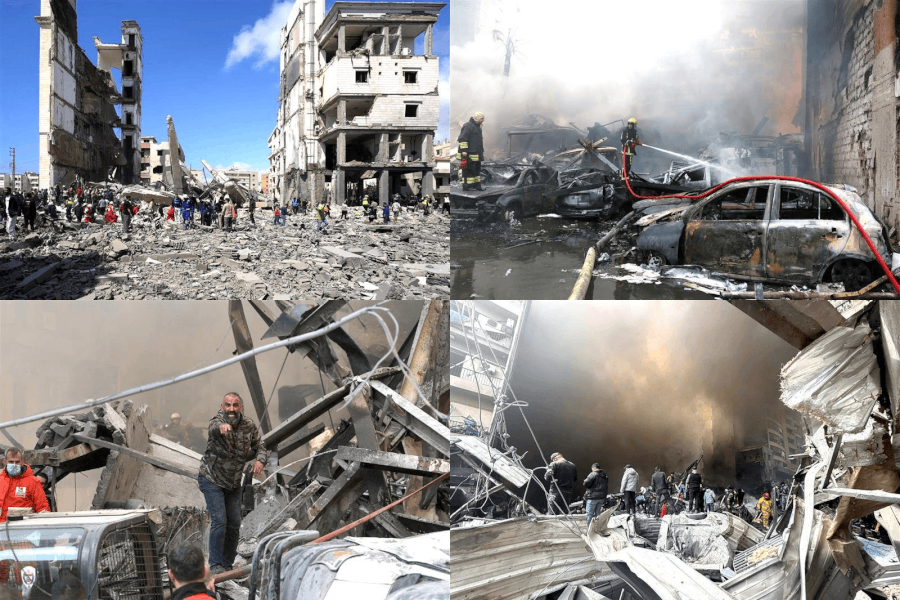
Hours earlier, President Donald Trump had threatened to return Iran to the “Stone Age” through systematic attacks on its energy grid and key civilian infrastructure. Pakistan’s interest in ending the war is obvious: much of its oil passes through the Strait of Hormuz; the country has about 50 million Shiite residents; it shares a 910-kilometer border with Iran; and for years it has sought Tehran’s support against its historic rival, India. In 1947, Iran was the first country to recognize the newly formed Pakistan after its separation from India. In 1979, Islamabad quickly recognized the Islamic Republic that emerged from Khomeini’s revolution.
It is worth recalling the difficult period of the American attack on the Taliban and Al Qaeda in Afghanistan in October 2001, as well as the pressures of the then American president, George Bush, on his Pakistani counterpart Pervez Musharraf. Then, as now, weaknesses and determination coexisted. Musharraf initially intended to remain an ally of the Taliban, but American pressure forced him to cooperate with the military intervention. Ten years later, the assassination of Osama bin Laden was carried out by American special forces in Abbottabad, which is considered the “West Point” of Pakistan. After a serious crisis, military cooperation resumed stronger.
Even today, the Pakistani military remains closely tied to the Pentagon. However, in the past, its nuclear scientists have collaborated with Iranian counterparts in the development of Tehran's controversial atomic program. The United States provides Pakistan with weapons, ammunition, financial support and intelligence for the general staff. Last year, Sharif visited Washington to meet with Trump in an attempt to reduce tensions after border disputes with India, accompanied by Asim Munir, who has strong ties to American military bases.
Sharif's weak points remain his past of trials and arrests for corruption. In 2022, a Lahore court acquitted him for lack of evidence on charges of money laundering worth more than $200 million. However, the charges have been repeated and his opponents claim that he uses political power and family ties to influence judicial processes. / Corriere della Sera


Lini një Përgjigje