


 Shkruar nga Pamfleti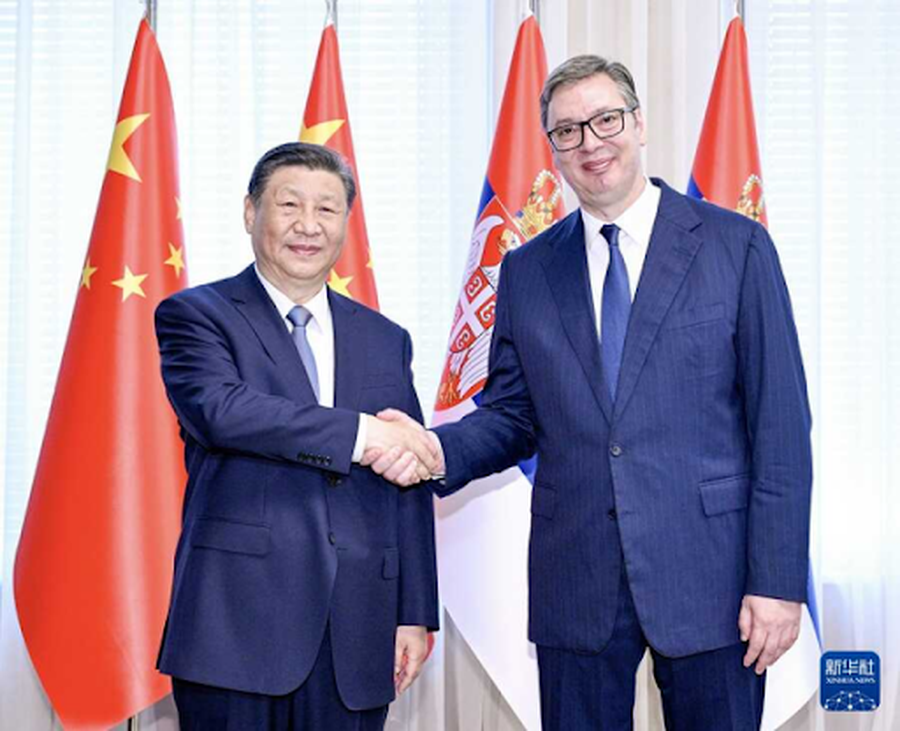
Chinese President Xi Jinping's visit to Serbia this week brought out large numbers of people carrying Serbian and Chinese flags on the streets and underscores the "steely" friendship of the two countries. In the West, this raised many questions about Serbia's future role in Europe.
Analysts say that was exactly the goal. At a time of global rivalry between Beijing and Washington, the messages President Xi delivered in Belgrade seemed aimed at a much wider audience.
President Xi and Serbian President Aleksandar Vucic signed a series of bilateral agreements on Wednesday. They were signed on the 25th anniversary of the NATO bombing of the Chinese embassy in Belgrade in 1999 to stop the ethnic cleansing of Albanians in Kosovo. The United States apologized for this action, calling it "a mistake".
David Shullman, a China expert at the Washington-based Atlantic Council, told VOA that President Xi's arrival in Belgrade on this anniversary was intended to send a broader message in the context of the war in Ukraine: that China is not a "warmonger" like the United States and NATO.
The Chinese messages, Mr. Shullman said, "repeated Russia's messages about the war in Ukraine, that Russia should not be blamed but the United States and NATO for 'fanning the flames' of the war, for continuing to support the Ukrainians, and that China is that which promotes peace and stability.
" There is a belief in the Chinese system that this is an important point that connects China and Serbia. This also fits with the message that China has given to NATO and the United States ".
China's president referred to the bombing of the Chinese embassy in an op-ed Tuesday published in Serbia's pro-government newspaper Politika: "The people of China value peace, but they will never allow such a historic tragedy to happen again," he wrote.
Paul McCarthy, director for Europe at the International Republican Institute in Washington, agrees that the timing of President Xi's visit was no coincidence.
" I think that President Xi's entire visit to Europe was organized around the 25th anniversary of the NATO bombing ," he says. "This was an important opportunity for the Chinese not to miss and it highlights Serbia's position and strategic dispute with the West for 25 years.
Presidents Xi and Vucic signed a declaration on the "shared future" of the two countries, which the Serbian president described as a level above the Comprehensive Strategic Partnership the two countries agreed to in 2016.
According to Atlantic Council analyst Shullman - President Xi has often used the phrase "shared future" to indicate that he wants a new balance of power in the world.
" The story of this shared future is that China wants to create a global order that is less led by the United States, that is multipolar, a more 'democratic' international order - as the Chinese say ," he said.
" Basically, it is a world order that is no longer led by the United States and in which China plays a more significant role ," says Mr. Shullman.
He adds: "The fact that Serbia is being talked about as the first European country that will be part of this community and the 'common future' shows that for the Chinese leaders, especially President Xi, Serbia is of great importance.. . as an economic partner and as a candidate country for the EU" .
Moreover, President Xi's visit to Serbia showed Washington that China has reliable partners in Europe and that the United States "will not be able to keep Europe as a whole on its side."
China owns mines and factories throughout Serbia and has provided billions of dollars worth of financing for roads, bridges and various facilities, becoming Serbia's main partner in developing much-needed infrastructure.
However, some experts say the future of cooperation between Belgrade and Beijing is uncertain, given the complicated relationship between the United States and China.
Vuk Vuksanovic, a researcher at the Belgrade Center for Security Policy, told VOA that the expansion of cooperation between Serbia and China from a strategic partnership to the level of "building a community of Serbia and China with a common future" is little more than a diplomatic game that suits both governments at the moment.
He added that the future relationship depends much more on Beijing than on Belgrade.
" The previous strategic partnership agreement was a 2009 joint statement that had warm rhetoric, but did not actually bring about any monumental transformation of relations ," he said.
That was until the time when China showed greater interest in the Balkans due to the One Belt One Road Initiative, a massive Chinese-led global infrastructure development strategy. I think the main question for the United States will be whether this cooperation will include any major projects in the field of defense and high technology .
Mr. McCarthy of the International Republican Institute says it is unclear how the agreements between Serbia and China and plans for a "shared future" will affect Serbia's relations with the West.
However, he notes, a free trade agreement between China and Serbia that takes effect in July "turns Serbia more towards the East," raising the question of "how serious Serbia is about its European path."
He adds that "from Washington's point of view, they may feel as if they are losing the battle for Serbia's heart".
This article was first published by the Serbian Voice of America Service, by journalists Dino Jahic, Marko Protic and Stefan Miljus./ VOA



Lini një Përgjigje