


 Shkruar nga Pamfleti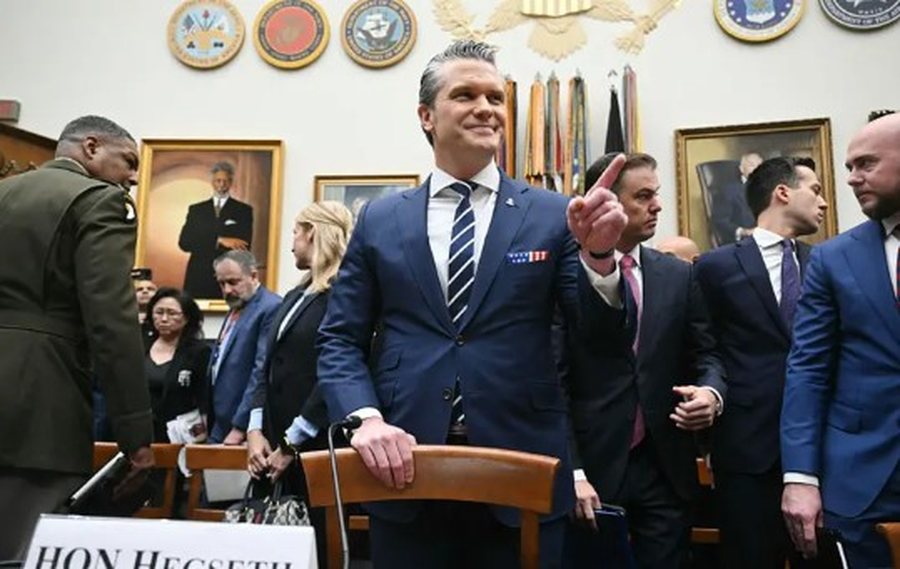
US Secretary of Defense Pete Hegseth has arrived at the Capitol ahead of his testimony before the House Armed Services Committee, in a hearing that has begun and is continuing.
Hegseth is making the case for a massive increase in defense spending. In addition to the Iran issue, the committee will ask about the White House's request to Congress to authorize a $1.5 trillion increase in the defense budget.
The hearing was opened by House Armed Services Committee Chairman Mike Rogers, who thanked Hegseth and the Chairman of the Army Joint Chiefs of Staff, Gen. Dan Caine, for their presence.
Rogers spoke about defense spending in a broader sense and suggested that it should be increased, comparing the US unfavorably to other countries, especially China.
"All of our adversaries are spending more of their GDP on defense than we are ," said Mike Rogers.
The Republican supported President Donald Trump's request for a $1.5 trillion increase, stressing that this amount understates the true cost of American deterrence. He concluded his speech by thanking American troops for their bravery, dedication and professionalism.
On the other hand, the top Democrat on the committee, Adam Smith, said the $1.5 trillion request comes at a time of competing priorities, such as health care and infrastructure costs. He presented a different approach from Rogers, emphasizing that the US cannot afford unlimited spending under the current debt conditions and noting that the US military has not yet passed an audit.
"If we give them a raise of about 50 to 60 percent, will this money be well spent? We have every reason to doubt it," said Adam Smith.
Smith also questioned the way the Trump administration has pursued the war in Iran, saying that military action has led to rising fuel costs globally and that there have been no fundamental changes in Iran.
He went on to mention the possibility of American involvement in a deadly attack on an Iranian school earlier this year. According to Iranian officials, the attack in Minab killed 168 people, mostly children, during the early stages of a joint US-Israeli attack on Iran.
"We made a mistake, and that happens in war... two months after it happened, we refused to say anything about it, giving the world the impression that we simply didn't care ," said Adam Smith.
Iran has blamed the US for the attack, while the Pentagon has said the investigation is still ongoing. Last month, US media reported that investigators believe a US strike may have been responsible for the accidental strike on the school, but there is no definitive conclusion yet.
Hegseth is facing questions from lawmakers for the first time since Trump launched a war with Iran. During his remarks, he said he appreciates the opportunity to testify in support of the defense budget request for fiscal year 2027.
"The president's budget request reflects the urgency of the moment ," said Pete Hegseth.
Defending the White House's request, he stressed that the administration aims to restore the defense industrial base to a level suitable for wartime. Hegseth also said he expects the issue of Iran to be an important part of the discussion and reiterated the position that the US will not allow Iran to acquire nuclear weapons, adding that US negotiators are working towards a deal.
"The biggest adversaries we face at this point are the reckless, relentless, defeatist rhetoric of Congressional Democrats and some Democrats ," said Pete Hegseth.
The hearing continues and is expected to include other questions on the defense budget, the war in Iran and responsibility for military incidents.
The proposal would represent the largest increase in defense spending since World War II, if approved. It includes measures such as building a new missile defense system, expanding shipbuilding and supporting increased domestic weapons production.
Funding for these measures is expected to come from deep cuts to a range of domestic services, including housing, education and environmental agencies. The proposed increase does not include the costs of the war on Iran, for which the administration has requested an additional $200 billion.


Lini një Përgjigje