


 Shkruar nga Pamfleti
Recent developments in Ukraine highlight a profound lack of strategic clarity, especially on the Western side.
International media reports, including Le Monde, report that the possibility of a "Korean model" similar to that of 1953 was discussed: not a peace agreement, but a ceasefire, a demilitarized zone in Donbas, free of heavy weapons and with international, mainly American, supervision.
A form of stability, but without a final solution.
However, this idea seems unacceptable to almost all the main parties involved. Ukraine has shown reluctance, while Russia is clear: it rejects a “frozen conflict” and insists on a long-term peace with clearly defined conditions, including recognition of the territories it controls and claims, mainly in the Donbas. From Moscow’s perspective, a simple ceasefire does not solve the problem, it simply postpones it.
Volodymyr Zelensky is now under great pressure. He raised the issue of elections, despite the fact that the country is under martial law, which makes such a process extremely difficult. At the same time, he left open the possibility of holding a referendum, without specifying which territories would be affected or what guarantees would be in place. The result is a politically constrained president, blocked both domestically and internationally.
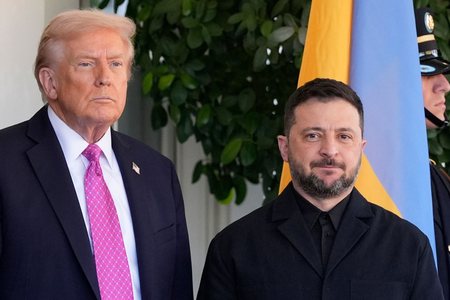
This pressure does not come only from Russia. In the United States, circles close to Donald Trump, with indicative statements from his son, are also accusing Zelensky of obstructing peace. The view is gaining ground that there is a general framework for ending the war, with Kiev emerging as the main obstructive factor. In this context, Trump appears as the player with the greatest negotiating power: if he loses patience with financing a war without prospects, he can simply cut off support.
In a sign of growing American involvement, Donald Trump's special envoy, Steve Witkoff, is traveling to Germany to meet with both Zelensky and European leaders as part of a new round of high-level talks. The meeting comes just days after Ukraine submitted a revised version of a 20-point peace plan to the United States, suggesting that Washington is trying to take a more active role in shaping the future.
Russian diplomacy is raising its voice
At the same time, Russian diplomacy is raising its voice. Russian Foreign Ministry spokeswoman Maria Zakharova told TASS that Zelensky is “squeezed” both by the situation on the battlefield and by his political delegitimization. As she said, large parts of the Ukrainian population do not trust him and have left the country en masse, while he, according to Moscow, has turned to blackmailing his Western supporters. Zakharova spoke of close corrupt relations between Zelensky and Western politicians, claiming that he is blackmailing them both on the issue of a peace settlement and on the issue of elections, even characterizing him as a “political terrorist” in terms of his methods and ideology.
In addition, Dmitry Medvedev found himself in the spotlight again with his statements, characteristically saying in reference to Zelensky: "The vile Führer pointed his finger directly from the White House. Everyone understands that a territorial referendum in Ukraine will delay the negotiations. This is exactly what the clown in Kiev wants. How much longer will you tolerate this, America?"
At the same time, Donald Trump himself has stated that a "free economic zone" could operate in Donbas, expressing confidence that many would be interested in investing in such a region, a stance that reinforces the feeling that tomorrow is already being planned more as an economic and geopolitical project than as a result of political reconciliation.
Europe cut off
For its part, Europe seems disconnected from the daily problems of its citizens. Precision, energy insecurity and migration are putting pressure on societies, while political leaders are embracing an increasingly belligerent rhetoric. Statements such as those of Mark Rutte, about "sacrifices like our ancestors", combined with the constant emphasis on military preparedness, reinforce suspicions of close relations between governments and the defense industry. Persistent rumors of the involvement of political and defense giants intensify this image.
The debate over frozen Russian assets is also particularly worrying. European institutions are considering channeling them to finance Ukraine, despite repeated warnings from Moscow of legal action. If this option continues, the most likely scenario is that European taxpayers will ultimately be called upon to bear the cost, paying both for Ukraine and, indirectly, for Russia.
The overall picture is revealing, Russia remains steadfast in its intentions, Trump moves with harsh realism and a strong negotiating position, while Europe continues to pay without defining decisions. And in the end, even the reconstruction of Ukraine seems to benefit mainly American interests. Once again, ordinary citizens are footing the bill.



Lini një Përgjigje