


 Shkruar nga Pamfleti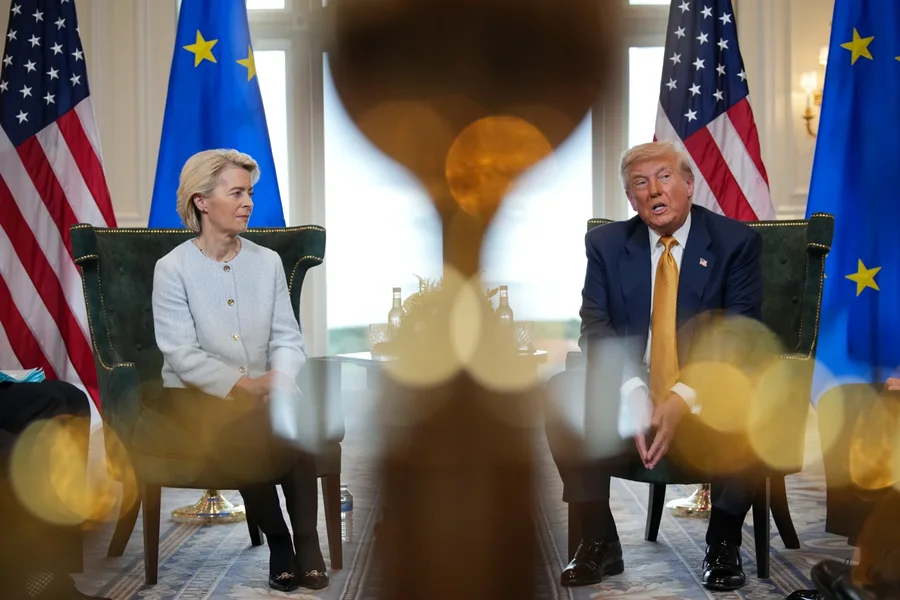
Dazed, discontented, and divided as ever: the EU was shattered by Trump.
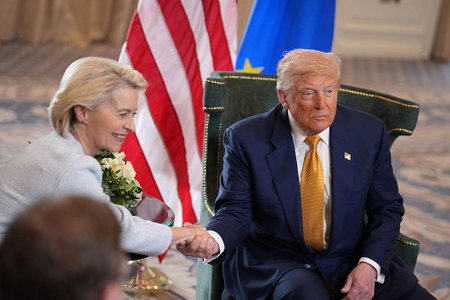
The next day, no one will be happy. The tariff deal, with Ursula von der Leyen and Commissioner Maros Sefcovic photographed smiling and giving a thumbs-up alongside Donald Trump in Scotland, does not inspire the same enthusiasm across the European Union.
It is the lesser evil, say the most complacent governments like Berlin. Paris, on the other hand, leads the front of the discontented. In Rome, Giorgia Meloni, with Trumpian leanings, feels uncomfortable. The agreement, which will impose 15 percent tariffs on many products exported to the US, including cars, semiconductors and pharmaceuticals, looks like an illegitimate child. However, Trade Commissioner Šefčovič, at a press conference in Brussels, argues that member states have been informed step by step about the negotiations.
In other words: Brussels should not be blamed for an agreement that, according to the commissioner, is “the best possible agreement.” The point is that, despite the dissatisfaction of national governments pressured by entrepreneurs and unions angry about the consequences on the economy, even the Berlaymont Palace is not sleeping peacefully now that the visit to the Scottish resort has brought new “surprises” from the unpredictable US president.
"It is a dark day when an alliance of free peoples, united to affirm their values and defend their interests, decides to surrender ," writes French Prime Minister François Bayrou in X.
According to France, the agreement is "unsatisfactory and unsustainable," says the French Minister for Europe, Benjamin Haddad, who is calling for the activation of the anti-coercion instrument to tax digital services such as apps.
It is an extreme demand that has not really been on the table with the US until now and is not being decided now.
Friedrich Merz is the only European winner of this game. The German Chancellor has not only imposed his line to reach an agreement at all costs, even if favorable to the US, to avoid 30 percent tariffs, but has also secured a reduction in taxation for cars, a strategic sector for Germany.
Under the Scottish deal, the car industry will be taxed at 15 percent instead of the current 25 percent. Merz thus emphasizes that the agreement avoids a trade conflict that would have a significant impact on the export-led German economy.
Meloni speaks of a “positive” agreement in principle, but he is neither happy nor clearly positioned. The reduction in tariffs on cars is also good news for Italy, which, like Germany, exports vehicles to the US. But overall, the agreement is also causing concern in Rome, both among the opposition and the majority. The Minister for European Affairs, Tommaso Foti, says only that “a war feared by consumers and categories has been avoided.” Foreign Minister Antonio Tajani calls for “support for companies,” but this does not find an echo in the capitals of Northern Europe.
"I appreciate the European Commission's effort and support this trade agreement, but I do so without any enthusiasm ," says Spanish Prime Minister Pedro Sánchez.
Viktor Orbán does not spare attacks on Brussels, as all sovereignists do: “ Donald Trump did not reach an agreement with Ursula von der Leyen, but rather 'ate' the president of the European Commission for breakfast. ”
For the Hungarian minister, the agreement is "worse" than the one reached by the United Kingdom: " It will be difficult to sell it as a success."
In fact, even in Brussels they are having a hard time selling it. The most the Commission can argue is that a worse scenario was avoided.
"We did our best to involve and inform our member states at every stage of the process, explaining the complexity of the situation ," says Sefcovic. Yesterday's meeting in Turnberry did not begin with an agreement, but with the threat of 30 percent tariffs from the Americans, but President von der Leyen has been a master at managing these negotiations, protecting millions of jobs, continues the commissioner, who rejects the criticism.
" The world that existed before April 2 (Liberation Day, note) no longer exists. We have to adapt. Without the agreement, with 30 percent tariffs, the situation would become so dire that we would have to sit down and negotiate a new agreement, but under much worse conditions ," says Sefčovič.
The fact is that the Commission does not feel confident in guaranteeing that the agreement with the unpredictable Trump will be respected by Washington. For this reason, the adoption of executive decrees for 15 percent tariffs from August 1 is expected. Only on August 4 will it be decided to extend the suspension of European countermeasures, which would enter into force on August 7 if all else fails. And fingers remain crossed on issues that are still subject to negotiations. Such as wines and spirits, excluded from yesterday's agreement, and steel and aluminum, which remain taxed at 50 percent.
The idea is to introduce quotas to regulate the amount that can be exported or imported without additional tariffs, but at the moment this is not a reality. Furthermore, there is the pharmaceutical sector, which is currently not taxed, but according to yesterday's agreement should be included in the products with 15 percent tariffs, not from Friday, but after the US completes its investigations into the imports.
Will that really happen?
In Brussels, they are hopeful, but remain on alert. Trump's threat resonates strongly: " Medicines are very important. We have to produce them in the US. We cannot depend on other countries for medicines. " In recent months, the tycoon has threatened to tax European pharmaceutical products imported into the US by 200 percent. And now, fingers crossed for that too: " There is a very clear political commitment to 15 percent tariffs" for pharmaceuticals as well, says a European Commission official, emphasizing that "it will not go beyond that. " But for now, " the commitment is not legal ," they admit.
Even in this case, the executive decree is expected: verba manent. To check, it is not confirmed with 600 billion dollars of investments made in the US. We are talking about private investments and not public investments, like the 550 billion dollars signed by Japan in last week's agreement with Washington.
Before Trump's second term in the White House, tariffs on European products generated $7-8 billion. At 15 percent, the value reaches about $80 billion, according to Brussels.
"But it will be paid by American importers ," insists the European Commission, hoping that the tariffs will backfire on the tycoon.
“It could also be American consumers who will pay higher tariffs on imported European goods ,” the same source continues. The real hope is that this nightmare will end in three years with the end of the Trump presidency. For this reason, the EU has committed to spending $750 billion on energy imported from the US: $250 billion over three years.
Meanwhile, Brussels will try not to make further concessions, for example in agriculture, where it has already agreed to pay zero tariffs on some imported American products.
“ There are no concessions for sensitive agricultural sectors. There is no beef, sugar, ethanol or poultry in our proposal. What we give the US is only about what we really need: soybeans, soybean oil, dried fruits and almonds, a category of nuts, ” says a European Commission official. Dazed, dissatisfied and divided as always: The EU crumbled under Trump./ Adapted from “Pamphlet” by “HuffPost”



Lini një Përgjigje