


 Shkruar nga Pamfleti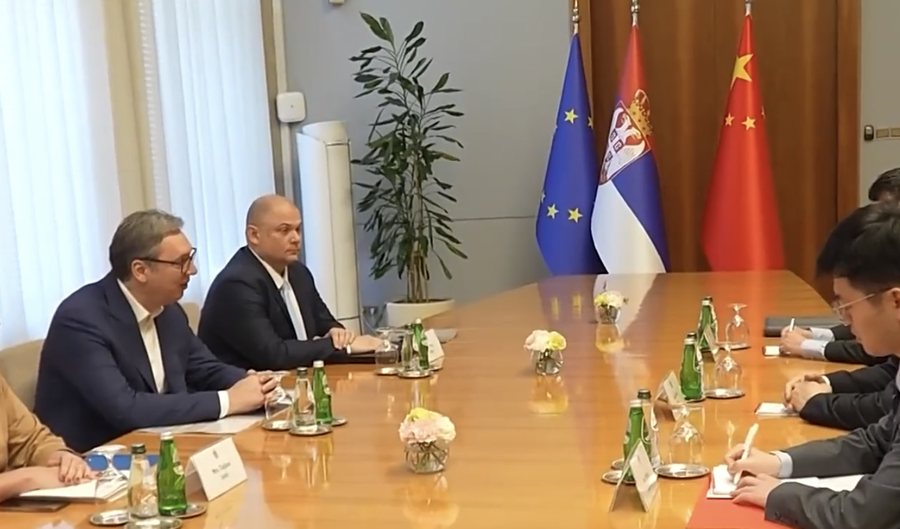
The meeting between Serbian President Aleksandar Vučić and Chinese President Xi Jinping strengthens the Beijing-Belgrade strategic partnership and reflects China's efforts to expand its political and economic influence in Europe in the context of an increasingly multipolar international order...
Serbian President Aleksandar Vučić's visit to Beijing has taken on considerable geopolitical weight at a time when the global balance of power is rapidly shifting. His meeting with Chinese President Xi Jinping goes beyond the framework of bilateral relations and is linked to China's broader strategy to strengthen its influence in Europe and consolidate its role as one of the main pillars of the new multipolar order.
The timing of the visit has been interpreted as symbolic in Serbia. Serbian media and political analysts have highlighted the fact that Vučić arrived in Beijing immediately after Xi Jinping's meetings with Donald Trump and Vladimir Putin. In Serbian public discourse, this ranking is seen as a signal that China considers Serbia a strategic partner in the Balkans and an important point for expanding Chinese presence in Europe, writes Independent Balkan News Agency.
Vučić's visit to China comes at a time when the US has published its new strategy for the Balkans, which is considered the center of geopolitical competition between the West, Russia, and China.
The US identifies Russia and China as the main actors challenging US interests in the Western Balkans. The new US strategy states that China uses state loans, infrastructure projects, propaganda and ties to political elites to expand its economic and political influence.
The report particularly criticizes the Chinese investment model, claiming that Chinese companies often win tenders with low bids, but then increase the real costs of projects through delays and financial overruns.
The US administration argues that functioning economies and transparent institutions are the best protection against Russian and Chinese influence.
From Beijing's perspective, Serbia remains one of China's most important partners on the European continent. In recent years, China has steadily expanded its economic and strategic presence in Serbia through investments in infrastructure, transport, energy and industry. The free trade agreement, visa-free regime and direct flights have further strengthened cooperation between the two countries.
At the same time, Serbia has become an important connecting node between Southeast and Central Europe in the context of Chinese economic interests. This has given Belgrade increased importance in Beijing's European strategy.
Relations between the two countries also carry a strong political and symbolic dimension. Chinese officials continue to use the term “iron friendship” for relations with Serbia, referring to the political support that Belgrade has given China on issues sensitive to Beijing, especially Taiwan.
On the other hand, Serbia has maintained close ties with China without fully aligning with Western political positions. This gives the partnership special importance for Chinese diplomacy.
For President Vučić, the visit comes at a time when Serbia is facing increased geopolitical pressures, especially regarding Kosovo, relations with Russia, and the process of integration into the European Union. In this context, China is presented as an important economic and diplomatic partner that does not impose political conditions similar to those of Western countries.
Serbian leaders try to maintain a careful balance between East and West, using relations with Beijing to strengthen Belgrade's negotiating position in the international arena.
In Serbian political and media circles, it is argued that China has offered Serbia investments and infrastructure projects at a pace and political flexibility that the European Union has not been able to offer in the same way. Serbian media also pay special attention to the way Beijing organizes visits by foreign leaders, interpreting the ceremonial protocol and symbolism of the meetings as indicators of the importance that China attaches to its partners.
For its part, China is trying to present cooperation with Serbia as an example of an alternative model of international relations, based, according to the official Chinese narrative, on mutual respect, equality, and non-interference in the internal affairs of sovereign states.
Beijing rejects Western criticism of creating spheres of influence and aims to promote relations with countries like Serbia as a model of cooperation between states of different sizes and political systems.
Vučić's visit to Beijing demonstrates the strategic importance that the Balkans are taking on in Chinese foreign policy, but also Serbia's attempt to strengthen its international role in the conditions of growing rivalry between great powers. In a period when global balances are being reshaped, relations between Beijing and Belgrade are taking on an increasingly pronounced political, economic and strategic dimension. / Pamphlet /


Nje shkja zuzare, qe mezi ngopet me buke, ço e sfidojnë perëndimin?!
Gjatë viteve 1960–1970, marrëdhëniet midis Shqipërisë dhe Kinës ishin shumë të ngushta. Pas prishjes së Shqipërisë me Bashkimin Sovietik ,në fillim të viteve ’60, regjimi i Enver Hoxhës u lidh fort me Kinën e Mao Zedong. Kina u bë mbështetësi kryesor ekonomik dhe politik i Shqipërisë. Sa i përket anijeve: Ka raste kur anije tregtare kineze janë regjistruar ose kanë lundruar nën flamur shqiptar. Kjo lidhej me arsye politike dhe tregtare gjatë periudhës së izolimit ndërkombëtar të Kinës komuniste. Në disa porte ose rrugë detare, përdorimi i flamurit shqiptar mund të shmangte kufizime, kontrolle ose tensione diplomatike që lidhen me Kinën. Shqipëria në atë kohë konsiderohej aleati më i afërt europian i Kinës.