


 Shkruar nga Martin Sandbu
For those Putin considers to be his own, any desire to escape his power is treated mafia-style, as treason for which no punishment is severe.
We cannot know whether Vladimir Putin timed Alexei Navalny's death to mark 10 years since his proxy Viktor Yanukovych was ousted as Ukrainian president following protests in Kiev's Independence Square – or actually two years of his war on a large scale. But such morbid calendrical symbolism would be in keeping with his character.
What we must be sure of is that the killing of Navalny and the attack on Ukraine are two related issues. They are manifestations of the same mafia gang. For those Putin considers to be his own, any desire to escape his power is treated mafia-style, as treason for which no punishment is severe.
This is why I wrote a year ago that Russia's war against Ukraine is not primarily a conflict over territory, or even over Ukraine's future NATO membership. It is a fight for a way of life. Moscow offers only a neo-Soviet restoration and the kind of society-eradicating occupation imposed on Eastern Europe in the late 1940s. The brutality of the Donbass, let alone the one in Bucha, attests to this, and Ukrainians are fully aware of this.
Their admirable struggle to defeat Russia's killing machine since 2014 has been accompanied by an equally impressive internal struggle to free themselves from their legacy of Soviet ways - corruption, monolithic governance, inequality in favor of those who capture the state, stifling thought and speech.
Neither the external nor the internal war has been won by Putin yet, but what is essential to understand is that both are the same thing. If Ukraine's Western friends can fully understand this, they would no longer be shy, which is evident even after the great contributions they have made to Kiev.
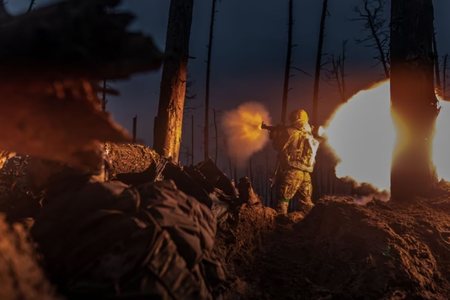
This timidity is most evident in the issue of weapons. Ukraine is struggling to hold the front line due to lack of ammunition. Her counterattack was unsuccessful in part because she could not sufficiently cover the sky. These concrete shortfalls are the result of Western leaders' early denial of Kiev's appeal for fighter jets or their failure to deliver on the munitions promise with the urgent action needed to produce it.
Even today, the West is reluctant to provide long-range weapons that reach Russia. However, as NATO Secretary General Jens Stoltenberg finally made clear this month, international law allows Ukraine to defend itself against a war of aggression by striking valid military targets inside the aggressor country. But international law has not suddenly changed. If it is allowed now, it was allowed two years ago.
So in all these cases, a more decisive action two years ago would have left Ukraine, and the West, in a much better position today.
The same applies to economic measures. Western sanctions have too many shortcomings, loopholes and lack of enforcement to list. As a result, the EU paid Russia far more money for oil and gas in the first year of the full-scale war than it gave Ukraine in two parts, and a thriving sanctions-busting business has been allowed to flourish. In the past year, sanctions have become more effective – but early enforcement would be better.
Two years ago, Western countries blocked Moscow's access to more than $300 billion in foreign reserves. They have vowed not to unlock them until Moscow compensates Ukraine for its destruction. But they have not yet dared to implement this compensation by transferring the assets to a fund for the reconstruction of Ukraine.
If, two years ago, the leaders who decided to immobilize Russia's reserves had gone further and seized them completely, they would now be held in storage for the sake of Ukraine's future needs, or they could already finance reconstruction, further strengthening Ukraine's ability to resist.
The lesson on both the military and economic sides is the danger of believing in the virtue of caution when in practice it means delay. Early "caution" has prolonged suffering in Ukraine, emboldened the Russian dictator who thinks he can outwit Kiev's Western backers, and increased the cost of pushing him back. Whatever might have been accomplished early can now be accomplished only in more time and at greater cost.
Navalny's message before his recent return to Russia was that " the only thing needed for the triumph of evil is for good people to do nothing ." Evil also benefits, when good people are too careful. Don't keep making that mistake./ Adapted "Pamphlet" from "Financial Times"


Lini një Përgjigje