


 Shkruar nga Pamfleti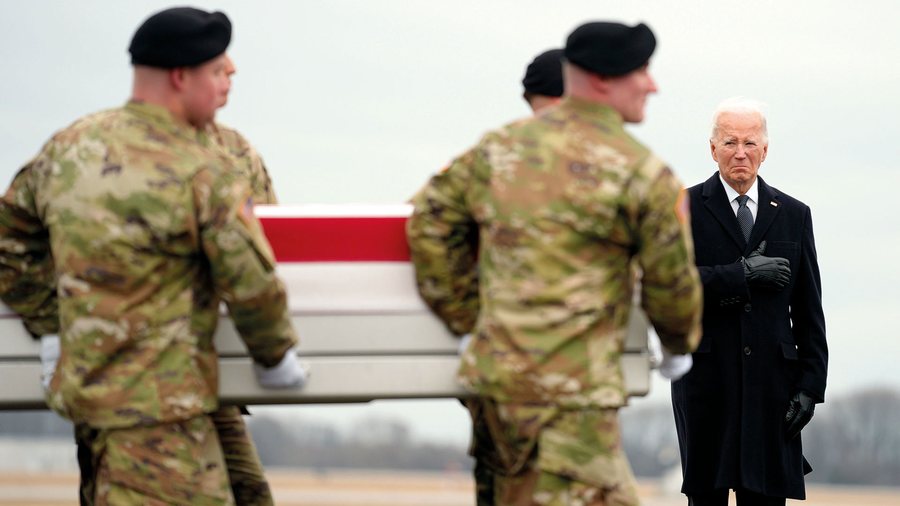
The attack by the Islamic Resistance in Iraq, which killed three Americans at a US base in Jordan a week ago, caught Washington by surprise because it clearly bore the hallmarks of Iran. This now forces it to respond strongly, but also to refrain at the same time, to attacks in Iraq and Syria, i.e. not inside Iran or against an Iranian target, in order not to risk a direct conflict with Tehran.
Last Sunday's attack took place in an unpredictable area, at the Tower 22 base in Jordan, the existence of which Amman had apparently denied until last week. The choice of target caught the US by surprise: it is an insignificant US military post in the middle of the desert, in the far northeastern tip of Jordan, on the border with Syria, while Iraqi territory is only 10 km away.
At the same time, the way it happened raises the suspicion that it was planned and carried out with the help of a well-organized force that had important information at its disposal: the enemy drone attacked at the moment when a friendly drone was returning to base and that was the reason which was not stopped in time. Iran insists it denies any involvement, but Joe Biden has been under intense pressure to retaliate decisively.
This particular pro-Iranian organization has enjoyed Tehran's military support for years, and while it has its own interests, these are often the same as Iran's. Since the American invasion of Iraq until today, Tehran has used such organizations to expand its influence in the country, and after the withdrawal of American forces in 2011, these organizations took over Iraq's fight against the Islamic State, which managed to control a third of the country. Today, these lands on the Iraq-Syria border, which were once under the control of the Islamic State, are the stronghold of the "Islamic Resistance", from where last Sunday's attack began.
In two movements
Joe Biden's doctrine was described this week very accurately in his New York Times (NYT) column by Pulitzer Prize winner Thomas Friedman. According to the journalist, in the first phase, Biden will respond decisively "against the representatives of Iran and its agents in the region". A few hours later, the presidential order for strikes against Iranian targets was announced, and on Friday night US warplanes struck a total of 85 targets in seven locations in Syria and Iraq. The US targeted the positions of the Revolutionary Guards and allied paramilitary organizations in both countries.
US warplanes hit a total of 85 targets in seven locations in Syria and Iraq. These were positions of the Revolutionary Guard and collaborating paramilitary organizations.
In a second phase, a US diplomatic initiative to create a Palestinian state is expected, as Washington has now concluded that there is an urgent need to recognize a Palestinian state in the West Bank and Gaza. In Friedman's view, this will only be possible when the Palestinians develop a set of defined, credible institutions and security capabilities that will guarantee that this state is viable and does not threaten Israel.
The problem is how this will happen while Israel's prime minister is Benjamin Netanyahu, who allegedly says one thing to Biden and another inside his own country. To his American interlocutors he appears relatively mild, while to the Israeli audience he presents the image of the intransigent. Apparently, the US, understanding bilingualism, is investing in a more palatable succession situation in the country after voting in the already highly unpopular "Bibi", who has become a hostage to his far-right partners. His position is indeed more than difficult: on the one hand, he faces the message of public opinion, which demands an agreement with Hamas for the release of the remaining hostages; on the other hand, if he submits to these pressures, he risks the departure of extreme right-wing parties, which consider any agreement treacherous, thus the fall of his government.
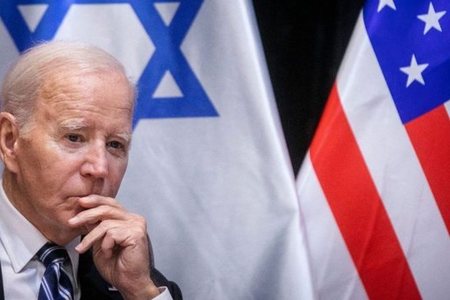
The conclusion of the Biden doctrine, as described by Friedman in the NYT, includes as a third pillar an expanded alliance between the US and Saudi Arabia, which also foresees the normalization of Riyadh's relations with Israel. Before the October 7 attacks, the two countries were very close to concluding an agreement, but a few days later, Saudi Arabia "frozen" the agreement.
Many of the US president's moves also obey pre-election needs, as Biden neither wants to lose the powerful Israeli lobby nor alienate voters of Arab origin and the progressive pro-Palestinian part of the Democrats. To maintain these difficult balances, this week he announced sanctions against those Jewish settlers who commit violence against Palestinians in the West Bank.
Famine crisis, dead and ruins
At this moment, however, daily life in the region leaves little room for optimism: the number of dead Palestinians has exceeded 27,000 and the number of wounded has exceeded 66,000. Over 1.7 million have been displaced and face the specter of hunger and disease. At least half of the buildings (estimates are 50%-61%) have been destroyed or damaged. In addition, Israeli forces have carried out massive demolitions of buildings, including mosques, schools and entire parts of residential neighborhoods, as part of the creation of a safe zone inside Gaza, to prevent another occupation operation like that of October 7.
At the same time, many countries have suspended funding to the UN Relief and Works Agency for Palestine Refugees (UNRWA), which is the main source of humanitarian aid for the Palestinian people. The reason is the revelation that 12 UNRWA workers were directly or indirectly involved in the October attacks. Most countries have clarified that the suspension is temporary, but the need for food and medicine is immediate.




Lini një Përgjigje