


 Shkruar nga Diane Francis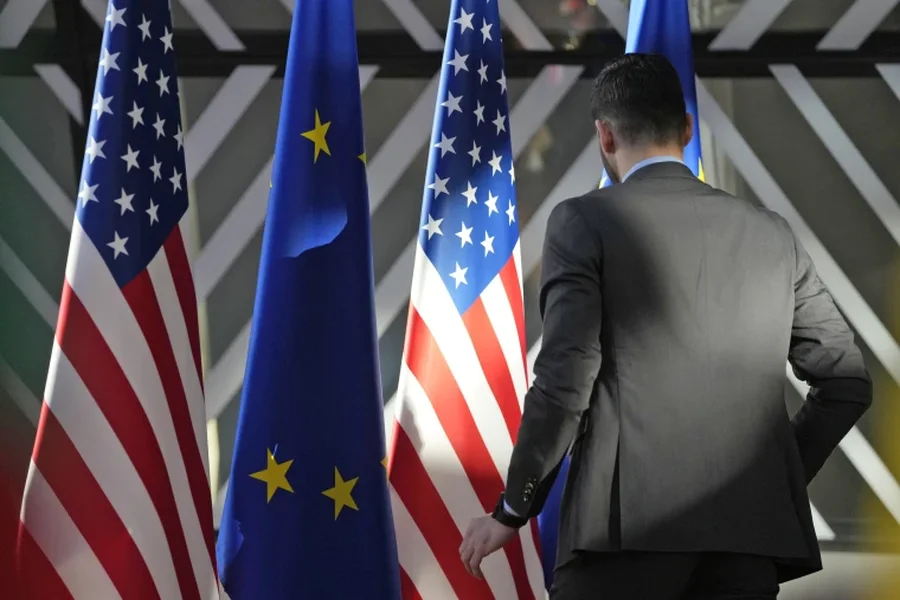
Europe must learn to "stand on its own two feet", but America cannot withdraw without causing serious political and economic difficulties for its most important allies...
In the fall, Americans will choose an internationalist or an isolationist as president. But the future of Europe, the outcome of the war in Ukraine, the global economy and the current world order also depend on these elections. If the isolationist Trump wins, he could withdraw or greatly reduce US contributions to NATO.
This would force Europe to rapidly build up a larger military force, and fund Ukraine endlessly in its war, to stave off Russia's march to the West. America's isolationist approach ended in the 20th century, when Washington volunteered twice to save Europe.
After 1945, America helped transform the continent from a heap of ruins and a perennial slaughterhouse into dozens of prosperous and peaceful democracies. The European Union and NATO were created. But today, Americans are tired of the role of global gendarme.
There is still no end in sight to the war in Ukraine, and the 27 EU members may be forced to shoulder the entire cost of aid themselves. Faced with this scenario, European financial markets are falling, while the price of the US dollar and gold is rising. There are also many political divisions on the continent, but Dutch Prime Minister Mark Rutte recently criticized European leaders for their grievances.
"We must stop complaining or worrying about Trump's return to the head of the USA. This is in the hands of the Americans. I'm not an American, I can't vote in the US. We must work with whoever will be in the White House," he said. Fortunately for Europeans, their nations are rich, and together have a GDP 10 times that of Russia.
And Ukraine may continue to struggle until 2025 or beyond, given the tens of billions in aid it has received from Europe, the $61 billion it has received from the US Congress, and the $50 billion in interest payments from frozen Russian assets recently granted by the G7.
However, sustained support will be needed to replenish depleted ammunition depots and deliver new weapons. And the Europeans are preparing for it. Mark Rutte was recently elected Secretary General of NATO, the de facto "national armed force" of Europe. He aims to press for more spending on defense and munitions production in Europe. And the EU just appointed as its foreign policy chief a figure who takes a very tough approach to Russia, former Estonian prime minister Kaja Kallas.
The latter has explained how both organizations will work together: "In the conditions of a military crisis, it is important who gives orders to whom, and how the chain of command really works. Militarily, this belongs to NATO. But in stimulating the defense industry, the European Union also has an important voice".
Rutte agrees with Kallas. But Viktor Orban, the pro-Russian prime minister of Hungary, who has just taken over the presidency of the EU for the next 6 months, is also on stage. He has upset many people by obstructing and delaying key decisions in both the EU and NATO over the past few years, which Russia has benefited from.
He has also been criticized for recently meeting with Russian President Putin, China's Xi Jingping and Republican candidate Donald Trump as a self-appointed peacemaker. When he returned from his international tour, Orban warned Europeans: Prepare for a U-turn in US policy in Asia, and seek negotiations with Russia, or provide more funding to continue the defense of Ukraine.
Ukraine's response to all this uncertainty and anxiety has been perfect. "I think if Donald Trump becomes president, we will work together. I am not worried about this issue" - said the President of Ukraine, Volodymyr Zelensky.
Meanwhile, on July 15, he announced that Ukraine will present a "plan" for a "just peace" in talks scheduled for November, the same month as the US presidential election. The importance of this proposal cannot be underestimated. Because it is the first time that Zelensky agrees to conduct direct negotiations with Moscow, without setting the precondition that Russian troops leave all Ukrainian territory.
However, success is by no means guaranteed. For starters, Putin wants the return of his frozen assets and Ukraine's non-membership in NATO or the EU. Meanwhile, Kiev wants the return of its territories, security guarantees equivalent to NATO membership, and independent peacekeepers stationed permanently in the disputed territories.
Another obstacle is the doubt whether Putin's words can be trusted, and the fact that Europe has not yet managed to take its measures. Either its states will unite and cooperate militarily, no easy task given their history of bloody conflicts, or they will divide and conquer.
"Our Europe today is mortal. She could die!” French President Emmanuel Macron warned in February. He wants Europe to mobilize quickly, and to consider sending troops to Ukraine, a statement that caught the French by surprise and contributed to his failure in the last election.
But this was not an extraordinary reaction. When polled recently, most Europeans said they would not fight for their country or for Europe. In May, the European Council on Foreign Relations (ECFR) institute polled citizens in 15 European countries, and most people believe that we are more likely to have a negotiated agreement with Russia, rather than an outright military victory. Ukraine.
In general, most countries agree to give Ukraine more weapons, even if only to improve its negotiating positions. Meanwhile, there is no agreement among the Czechs, French, Germans, Dutch and Spanish on the future role of the EU.
None support sending troops to Ukraine, and only 32 percent of Europeans said they would be willing to fight for the EU, with only 14 percent of Italians saying they would be willing to fight for Italy. Also, only the countries closest to Russia, which surround the Baltic Sea, have compulsory military conscription in force: Sweden, Denmark, the three Baltic countries, Finland and Norway.
Despite everything, Europe must learn to "stand on its own two feet", but America cannot withdraw without causing serious political and economic difficulties for its most important allies, trading partners and democracies. The retreat, based on the myth that Russia is not an existential threat to Europe and the world economy, is unreasonable.
Putin invaded Ukraine without any provocation or justification, and may then aim to invade EU and NATO countries. He is causing unrest in the Middle East. If America reneges on its commitments, it will be tested by China and others.
Putin will escalate the war in Ukraine, and 10 million more refugees will go to EU countries, causing political and financial chaos. Therefore, NATO members of Europe must pledge to invest heavily in defense and security industries. / Adapted "Pamphlet" from "Kyiv Post"


Lini një Përgjigje