


 Shkruar nga Pamfleti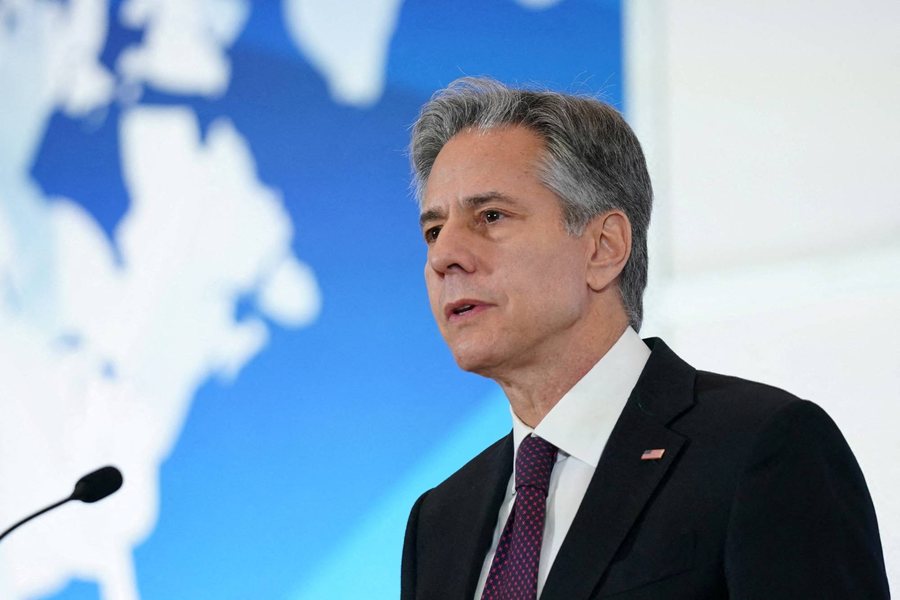
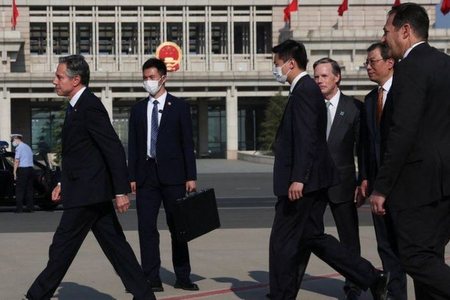
The visit of US top diplomat Antony Blinken to Beijing is a difficult political balancing act. Blinken's most important mission: to reduce the risk of military confrontation with China.
"Competition with China should be managed in such a way that it does not turn into a conflict", this is the message that President Biden gave to the American Secretary of State, Antony Blinken, at a reception at the White House a few days before the visit to Beijing that starts on Sunday with bilateral meetings. How tense the situation is between China and the US was shown a few weeks ago, when there was almost a collision between an American and Chinese military ship in the Taiwan Strait. Of greater concern to experts is the fact that both parties communicate more through the media than directly. Beijing's military refuses to respond to calls from the Pentagon.
"Long and difficult process"
That dialogue is difficult was also seen at the Asian Security Forum in Sangri-La, Singapore, when the US Secretary of Defense, Lloyd Austin, said that the US will not "back down from Beijing's provocations". At the same time, the Chinese counterpart, Li Shangfu, did not accept a bilateral meeting within the framework of the summit.
Washington did not exaggerate this diplomatic incident further, and this shows the concern of the US before another escalation. "It will be a very long and difficult process to recreate the communication channels with Beijing", is the opinion of Noah Barkin, analyst from the research institute "Rhodium Group Research" for DW. US China conflict topics range from Taiwan to China's support for Russia to reports of China's espionage installation through Cuba.
Washington, for its part, strives for extension. "Both sides have an interest in maintaining stable, clear and open channels of communication," says Kurt Campbell, White House coordinator for Indo-Pacific affairs. But apparently both sides have different assessments. "The Chinese see contact, exchange and summits as a favor they do the other side," says Dean Cheng, an adviser at the American Institute of Peace, a think tank close to the government. The fact that the US did not release information about the spy balloon discovered in February is seen in Beijing as a concession by Washington, which enabled Blinken's current visit.
Taiwan the apple of the row
A visit at a heated geopolitical moment. Last year, US President Joe Biden announced a "new era" of cooperation in the Indo-Pacific space and deepened this with the prospect of cooperation for a number of ASEAN countries, Japan, the Philippines and South Korea. The US recently declared that it has access to Philippine military bases. China sees this as a provocation. Such conflicts will play a role in Antony Blinken's meeting with Chinese Foreign Minister Qin Gang in Beijing, even as Blinken mentions China's support for Russia. The US is concerned that China is supplying Russia with weapons in the war against Ukraine, but so far the US has no evidence of this.
At the same time, members of the American Congress have entered into a rhetorical contest for toughening the policy towards China. House Speaker Kevin McCarthy met with Taiwan President Tsai-Ing-Ven. "I don't believe anyone wants a conflict on the Taiwan Strait," is the opinion of Noah Barkin. "However, it is difficult to send the right messages, especially when Beijing sees anything that happens in relation to Taiwan as a provocation."
Bilateral dependence in trade
The tough political line sought by the American Congress casts a shadow on the talks on the perspective of economic cooperation. Before the export controls on high-tech chips and other technologies, the Chinese side is expected to seek concessions from Washington, according to Barkin. This also applies to the control of other technologies. The export bans the U.S. imposed on American technology range from software to equipment for making modern computer chips.
It was a "shock" for the Chinese government to realize how dependent it was on Western software, says Dean Cheng. But the expert does not expect that the US will make concessions in this regard. As Washington tries to free itself and allies from Chinese imports, Beijing is seeking talks with the US to reassure investors, Noah Barkin opines. The world's largest economy and the second largest are closely linked, although strategic interests in the competition for world hegemony are increasingly clashing with the superpowers. However, for Barkin trade is currently a source of stability.
Clash for human rights
At the meeting in Beijing, two political systems completely different in the values they carry face each other. The world's most powerful democracy is facing the world's most powerful authoritarian regime. A dozen human rights organizations have signed a statement ahead of the visit, asking US Secretary of State Blinken to address a range of issues related to the human rights situation, from Uyghurs to freedom of the press./DW







Lini një Përgjigje