


 Shkruar nga Pamfleti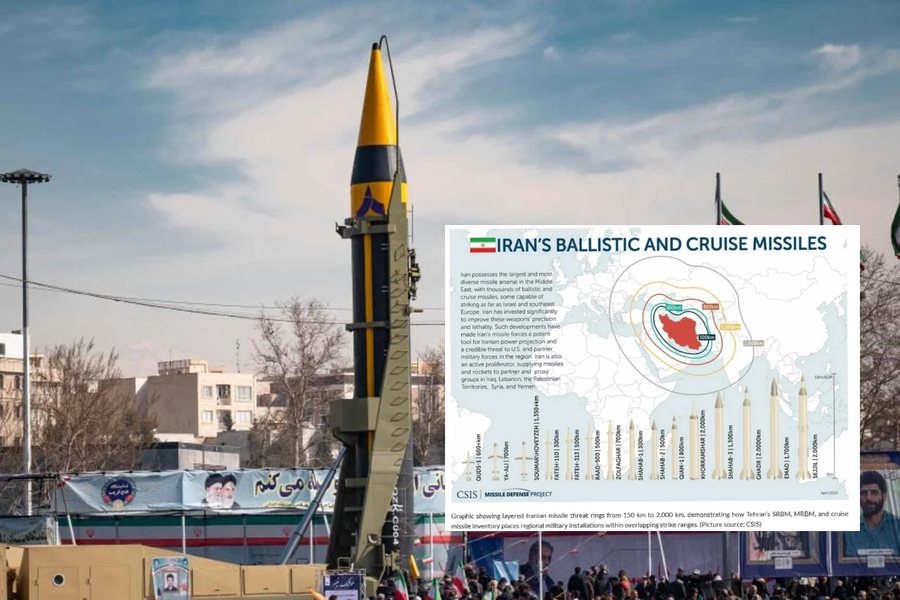
Mediterranean and Balkans in the perimeter of Iranian missiles
Iran's missile program has capabilities that extend beyond the Middle East and directly affect European territory. According to a chart published by the US think tank Center for Strategic and International Studies (CSIS), Iran's ballistic and cruise missiles create strike rings of 300 to 2,000 kilometers, encompassing a significant part of Southeast Europe.
Shorter-range missiles, around 300–500 kilometers, cover Iran's neighboring countries. But the 1,300-kilometer ring, which includes the Shahab-3 missile, reaches all the way to the eastern Mediterranean, including Cyprus and parts of Turkey.
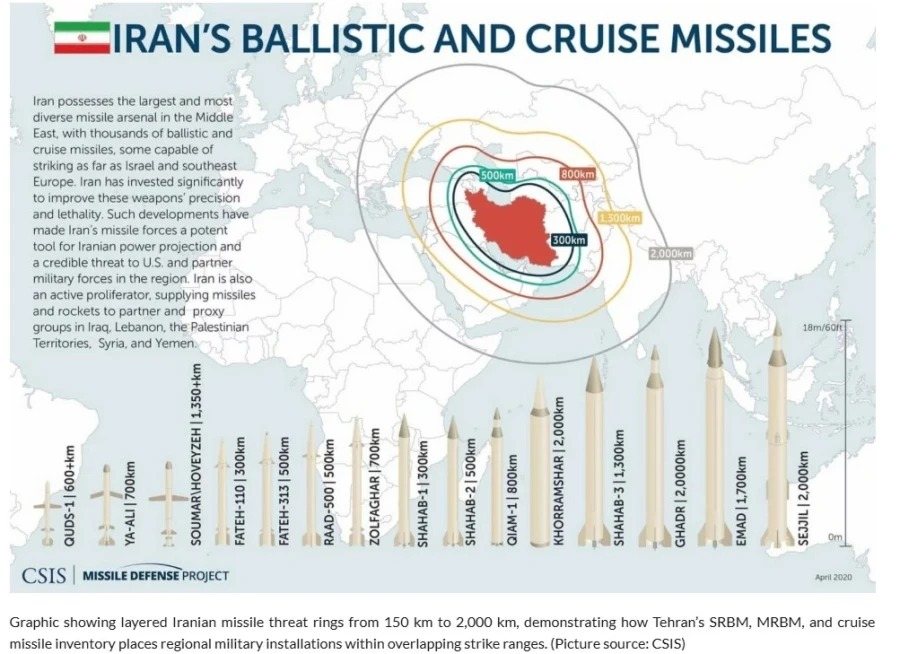
The wider ring, up to 2,000 kilometers long, which includes the Sejjil, Ghadr and Khorramshahr missiles, extends deep into European territory. Within this radius fall Greece, Albania, Bulgaria, Romania and a significant part of the Western Balkans. Also, parts of southern Italy, Hungary, Slovakia and even areas of Central Europe are within this theoretical perimeter.
According to CSIS data, Iran possesses thousands of ballistic and cruise missiles, considering its arsenal the largest in the Middle East. Some of the most advanced systems, such as the Khorramshahr-4, have a range of 2,000 kilometers and carry heavy warheads, while using engines that reduce the time of preparation for launch. The solid-fuel Seyjil missiles provide operational flexibility, while the Ghadr-110 improves the response time compared to the previous Shahab versions.
The map published by CSIS clearly shows the overlap of these beams, creating a wide area of influence that includes military installations, strategic ports, and airports in the eastern Mediterranean and Southeast Europe.
Iranian Arsenal
Khorramshahr
The Khorramshahr missile has a range of 1,000 to 2,000 kilometers and can carry a warhead weighing up to 1,800 kilograms. Its length reaches 13 meters. The latest version, the Khorramshahr-4, was presented on May 25, 2023. According to Iranian authorities, this variant has a range of 2,000 kilometers when carrying a 1,500-kilogram warhead. It uses a more advanced engine with special fuel, reducing the preparation time for launch to about 12 minutes.
Sejjil
The Sejjil is a solid-fueled medium-range ballistic missile. The system was developed to replace the liquid-fueled Shahab missiles. Development of the Sejjil is believed to have begun in the late 1990s, drawing on Iran's experience with previous missile programs. The use of solid fuel reduces preparation time and increases operational flexibility.
Ghadr (Qadr-110)
The Ghadr-110, also known as the Qadr-110, is a ballistic missile with a range of 1,800 to 2,000 kilometers. Iran first publicly unveiled it during a military parade marking the anniversary of the Iran–Iraq War. The Ghadr is considered an improved version of the Shahab-3A. It is estimated to combine a liquid-fueled first stage and a solid-fueled second stage, achieving a range of up to 1,500 kilometers in some configurations.
The Ghadr-110 has a preparation time of about 30 minutes, shorter than that of the Shahab-3, which takes several hours. The missile is manufactured in Iran, at the Hemmat Missile Industries complex.
Shahab-3
The Shahab-3 is a family of liquid-fueled ballistic missiles developed by Iran and the Revolutionary Guard, based on the technology of the North Korean Nodong-1/A and Nodong-B missiles. Their range varies from 1,000 to 2,000 kilometers, depending on the variant.
According to CSIS analysis, the combination of these systems gives Iran a strike capability with a wide regional reach. In the context of current tensions in the Middle East, the range of these missiles places part of the eastern Mediterranean and southeastern Europe within their operational potential.





Para se të bëni llogaritë e rraketave Iraniane që të përhapni panik në popull,shtoni presionin ndaj qeverisë që të largojë Iranianët nga manza sepse janë fiks në kohë për të arritur objektivat në vendin e tyre dhe mos na bëjnë neve objektiv goditje për faj të tyre,pse kështu shpërblehet nderi që i mbajtëm deri tani?!