


 Shkruar nga Pamfleti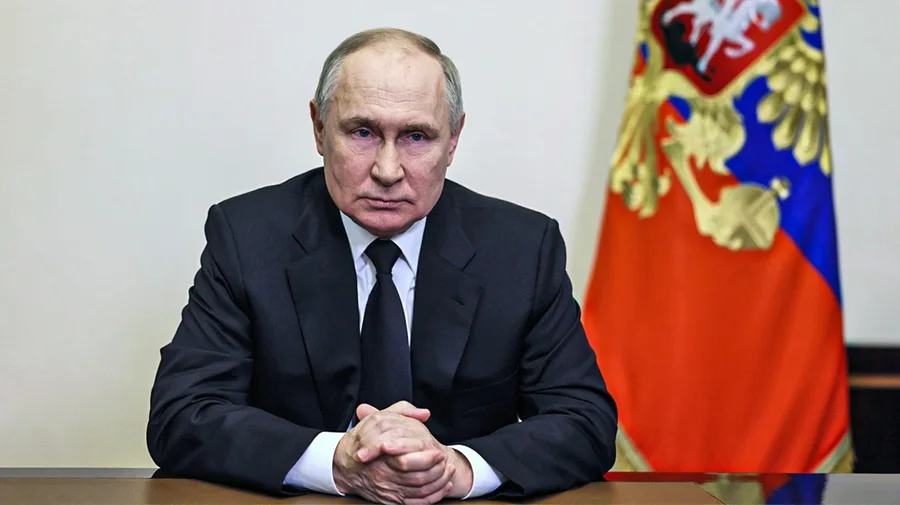
Putin seemed blindsided by the attack. He took more than 19 hours to address the nation about the attack, the deadliest in Russia since the 2004 school siege in Beslan, in the south of the country, which claimed 334 lives.
Less than a week ago, President Vladimir Putin of Russia claimed a fifth term with his largest ever share of the vote, using a stage-managed election to show the nation and the world that he was firmly in control. .
Just days later came a fiery backlash: his vaunted security apparatus failed to prevent Russia's deadliest terror attack in 20 years.
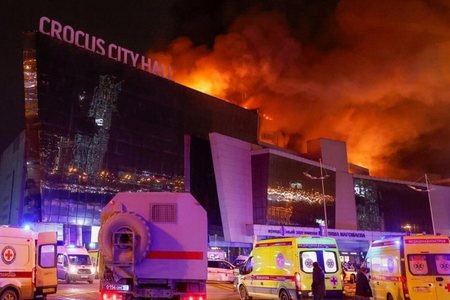
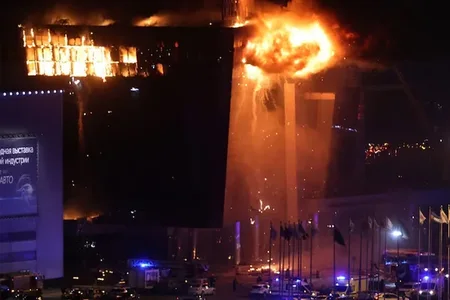
Friday's attack, which killed at least 133 people at a concert hall on the outskirts of Moscow, was a blow to Putin's image as a leader for whom national security is paramount. That's especially true after two years of a war in Ukraine, which he describes as key to Russia's survival — and which he made his top priority after last Sunday's election.
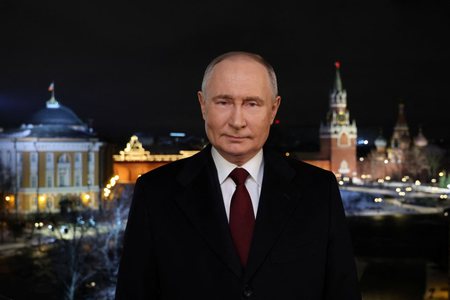
Putin seemed blindsided by the attack. He took more than 19 hours to address the nation about the attack, the deadliest in Russia since the 2004 school siege in Beslan, in the south of the country, which claimed 334 lives. When he did so, the Russian leader said nothing about mounting evidence that an Islamic State affiliate carried out the attack.
Instead, Putin hinted that Ukraine was behind the tragedy and said the attackers had acted "like Nazis" who "used to carry out massacres in occupied territories" - evoking his frequent and false description of Ukraine today as directed by the neo-Nazis.
"Our common task now - our comrades at the front, all citizens of the country - is to be together in one formation," Putin said at the end of a five-minute speech, trying to confuse the fight against terrorism with the invasion of Ukraine.
The question is how much the Russian public will buy into his argument. They may wonder whether Mr Putin, with his invasion and conflict with the West, really has the country's security interests at heart – or whether he is woefully abandoning them, as many of his opponents say.
That Putin apparently ignored a warning from the United States about a possible terrorist attack is likely to deepen skepticism. Instead of acting on the warnings and tightening security, he dismissed them as "provocative statements".
"All this resembles complete blackmail and an aim to intimidate and destabilize our society," Mr Putin said on Tuesday. After Friday's attack, some of his critics in exile have cited his response as evidence of the president's disconnection from Russia's real security concerns.
Instead of keeping society safe from actual and violent terrorists, critics say, Putin has directed his multiple security services to go after dissidents, journalists and anyone deemed a threat to the Kremlin's definition of "values." traditional".
Case in point: Just hours before the attack, state media reported that Russian authorities had added the "LGBT movement" to an official list of "terrorists and extremists"; Russia outlawed the gay rights movement last year. Terrorism was also among the many charges brought by prosecutors against Alexei Navalny, the jailed opposition leader who died last month.
"In a country where special anti-terrorist forces hunt down online commentators," wrote Ruslan Leviev, an exiled Russian military analyst, "terrorists will always feel free."
Although the Islamic State has repeatedly claimed responsibility for the attack and Ukraine has denied any involvement, Kremlin spokesmen have tried to convince the Russian public that it was just a hoax.
Olga Skabeyeva, a presenter on state television, wrote on Telegram that Ukrainian military intelligence had found attackers “who would look like ISIS. But this is not ISIS.” Margarita Simonyan, editor of the state television network RT, wrote that reports of Islamic State responsibility amounted to a "basic hoax" by the American news media.
In a TV show on state television Channel 1, Russia's best-known ultraconservative ideologue, Aleksandr Dugin, declared that the Ukrainian leadership and their "puppet masters in Western intelligence services" had certainly organized the attack.
It was an attempt to "undermine confidence in the president", Dugin said, and showed ordinary Russians they had no choice but to unite after Mr Putin's war on Ukraine.
Mr. Dugin's daughter was killed in a car bomb near Moscow in 2022 that US officials said was indeed authorized by parts of the Ukrainian government but without US involvement.
US officials have said there is no evidence of Ukrainian involvement in the attack on the concert hall, and Ukrainian officials scoffed at the Russian accusations. Andriy Yusov, a representative of Ukraine's military intelligence agency, said Mr. Putin's claim that the attackers had fled toward Ukraine and intended to cross into it with the help of Ukrainian authorities made no sense.
In recent months, Putin has appeared more confident than at any time since he launched his full-scale invasion of Ukraine in February 2022. Russian forces have regained the initiative on the front lines as Ukraine struggles amid flag support western and lack of troops.
Inside Russia, the election and its predetermined outcome underscored Mr. Putin's dominance of the country's politics.
Kynev, the political analyst, said he believed many Russians were now in "shock" because "restoring order has always been Vladimir Putin's calling card".
Putin's early years in power were marked by terrorist attacks, culminating in the Beslan school siege in 2004; he used those violent episodes to justify his return of political freedoms. Before Friday, the most recent mass-casualty terror attack in the capital region was a suicide bombing at a Moscow airport in 2011 that killed 37 people.
However, given the Kremlin's efficiency in cracking down on dissent and the news media, Kynev predicted that the political fallout from the concert hall attack would be limited, as long as the violence was not repeated.
"To be honest," he said, "our society is used to being silent about inappropriate topics."/ New York Times



Lini një Përgjigje