


 Shkruar nga Asli Aydintasbas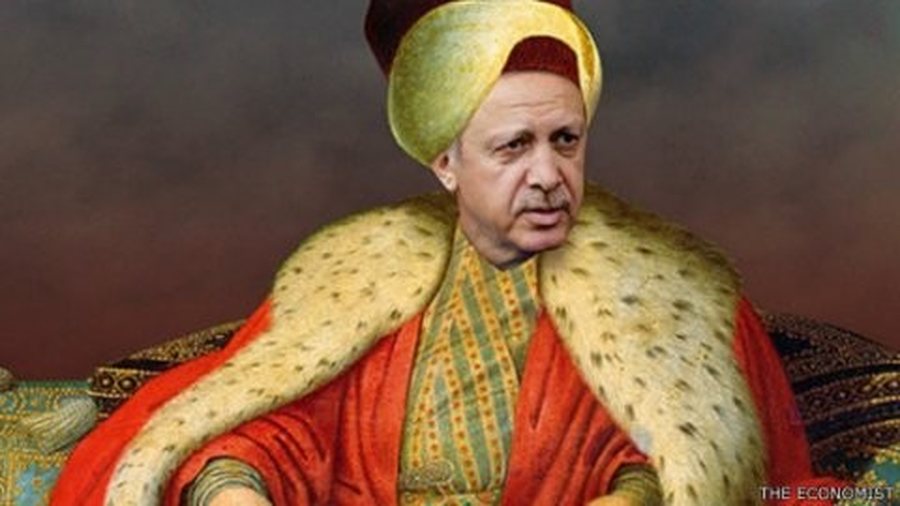
Turkey's current power does not match Ankara's grand ambitions. The serious economic crisis, the suppression of the opposition, the Kurdish issue, the challenge of Israel, but also the unstable behavior of Donald Trump, make the plans of the "Sultan" very difficult...
When Turkish President Recep Tayyip Erdogan entered the White House in late September, he was expected to leave with a victory. Erdogan had presented the Turkish public with a grand vision of Turkey’s leadership in the Middle East, but that vision was increasingly clouded by doubts.
Domestic discord and economic problems demanded Erdogan’s constant attention and risked tarnishing his legacy after 23 years in power. The success of Turkish-backed opposition forces in overthrowing Bashar Al-Assad’s regime in Syria last December seemed to offer a golden opportunity to expand Turkey’s influence.
But it became clear that the monumental task of rebuilding Syria would be beyond Turkey's ability to do it alone. At one point, it seemed as if the commitment of US President Donald Trump might give Erdogan the boost he needed.
Although Ankara and Washington have had recent disagreements, including Turkey's purchase of Russian missile systems and repeated interventions in Syria, Trump saw Erdogan as a partner to help stabilize the Middle East.
Turkey had influence over Hamas, which could be useful during US-led ceasefire negotiations with Israel. Ankara could also support peacekeeping and reconstruction efforts in Gaza and Ukraine.
Turkish officials, for their part, hoped that a renewed partnership with a more transactional Donald Trump than in his first term could help Turkey raise its profile in the Middle East. And at first it seemed as if their wish was granted.
Within days of Erdogan’s visit to Washington, Turkey’s intelligence chief, Ibrahim Kalin, joined talks in Egypt for a ceasefire in Gaza. When the ceasefire agreement was signed on October 13, Erdogan stood by Trump and the leaders of Egypt and Qatar.
The Holy Land’s entry into the political center stage was seen as the definitive restoration of Turkey’s historic role in the Middle East. Or so Erdogan would have ordinary Turks believe. But, in reality, Turkey’s power has so far not matched Erdogan’s aspirations to create a Turkish-led regional order.
The grand strategy
Erdogan’s geopolitical project is based on a simple idea: as more than a middle power, Turkey is destined to lead the entire Middle East. A week after Assad’s fall, Erdogan declared that “Turkey is bigger than Turkey,” that “as a nation, we cannot limit our vision to just 782,000 km².”
There is some truth to Erdogan's vision, but also a lot of fabricated myth. Domestically, the government's powerful propaganda machine has pushed forward the "Turkish Century" campaign and popularized the idea that Turkey is destined for greatness.
The Ottoman Empire, once derided by modern Turkey's political elite as a symbol of decadence, has been rehabilitated as a model of order and pluralism. Turkey's security establishment, centralized under the Turkish presidency since constitutional changes took effect in 2018, supports the idea of a regional order led by Turkey.
The army, once a symbol of restraint, now supports Turkey’s military missions in Iraq, Libya, Syria and the Eastern Mediterranean. In private discussions, Turkish officials portray Turkey as a guarantor of stability from the Caucasus to the Levant, emphasizing the country’s alignment with friendly regimes.
In fact, under Erdogan's rule, Turkey has expanded its regional presence. Its military presence extends throughout the Caucasus, the Levant, and parts of Africa, while projecting naval power into the Eastern Mediterranean and the Black Sea.
Over the last decade, Ankara has signed defense and security partnerships with Albania, Algeria, Azerbaijan, Bosnia, Ethiopia, Libya, Niger, Pakistan, Qatar, Somalia, Syria, and Tunisia.
In 2020, Turkey supported Azerbaijan's military intervention to reclaim territory from Armenia and now wants to normalize relations with Armenia as well, and create a regional economic compact that would reduce Iran's and Russia's influence in the Caucasus and expand Turkey's direct market access.
But while it seeks influence, Turkey is not particularly concerned with the internal governance of its neighbors, focusing primarily on agreements that advance its economic and security interests. In this sense, Erdogan’s vision today is narrower than the agendas previously put forward by his government, such as the “zero problems with neighbors” doctrine of former Turkish Foreign Minister Ahmet Davutoglu.
This idea aimed to balance Turkey's traditional Western alliances with an expansion eastward, increasing the country's influence in the Middle East and Africa, and positioning it as a regional model for democratic reform. Davutoglu's policy collapsed during the Arab Spring, in part because the political transformation that Turkey tried to foster in Egypt, Syria, and Yemen failed to materialize.
Tani, duke mos qenë më një demokraci në vetvete, Turqia është më pak e interesuar të ndryshojë sistemet politike të fqinjëve të saj sesa të përdorë fuqinë e fortë dhe marrëveshjet transaksionale për të promovuar solidaritetin midis regjimeve joliberale sunite.
Siria si gur prove
Kohët e fundit, Siria ka qenë laboratori për ambiciet rajonale të Turqisë. Turqia kontrollon pjesë të mëdha të Sirisë veriore dhe ka ndërtuar shkolla, spitale dhe gjykata në rajone që gjatë regjimit të Asadit qeveriseshin nga forcat opozitare të mbështetura nga Turqia.
Hayat Tahrir al-Sham, grupi që rrëzoi Asadin, ka gëzuar prej kohësh mbështetjen e Ankarasë. Që kur HTS dhe udhëheqësi i saj, Ahmed Al-Shara, morën pushtetin në Damask, Turqia ka ndihmuar regjimin e ri me trajnime dhe pajisje sigurie, menaxhim kufitar, ndihmë humanitare, pajisje bujqësore dhe fara, si dhe punime urgjente riparimi në rrjetin energjetik të Sirisë.
Kompanitë turke po fillojnë të bëjnë oferta për projekte ndërtimi, energjie dhe rrugore brenda Sirisë. Po ashtu, Ankaraja ka lobuar me sukses në Uashington, Riad dhe kryeqytetet evropiane për të hequr sanksionet e epokës së Asadit.
Shfaqja e një regjimi miqësor në Siri i ka hapur gjithashtu rrugën Turqisë të ringjallë negociatat me Partinë e Punëtorëve të Kurdistanit (PKK), një grup separatist që luftoi një kryengritje dekadash kundër shtetit turk. Erdogani shpreson të demonstrojë një model qeverisjeje multietnik - edhe pse joliberal - që pranon diversitetin nën një udhëheqje të fortë sunite.
Por, nëse bisedimet me kurdët ngecin në Turqi ose në Siri, e gjithë struktura do të fillojë të lëkundet. Trazirat e reja të nxitura nga kurdët do ta shtynin Turqinë të vendoste forcat e saj të sigurisë, duke konsumuar burimet e nevojshme për diplomaci më të gjerë rajonale.
Një shtet i brishtë
Por edhe nëse Ankaraja dhe Damasku mund të arrijnë një marrëveshje me kurdët, ëndrra e Erdoganit për të nisur një shekull të ri turk mbështetet në themele të brishta. Për turqit e zakonshëm që po përpiqen të sigurojnë jetesën, madhështia perandorake duket e largët nga vështirësitë e përditshme.
Vite të tëra politike monetare kaotike e kanë dëmtuar shumë Turqinë për shkak të inflacionit të lartë dhe zhvlerësimit të monedhës kombëtare. Prandaj Turqisë i mungon kapaciteti ekonomik për të mbështetur rindërtimin e Sirisë - ose ndonjë projekt tjetër të madh rajonal.
Dhe dobësia e Turqisë e ka detyruar qeverinë e re siriane të drejtohet nga Katari dhe Arabia Saudite për të mbuluar nevojat e menjëhershme buxhetore, të tilla si pagat dhe pensionet - një ndryshim që rrit ndikimin e Gjirit në Damask në kurriz të Turqisë.
After two decades, Erdogan’s hypercentralized system of government has begun to suffer from its own success. “The state rests on the shoulders of just 10 capable people,” one senior official told me. But beneath this small circle of competent technocrats, government agencies have atrophied, while purges and loyalty-based appointments have eroded institutional knowledge.
Decision-making has been concentrated in the presidential palace, leaving the bureaucracy unable to develop its own policies or the capacity to execute them. Meanwhile, politically, Erdogan's base of supporters has narrowed even as his iron-fisted control has increased.
The opposition won the 2024 municipal elections. Erdogan's party received only 35 percent of the vote, its worst result since coming to power in 2003. The arrest of Istanbul Mayor Ekrem Imamoglu in March 2025 on corruption charges and the subsequent arrests of more than a dozen other mayors belonging to the main opposition party were widely considered politically motivated.
Among other things, they exposed the government's insecurity: no longer confident that he can win elections, Erdogan has turned the legal system into a stick to beat his opponents. The erosion of support for Erdogan's party ultimately limits his regional aspirations.
The rivalry with Israel is the main external challenge, as their military dominance hinders Turkey's regional project. The clash between them culminates in Syria, where Turkey aims for a strong, centralized state under its orbit, while Israel seeks a weak, decentralized Syria.
This confrontation forces Erdogan to spend precious resources to contain Israel, weakening his ambition for leadership. Trump has given Erdogan the status of a key partner in Syria, but this support is uncertain and depends on the mood of the American president. / Adapted from "Pamphlet" from "Foreign Affairs"



Lini një Përgjigje