


 Shkruar nga Pamfleti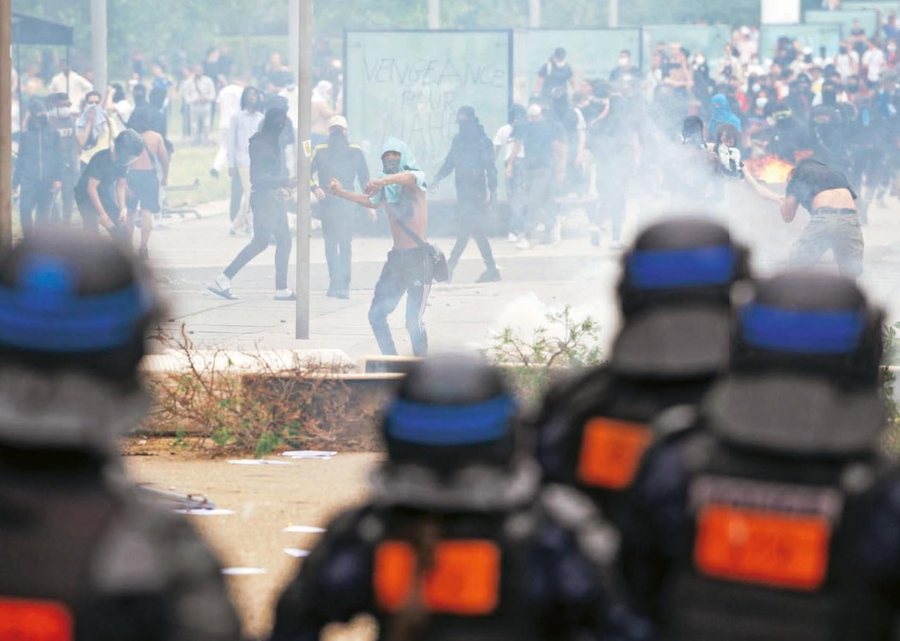
Place Mendès-France, in Nantes. A Sunday like many others. Some guys are waiting for the tram at the stop in front of three large apartment blocks that are being renovated. The supermarket is open, life in the neighborhood goes on as usual. Including drug dealers. Indifferent to the police patrols that come and go, even to show that the state is there. They distribute and everyone knows that they are always there, at the foot of those buildings, in the very place where a 19-year-old man was shot dead with a Kalashnikov the night before - on October 7. A quick kill: a guy on a scooter shoots and runs. The victim is an Algerian without a residence permit. Maybe a washout.
The thirty-sixth attack since the beginning of the year in Nantes. Almost one every week. Besides Nantes: Nimes, Toulon, the suburbs of Paris and Lyon, there are many cities where fire is opened.
In Marseille, there have been reports of at least 42 deaths since the start of the year in drug-trafficking gang wars in the popular northern suburbs.
Three were "collateral victims". Accidental death. And there are countless injuries. The last, double murder, dates back to a few weeks ago. But now there are also shootings in the center of the city, as on October 6: a twenty-year-old was wounded by gunfire among tourists in the Porto Vecchio area. "Known to the police for various types of crimes," the police summary said.
France has been the most violent country in Europe for several years and the statistics are getting worse. There has been terrorism, the demonstrations organized by the yellow vests also affect the data, until the last revolt of the suburbs. But it is not only that. It was in Marseille, three years ago, that a sixteen-year-old decided to do something against violence. It is Amine Kessaci, the 19-year-old law student and with the association he founded, Consciousness, speaks simultaneously of success and loss: five thousand members in France, tens of thousands of people helped, including victims of violence or their families, but also among those who need administrative help, or to find a dialogue with the institutions.
He still lives in the Frais Vallon district, where he was born and grew up: "The areas north of Marseille are very popular and unfortunately there is a lot of poverty, but beyond that people talk to each other, there is stability, there "is solidarity, you meet and smile," he says.
But there is also violence, trafficking, murder. Like the case of his older brother, whose burnt body was found inside a car shortly after the association was founded. "Today things have not changed: more and more deaths, more and more violence, more and more barbarism", continues Amine, "but our fight for a dignified life has just begun".
More and more barbarism, says Amine, and French statistics confirm this. In the first eight months of 2023, only five indicators out of 13 are declining. On the rise, among others: burglaries, car thefts, vandalism, assaults and above all murders, with a +8 percent, adding to last year's already impressive increase. In 2022 there were 948 victims and in 2020 there were 879, increasing, with 12 murders per million inhabitants, compared to 4.9 in Italy (which the French still call "Le pays de la mafia!").
Data on socially perceived violence also weigh in: 10 percent of French people say they feel unsafe in their neighborhood or village. A figure that rises to 26 percent in urban suburbs, where police presence is less frequent.
The Jean Jaurès Foundation, in its Fractures Sociales report, notes that 87 percent of French perceive violence to be increasing. It is the fourth leading concern (after purchasing power, environment and social status), on a par with immigration.
On the other hand, the perception of a direct link between violence and immigration is increasingly widespread. A feeling partially confirmed by the Minister of the Interior Gérald Darmanin, who specified in Parliament that in 2022, they were committed by foreigners, who represent only 8 percent of the French population: 41 percent of the total thefts, 35 percent of violent burglaries without the use of weapons, 17 percent of assaults and the same for murder.
According to Alain Bauer, the most famous French criminologist, this disproportion is more due to young age than to the fact of being an immigrant. Young boys, who have a greater tendency towards violence. But just consider that in 2022 approximately 125,000 female genital mutilations have been committed, a crime, to understand that the ethnic and social matrix cannot help but weigh.
Didier Leschi, who has headed OFFI, the French immigration and integration office, since 2015, confirms to Panorama that "80 percent of asylum requests in France come from men." Among whom there is sometimes no desire to integrate. A minority that "tends to grow with increasing flows".
One of the factors of the lack of integration is religion: "In the absence of other available ideologies, young people, above all, are attracted to radical Islamism", explains Leschi further. The problem is exacerbated by easier contacts with the country of origin than in the past: satellite networks and televisions contribute to maintaining a cultural environment sometimes even hostile to the host society. / With abbreviations from Panorama Italia - Bota.al




Lini një Përgjigje