


 Shkruar nga Federico Rampini
The level of dissatisfaction with the America-Israel axis is at the highest level...
America tries again to "separate" from Israel. The apparent divergence between the Biden administration and the Netanyahu government—especially over the need to create a Palestinian state—could bring about a fundamental shift in American foreign policy: The breakdown of a unique relationship in history, an alliance so close that it even transcends relations with NATO's Atlantic allies, including the United Kingdom.
The axis between the United States and Israel is contested today more than ever by various American constituencies: on college campuses, in the black community, among Arab immigrants, and by many federal officials at all levels who have joined recent petitions to Gaza.
A partial "disengagement" between America and Israel certainly does not mean a total separation (unthinkable), in many respects the alliance would remain standing, but it would become a more normal relationship, more similar to what Washington has with other friendly countries and allies. It would be an innovation and at the same time a return to origins.
The first presidents to govern the United States after the birth of the State of Israel, Democrat Harry Truman and Republican Dwight Eisenhower, maintained some balance between the defense of the new nation and the interests of the Arab world. Things began to change during the presidency of John Kennedy, but under Lyndon Johnson the situation stabilized. Efforts to make American foreign policy more autonomous from Israel occurred under Jimmy Carter and Bill Clinton; but the terrorist attack of September 11, 2001 and the "war on terror" declared by George W. Bush led to the strengthening of this alliance again.
In terms of its theoretical foundations, the most systematic attempt to contest the America-Israel axis dates from a major exponent of the "realist school" in geopolitics, John Mearsheimer. I would define him, to put it simply, as a student of Henry Kissinger who moved further to the right. Mearsheimer is no "dove", he does not contest the relationship with Israel on pacifist grounds. He is an extreme realist, in favor of a foreign policy that corresponds to the true vital interests of the United States: the security, liberty, and prosperity of the American nation.
He is not necessarily an isolationist, even if his analysis could lead to a drastic reduction of the United States' international commitments. Since the 1980s he has developed his realistic and conservative thinking, authoritarian but unheard of; today it is coming back into fashion with the isolationist wind blowing across America.
A highly controversial classic by Mearsheimer, co-written with Stephen Walt, was The Israel Lobby and US Foreign Policy. A first article on the subject was commissioned a few years after 9/11 by the progressive magazine 'The Atlantic', which then refused to publish it. It was later published in the "London Review of Books" in 2006. It was immediately flooded with criticism and accused of anti-Semitism. Partly to answer those criticisms, Mearsheimer and Waltz developed it into a book, published in 2007. It's still interesting reading today, despite all that has changed in both America and the Middle East.
However, in the case of that classic work by Mearsheimer and Walt, the charge of anti-Semitism is unfounded. For starters, their definition of the "Jewish lobby" has nothing ethnic about it. It does not describe a Jewish lobby, but rather a series of American groups and organizations that also include many non-Jews, united by a certain vision of Israel's role and thus the need to support this state in an almost unconditional way.
For example, many evangelical Christians are part of the Mearsheimer-Walt "Jewish lobby" who have their own biblical motivation for supporting Zionism. By contrast, much of the American Jewish community is critical of Israel and the unconditional support it receives from Washington. In this sense, the "Jewish lobby" in the Mearsheimer-Walt sense is a classic lobby, no different from the gun lobby, or the anti-racism lobby, or the LGBTQ lobby; indeed even more diverse and internally composed. Its nature, organization, and modus operandi are largely transparent, in broad daylight, like most lobbies in the American political system: no conspiracy, no secret plot.
Mearsheimer's critique is very detailed, I only remember one aspect of it. It is the adjective "unconditional" that recurs in characterizing American support for Israel. No other country in the world receives a comparable amount of aid from Washington. And this is aid that the United States does not base on conditions in the true sense of the word.
From the 1970s onward, there has never been a US administration that knew or wanted to use that aid as leverage to bend Israeli governments to its will. Even when Israeli governments did the opposite of what Washington wanted (for example regarding illegal settler settlements), aid continued to arrive. According to Mearsheimer, America has sacrificed many of its interests in the Middle East, alienated many sympathies in the Arab world and also in other parts of the global South, without receiving adequate benefits in return.
I don't buy all of Mearsheimer-Walt's theses: 14 years later, some of their judgments seem too soft on the Palestinian leadership, on Hamas and Hezbollah, on Iran. However, this essay serves to remind us that there has long been a current of critical revisionist thought calling for a deep re-examination of the relationship between America and Israel. With Netanyahu, we had the feeling several times that the rope was pulled too far, to the point where we were in danger of snapping.
When Netanyahu came to the United States to galvanize the Republican-majority Congress against Barack Obama, relations with the White House soured. But then the Obama presidency was accused – rightly – of making catastrophic mistakes in the Middle East. With Donald Trump in the White House, Netanyahu found an iron ally.
Now we are in a new situation. The level of discontent with the America-Israel axis is at an all-time high and cuts across many different areas - the youth electorate, the African-American electorate, Arab immigration, plus part of the establishment and diplomatic corps - and perhaps Biden even risks playing elections in Gaza.
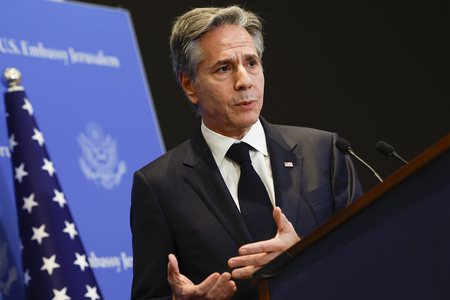
Thus, his Secretary of State Antony Blinken's grandiose maneuvers in the Middle East, the emergence of a Washington-Riyadh axis, mean that the adjective "unconditional" may cease to apply to the special relationship with Israel. / Adapted "Pamphlet" from "Corriere Della Sera"





Lini një Përgjigje