


 Shkruar nga David Remnick

The cruelest irony is that the President who addresses the Iranian people with the language of liberation, urging them to throw off the yoke of a regime that has brutalized them for decades, is the same man who threatens American journalists with treason charges and tries to force broadcasters into submission.
“In war, truth is the first casualty.” It’s a phrase often attributed to Aeschylus and has never lost its relevance. Sometimes the culprit is the observer, the propagandist correspondent, the mythologizing historian. Now, three weeks into a war of choice, the chief offender is the President of the United States.
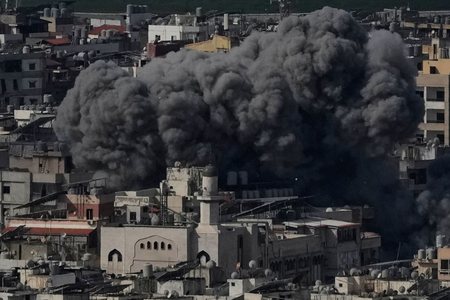
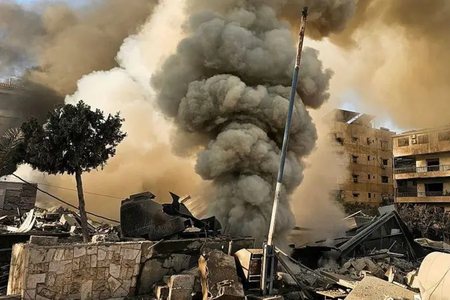
On February 28, at 2:30 a.m., the White House press operation released a pre-recorded video of Donald Trump at Mar-a-Lago standing at a podium in dim lighting. Wearing a large American hat and no tie, the President announced that he had ordered American bombers to begin destroying targets throughout the Islamic Republic of Iran.
Trump made a preemptive claim. He was acting, he said, to “protect the American people by eliminating the immediate threat from the Iranian regime.” (This was confusing. Hadn’t Trump declared last June that he had “disappeared” Iran’s nuclear program? Hadn’t the foreign minister of Oman, a mediator between the U.S. and Iran in the Geneva negotiations, told “Face the Nation” that “a peace deal is within our reach”?) Trump went on to advise the Iranian people to find shelter somehow. “It’s very dangerous out there, bombs are going to fall everywhere ,” but then, at some unspecified point, they should “take control” of their government. “Let’s see how you respond.” And to his American listeners, he conceded: “We may have casualties. That happens a lot in war.”
For a narcissist obsessed with projecting strength and grandeur, Trump gave a particularly weightless performance. The front of his hat obscured his vision. He jogged and struggled to read his message. And, instead of rushing back to the White House, he stayed at his country club. He had a fundraising dinner to attend. His communications director, Steven Cheung, was left to give clear instructions on how to respond to the prospect of another American war in the Middle East. “Don’t panic!” he wrote on X. “Trust Trump!”
The president, along with Israeli Prime Minister Benjamin Netanyahu, could soon be heard praising the precision with which they had “decapitated” the Iranian leadership and demolished military, police and intelligence installations.
And yet, as Defense Secretary Donald Rumsfeld once said wistfully, in the midst of America’s disastrous adventure in Iraq, “Things happen.” The Supreme Leader, Ayatollah Ali Khamenei, and most of the Iranian security hierarchy, would not survive the first day of bombing; nor would some one hundred and seventy-five innocents in the southern city of Minab, most of them children. When asked about a girls’ school there that was hit by what was likely an American missile, Trump blamed Iran. “They’re very inaccurate, as you know, with their munitions,” he said.
Now, as the war has engulfed both the region and the global economy, Trump and his servile advisers have begun to improvise in the moment, offering contradictory justifications for the war and predictions about its duration. The Iranians were close to developing missiles that could reach the United States. (They weren’t.) They were weeks away from building a nuclear weapon. (They weren’t.) Israel forced America to intervene. (Marco Rubio.) “No, I could have forced them.” It’s all about regime change. It’s not about regime change,” Trump said.
When faced with these contradictions and lies, all of the President's people followed his example: they blamed the media.
Trump increasingly berates journalists (especially female journalists). He sues sports media. Decisiveness is in short supply. The owner of the Washington Post, the Watergate newspaper, has done irreparable violence to his property just to stay in Trump's favor.
But while the President has little respect for the freedom of the press, he craves its unceasing attention. His need has the quality of addiction. In Washington these days, there is hardly a journalist who does not have the President’s cell phone number. It is said that the best time to call is late at night, while he is watching himself on TV and making irrelevant posts in his pajamas. He likes to meditate out loud, then watch as these meditations are recorded in foreign capitals and markets. Lately, he has been willing to say anything. The war will be over soon. Or maybe not. Whatever. Any pseudo-spoon is as temporary as a mayfly. But who can resist? When asked about the possibility of sending his infantry into Iran, he replies in golfing language: “I don’t care about boots on the ground.” At other times, he simply changes the subject, for example, to his taste in interior decoration. “If you look behind me, you see beautiful gold curtains.” Aren’t you amused?
His advisers, of course, know what to do. Defense Secretary Pete Hegseth, who has cracked down on current reporting at the Pentagon and has filled his press room with “influencers” and propagandists, spoke in his usual angry tone recently when he sharply criticized CNN’s war coverage as “fake news.” He would be pleased, he said, when the Trump-friendly Ellison family, which has already “swallowed up” CBS News, finally took over CNN.
Brendan Carr, who heads the Federal Communications Commission for Trump, eagerly joined the debate by threatening to revoke the licenses of television networks that, he said, are “spreading hoaxes and distorted news.” Trump declared himself “thrilled” by Carr’s outburst. In Social Truth, he accused “Very Unpatriotic ‘News’ Organizations” of broadcasting “lies.” Perhaps, he wrote, he would prosecute unruly journalists with “Treason Charges.”
Carr’s threats to revoke network licenses carry no legal weight; the more immediate danger is that media owners, acutely aware of the economic pressures they face, will quietly curtail critical coverage of the Trump presidency in general and the war in particular. They will fear stepping outside the bounds of what is considered patriotic. Historian Garry Wills, in an essay on Phillip Knightley’s 1975 book on wartime journalism, “The First Victimalty,” wrote: “A liberal democracy is more susceptible to propaganda than a totalitarian state. Self-censorship is always more effective than bureaucratic censorship.”
The cruelest irony is that the President who addresses the Iranian people with the language of liberation, urging them to throw off the yoke of a regime that has brutalized them for decades, is the same man who threatens American journalists with treason charges and tries to force broadcasters into submission.
Having destroyed a nuclear deal in his first term and gone to war without any coherent purpose in his second, Trump is now turning his fire on the one thing he cannot afford to leave standing: the truth. What is at stake is the oldest promise of democracy, that the people can hold their government accountable for what it does in their name. / Adapted from “Pamphlet”


Lini një Përgjigje