


 Shkruar nga Pamfleti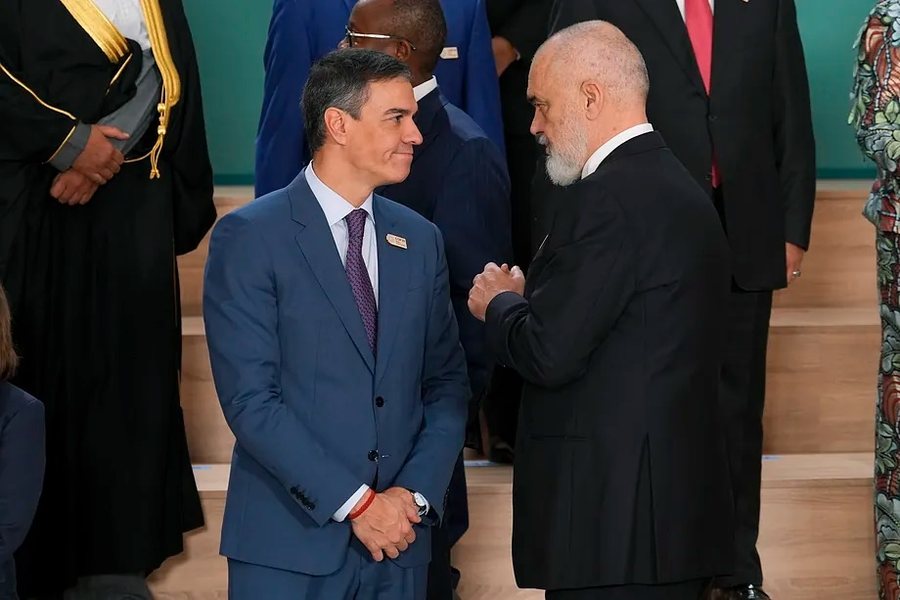
Corruption investigations into Spain's prime minister are reaching their final stages at a crucial time for his fragile government.
Spanish Prime Minister Pedro Sánchez is experiencing "hell before Christmas". That's the claim of the conservative opposition People's Party (PP), voiced by spokeswoman Cuca Gamarra, as Sánchez seeks to avoid a barrage of corruption investigations into members of his family – and his own party.
Allies of the Socialist leader insist the scandals are part of a politically motivated witch hunt and coincide with his struggles to hold on to a tenuous parliamentary majority.
"Pedro Sanchez's government is at a critical point, it is in a very difficult position. His previous legislature was long and very successful in terms of legislative output and parliamentary stability – but now the situation is the polar opposite ," said political scientist Lluís Orriols, author of "Democracia de trincheras" ("Democracy of the Trenches").
Three separate investigations involving people close to Sanchez are underway: into his wife and brother, and another into alleged corruption by senior members of his party.
Family matters
Sánchez's wife, Begoña Gómez, has been under investigation since April following allegations that she used her position as the prime minister's wife to influence the awarding of government contracts. She is also being investigated for embezzling software from Complutense University where she worked.
On December 18, she appeared for the third time before the judge leading the investigation, denying wrongdoing. In a separate case, Sánchez's musician brother - David Sánchez - is being investigated for alleged irregularities during his employment as director of the performing arts office in the southwestern province of Badajoz. He will testify in court on January 9.
Far-right campaign organization Manos Limpias filed the legal complaints triggering both investigations, which Sanchez's allies have cast as part of a right-wing campaign to undermine his government.
In April, when the investigation into his wife began just five months after he formed a new coalition government, Sánchez threatened to resign over what he said was an attempt " to dehumanize and delegitimize the political opponent through scandalous accusations and fake ".
Although both cases involving family members have dominated headlines in right-leaning newspapers, neither has so far led to charges, and many observers expect them to eventually be dropped.
However, another investigation - into the activities of businessman Victor de Aldama - is likely to be far more damaging. Aldama claims to have been an intermediary in the payment of commissions to members of the government in exchange for awarding public works contracts to private firms.
Socialists are accused of corruption
José Luis Ábalos, a former minister of transport and public works and a heavyweight in the PSOE, was implicated following the arrest in February of his close adviser, Koldo García. Although the PSOE moved quickly to expel Ábalos (who maintains his innocence), Aldama made other accusations implicating other prominent socialists, most recently when he testified in court on 17 December.
While Aldama has not provided any hard evidence to back up his claims, the opposition has presented the three separate investigations as evidence that the administration has a rotten foundation.
Pablo Simón, a political scientist at Madrid's Carlos III University, says that beyond their legal impact, the three investigations have a political impact.
With its strong growth, contained inflation and robust job creation, Spain topped a recent Economist ranking of the world's best-performing economies. However, Sánchez's government has struggled to capitalize on such indicators as it fends off corruption-related attacks and defends concessions made to keep its parliamentary majority intact.
So far, the coalition's junior partner - the left-wing Sumar - has stood by the PSOE. However, with its majority dependent on a wide range of parties, including Catalan and Basque nationalists, the government's stability is shaky.
This became apparent when the Catalan separatist Junts party, Sanchez's most worried ally, this month proposed a no-confidence motion against him in the coming weeks, claiming he had failed to fulfill previous commitments. Junts, the party of self-imposed Carles Puigdemont, is not expected to follow through on the threat. Rather, it is seen as an attempt to squeeze further concessions from Madrid, such as improved funding for Catalonia.
However, the Junts' ability to block the 2025 budget, currently under negotiation, is seen as a more concrete risk for Sanchez. Different parties have used the budget as a bargaining tool. The unpredictability of his allies meant the prime minister was unable to approve the 2024 budget a year early.
His former coalition partner, far-left Podemos, is also making tough demands in return for continued core support for the coalition majority – including cutting diplomatic ties with Israel and introducing radical caps on housing rents.
These factors, when taken together, mean that the threat of a collapse of power in parliament is substantial./ Adapted "Pamphlet" from "Politico"





Lini një Përgjigje